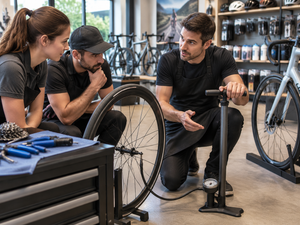
For bike shops, valve compatibility is not a small detail. It affects daily service speed, customer experience, product recommendations, and even after-sales questions.
A shop may serve road bikes in the morning, mountain bikes in the afternoon, and e-bikes or city bikes throughout the day. These bikes may use different valve types, mainly Presta and Schrader. If a pump cannot handle both clearly and reliably, staff may need extra adapters, additional explanations, or repeated checks to avoid air leakage.
For B2B buyers, retailers, and shop owners, choosing an electric bike pump is not only about pressure, size, or battery life. Valve compatibility should also be part of the selection process.
This article explains why Presta and Schrader compatibility matters for bike shops, what problems can happen when adapter use is unclear, and what buyers should check when selecting a bike pump for shop or retail use.

Why Valve Compatibility Matters in Bike Shops
A bike shop is different from a single end user. A cyclist may only need a pump for one bike, but a shop needs to support different customers and different bicycle types.
In a normal retail or service environment, staff may handle:
- road bikes
- gravel bikes
- mountain bikes
- commuter bikes
- children’s bikes
- e-bikes
- rental bikes
Because of this variety, a shop-friendly pump needs to work smoothly across common valve types. If the connection process is slow or confusing, it can affect service efficiency.
For example, when a customer asks for a quick tire pressure check, staff should not need to search for an adapter or explain why the pump does not connect directly. A clear valve solution helps the shop provide faster service and creates a more professional customer experience.
Presta vs Schrader: What Shops Commonly Handle
Presta and Schrader are the two most common valve types bike shops deal with.
Presta valves are commonly found on road bikes, gravel bikes, and many performance bicycles. They are narrower and usually require the user to loosen the small valve nut before inflation.
Schrader valves are wider and similar to car tire valves. They are commonly found on mountain bikes, city bikes, children’s bikes, some e-bikes, and casual bicycles.
For a bike shop, both valve types are important. A pump that only supports one valve type may be too limited for daily use unless the shop has separate tools or adapters available.
For retail sales, compatibility also matters because customers may not always know their valve type. If the product packaging or sales explanation is unclear, customers may buy the wrong pump or misunderstand how to use it.

Common Problems When Pumps Need Extra Adapters
Adapters are common in the bike pump category, especially for compact electric pumps. They can work well if they are designed clearly and included properly. However, they also create several practical issues.
1. Adapters Can Be Lost
Small adapters are easy to misplace. For a cyclist, losing the adapter may make the pump unusable for their bike. For a shop, missing adapters can slow down service or create extra replacement needs.
2. Customers May Not Understand the Setup
Some users do not know whether they have Presta or Schrader valves. If the pump needs an adapter, they may not know when or how to use it. This can lead to complaints even when the product itself is working correctly.
3. Air Leakage Can Be Mistaken for Product Failure
If the adapter is not tightened properly, air may leak during inflation. End users may think the pump is weak or defective, while the real issue is the connection.
This is especially important for electric bike pumps because users expect a simple, automatic experience. Any extra step can increase the chance of incorrect use.
4. Service Efficiency May Be Reduced
For bike shops, repeated adapter changes can slow down simple service tasks. If staff need to serve many customers, a pump with easier valve handling can save time.
What Makes a Pump More Shop-Friendly
A bike pump used in or sold through bike shops should be evaluated for real operating convenience.
B2B buyers should look at several points.
 electric bike pump battery life

Clear Valve Compatibility
The product should clearly state whether it supports Presta, Schrader, or both. If an adapter is required, the instructions should be simple and visible.
Stable Connector Design
The connector should attach securely without frequent leakage. A stable connection reduces user frustration and helps maintain pressure accuracy.
Easy Switching Between Valve Types
If the pump uses an adapter, switching should be fast and intuitive. If the connector supports both valve types directly, the mechanism should still be durable and easy to understand.
Durable Hose or Nozzle
Bike shops may use the pump more frequently than individual riders. The hose, nozzle, and connector should be strong enough for repeated handling.
Simple User Instructions
For retail sales, instructions should not depend on technical knowledge. Clear illustrations, packaging icons, or quick-start guides can help customers use the product correctly.
Retail Sales Meaning for Bike Shops
Valve compatibility also affects retail sales.
When bike shops sell electric bike pumps, staff often need to explain the product quickly. A customer may ask:
- Will this work with my road bike?
- Can I use it for my mountain bike?
- Do I need another adapter?
- Is it suitable for Presta valves?
- Can I carry it during rides?
If the product has clear compatibility and simple instructions, it becomes easier for staff to recommend.
This is especially important for electric mini pumps, because they are often positioned as emergency top-up tools for riders. If a rider discovers during a roadside situation that the pump does not connect easily, the experience will be poor.
For shops, a product that is easy to explain is often easier to sell.
Compatibility and Product Positioning
Different electric bike pumps may have different positioning.
A compact emergency pump may use a smaller connector and adapter system to reduce size. A larger daily-use rechargeable pump may provide a more flexible hose or connector design.
Both approaches can make sense, but the product positioning should be clear.
For road cycling users, Presta compatibility is essential. For MTB, city bike, or e-bike users, Schrader compatibility may be equally important. For mixed retail channels, supporting both valve types clearly is usually the safer choice.
B2B buyers should therefore match valve compatibility with the target customer group.
Questions B2B Buyers Should Ask
Before selecting an electric bike pump for bike shop or retail use, buyers should ask:
- Does the pump support Presta and Schrader valves?
- Is an adapter required for either valve type?
- Is the adapter included in the standard package?
- How is the adapter stored to avoid loss?
- Does the connector leak under higher pressure?
- Is the setup easy for non-technical users?
- Are the instructions clear enough for retail customers?
These questions help buyers reduce after-sales issues and select products that fit real shop environments.
Conclusion
For bike shops, valve compatibility is not just a technical specification. It affects service speed, customer explanation, retail recommendation, and user satisfaction.
A pump that works clearly with both Presta and Schrader valves is easier for shops to use and easier for customers to understand. If adapters are required, they should be simple, secure, and well explained.
For B2B buyers, the right electric bike pump should match the target riders, sales channel, and service environment. Pressure, battery life, and size are important, but valve compatibility can determine whether the product feels practical in everyday bike shop use.