For an individual driver, recharging a jump starter occasionally may not seem like a major task.
For a fleet, distributor, rental operator, warehouse, or service organization managing dozens or hundreds of units, the situation is different.
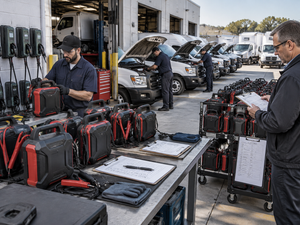
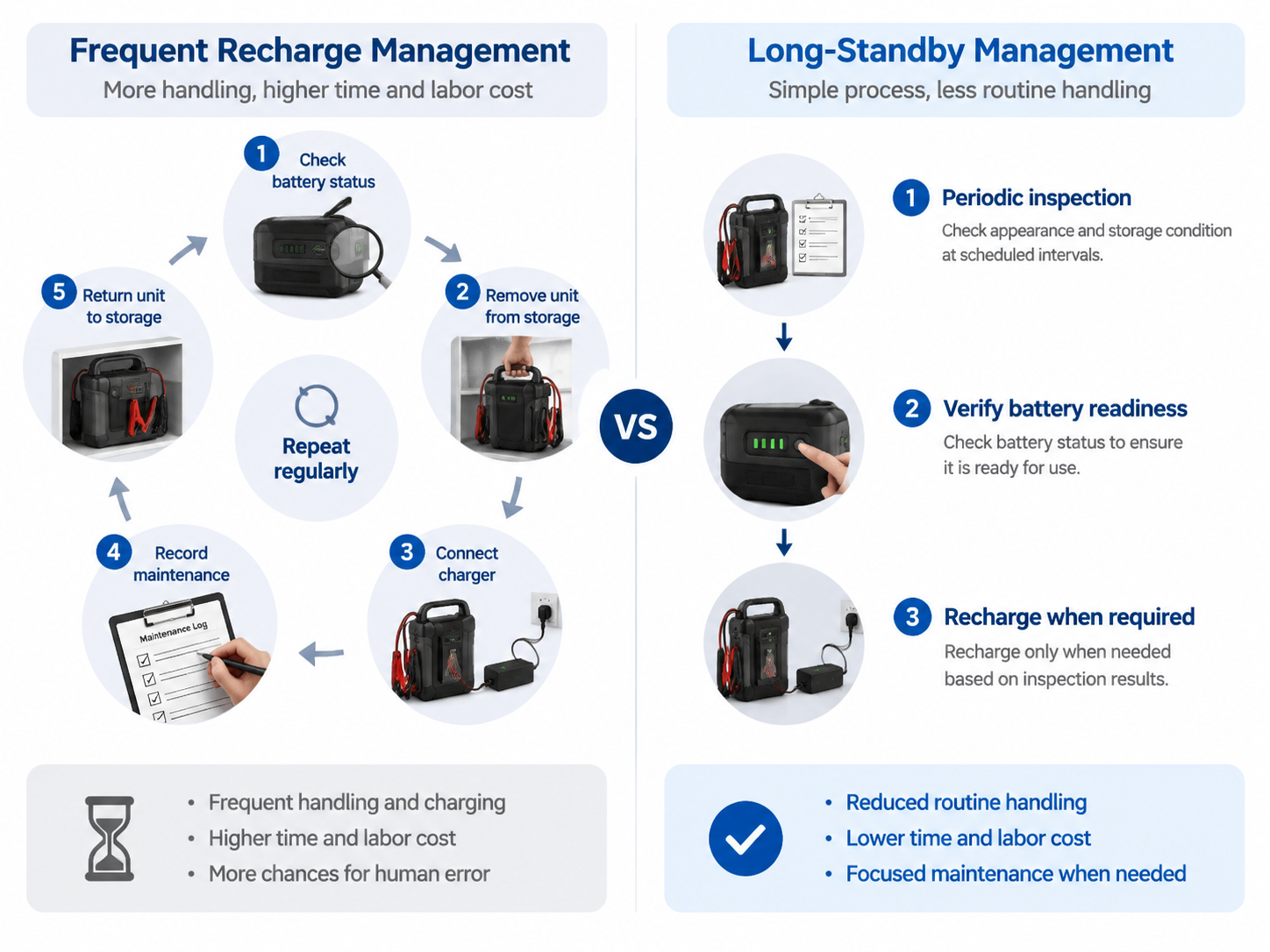
Every required battery check can involve locating the unit, checking its charge level, recording its condition, connecting it to a charger, waiting for charging, disconnecting it, and returning it to storage.
Over time, this becomes a management task rather than simply a battery specification.
That is why standby performance can have a direct effect on operational workload.
The comparison between a jump starter positioned around long standby—such as a product tested for a multi-year storage period—and a product that requires much more frequent charging should therefore include time investment, not only battery capacity or starting current.
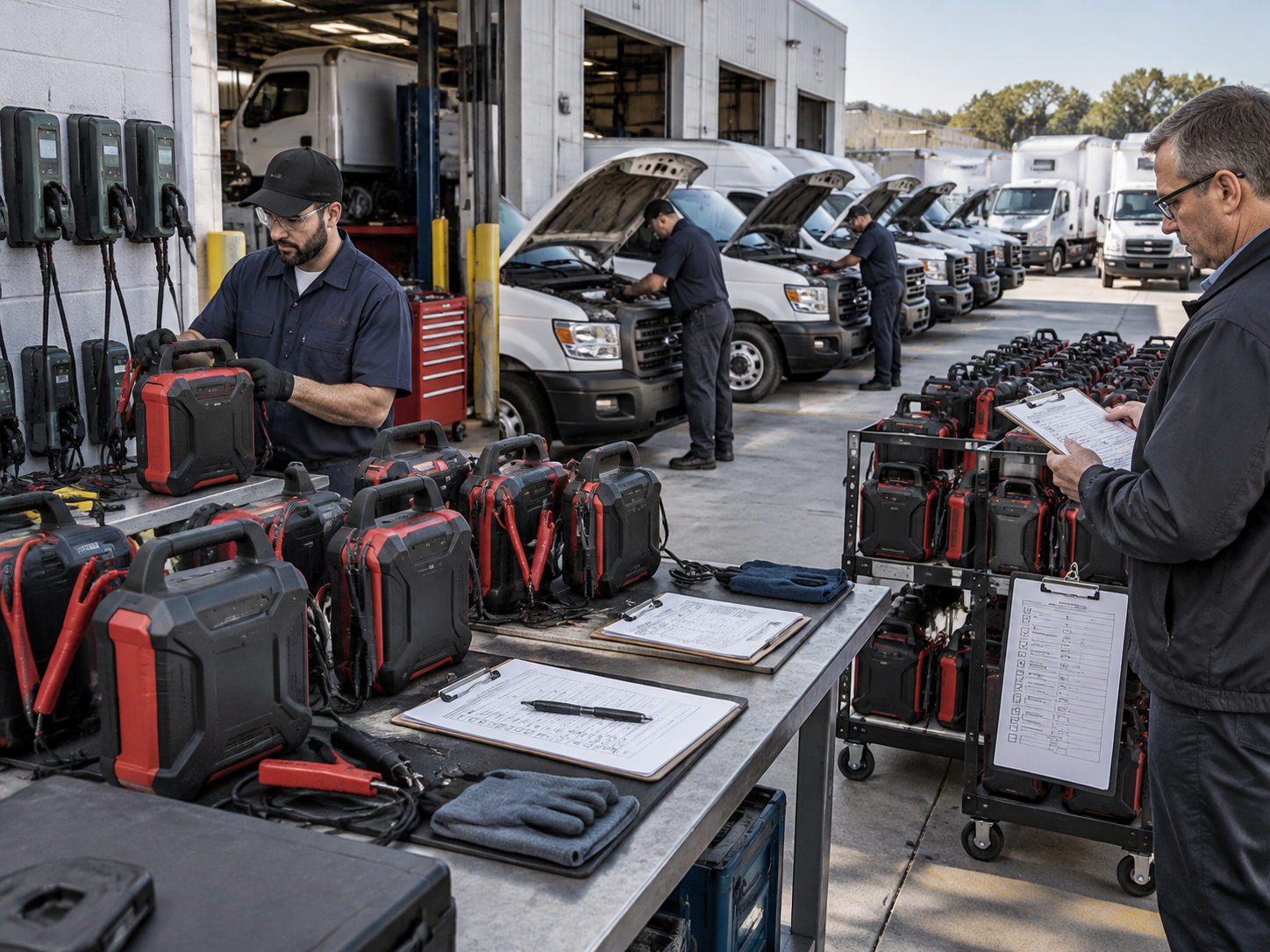
Standby Performance Is Also a Management Issue
Most jump starter comparisons focus on technical specifications such as:
- peak current
- battery capacity
- starting performance
- operating temperature
- charging time
- weight
- output ports
These specifications matter, but they do not show how much attention the product may require while sitting unused.
For organizations managing emergency equipment, readiness has to be maintained.
That can involve:
- battery-level checks
- scheduled recharging
- inspection records
- warehouse handling
- vehicle-by-vehicle checks
- charger availability
- staff responsibility
- replacement of units that no longer hold charge properly
A jump starter with better validated standby retention may reduce how often some of these tasks need to be performed.
The value is therefore not only “the battery stays charged longer.”
The operational value is that fewer routine interventions may be required to maintain emergency readiness.
What “Monthly Charging” Really Means
“Monthly charging” should not be treated as a universal requirement for every lithium jump starter.
Recharge recommendations depend on the specific product, battery system, standby current, storage conditions, age, and manufacturer instructions.
Some products may recommend periodic checks rather than a strict monthly recharge.
Others may need more frequent attention in demanding storage environments.
For B2B buyers, the useful comparison is therefore between:
a product requiring frequent scheduled recharge management
and
a product validated for substantially longer standby intervals under defined conditions.
This creates a fairer purchasing framework than assuming every product using one battery chemistry behaves identically.
 jump starter storage comparison
What “5-Year Standby” Should Mean to Buyers
The same caution applies to a five-year standby claim.
A five-year figure should not automatically be interpreted as:
- no checks for five years
- no energy loss
- guaranteed starting after five years in any climate
- maintenance-free operation
- identical performance after extreme storage conditions
A credible standby claim should be linked to product-specific testing.
Buyers should ask about:
- initial state of charge
- storage temperature
- shutdown condition
- standby power consumption
- remaining capacity
- testing duration
- final starting performance
- battery-status inspection method
If a product can demonstrate strong long-term retention under defined conditions, then a longer inspection or recharge interval may become a real operational advantage.
Where the Time Is Actually Spent
Recharge management involves more than electricity.
Consider a fleet manager responsible for jump starters stored across several vehicles.
A routine check may require:
- locating each vehicle or stored unit,
- removing the jump starter,
- checking battery level,
- deciding whether charging is required,
- transporting it to a charging point,
- connecting the charger,
- recording the maintenance action,
- disconnecting it after charging,
- returning it to the correct vehicle or storage position.
The charging process itself may be automatic, but the handling work is not.
When this workflow is repeated frequently across many units, the labor becomes significant.
For distributors and warehouses, the same issue appears differently. Staff may need to inspect stock that has remained unsold for extended periods and confirm that units are still within an acceptable readiness level before shipment.
Comparing Management Workflows
A simplified comparison can look like this:
| Management Area | Frequent Recharge Model | Long-Standby Model |
|---|---|---|
| Battery Checks | More frequent | Potentially less frequent |
| Recharge Scheduling | Regular management needed | Reduced routine intervention if validated |
| Unit Handling | More movement in and out of storage | Less handling |
| Record Keeping | More maintenance entries | Fewer routine entries |
| Charger Availability | More important | Less frequent demand |
| Fleet Coordination | More scheduling | Simpler readiness management |
| Warehouse Labor | Higher if stock requires regular recharge | Potentially lower |
| Emergency Readiness | Depends strongly on maintenance discipline | Still requires periodic verification |
The main advantage is not eliminating maintenance.
It is reducing unnecessary maintenance frequency where the product’s verified standby performance allows it.
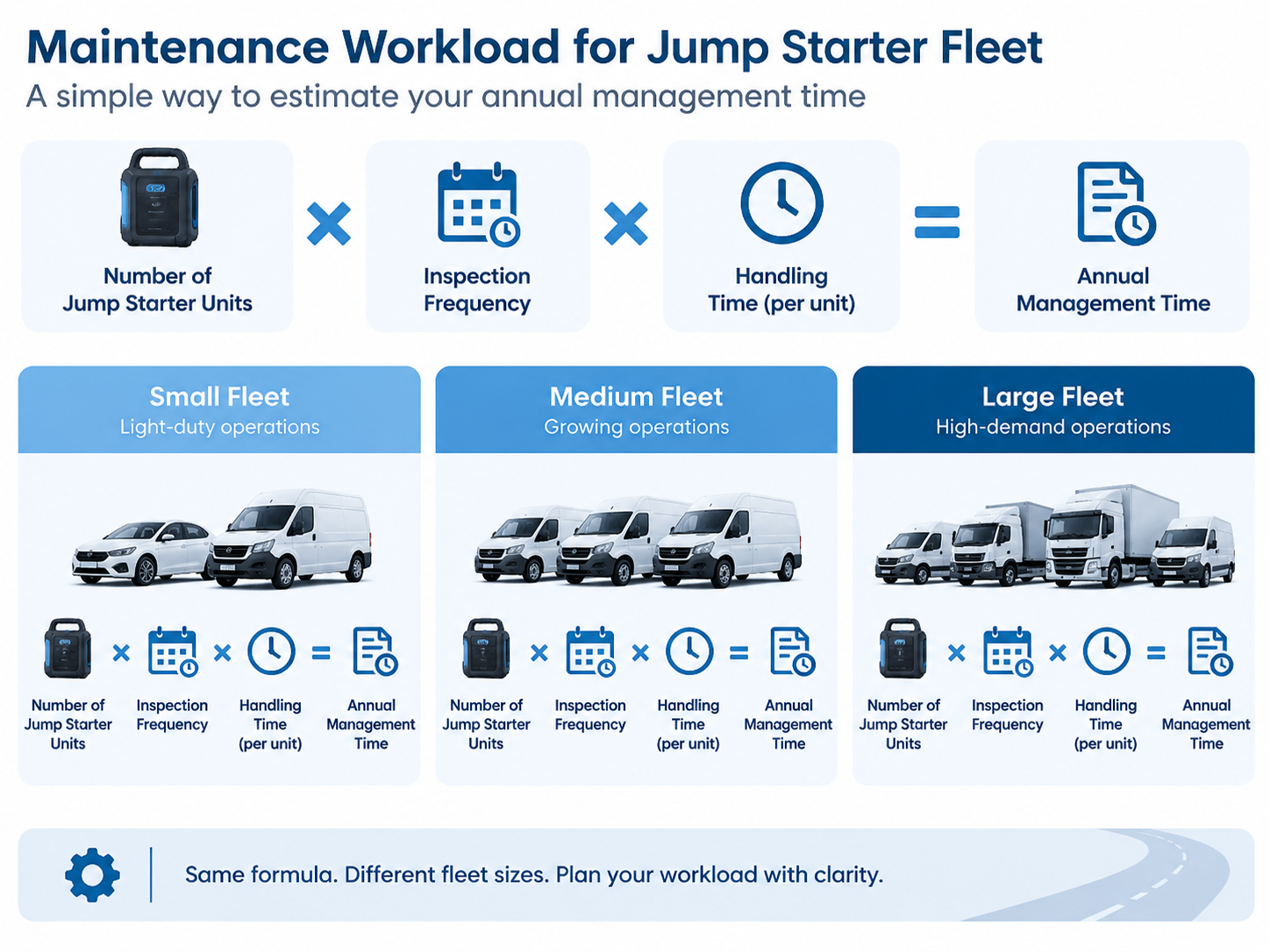
Fleet Size Multiplies Small Tasks
One battery check may take only a short time.
But fleet operations multiply small tasks.
A business with one jump starter has one maintenance point.
A fleet with 50 vehicles may have 50.
A national service organization may manage hundreds.
The same applies to:
- car rental companies
- roadside assistance operators
- logistics fleets
- construction fleets
- agricultural equipment
- seasonal vehicles
- automotive distributors
- warehouse inventory
For these buyers, the correct question is not simply:
“How often do I charge one jump starter?”
It is:
“How many maintenance actions will our organization perform across the entire installed base?”
This is where standby behavior can become part of total ownership cost.
How Buyers Can Calculate Their Own Time Investment
Rather than using a universal labor-saving figure, buyers can calculate their own workload.
A simple approach is:
Annual management time = number of units × inspection frequency × average handling time per inspection
If recharging is required, the buyer can also consider:
- staff handling time
- internal transport
- record keeping
- charger availability
- vehicle downtime or equipment access
- missed maintenance risk
This calculation makes the comparison specific to the organization.
For example, a fleet with centralized maintenance may manage charging efficiently.
A distributed fleet with jump starters stored across many remote vehicles may experience a much larger coordination burden.
The same product can therefore have different operational value for different customers.
Long Standby Does Not Mean No Inspection
Even a long-standby jump starter should remain part of a periodic equipment inspection program.
Staff should still check:
- battery indicator
- housing condition
- clamps
- cables
- connectors
- storage case
- signs of physical damage
- correct vehicle assignment
- product documentation
Storage conditions also matter.
A jump starter kept in a controlled warehouse is not exposed to the same environment as one stored inside a vehicle through seasonal temperature changes.
For professional buyers, reducing recharge frequency should not mean eliminating equipment management.
The better objective is lower-maintenance readiness.
Where Time Savings Matter Most
Long-standby positioning can be especially relevant for applications where products remain unused for long periods.
Examples include:
- fleet emergency kits
- seasonal vehicles
- boats
- RVs
- classic cars
- agricultural equipment
- backup workshop equipment
- warehouse inventory
- roadside service reserves
In these applications, frequent charging may add little customer value but still require labor.
A longer validated standby interval can reduce this maintenance burden.
For distributors, it may also simplify inventory management when products remain in storage before sale.
What B2B Buyers Should Ask Suppliers
Before using standby performance as a purchasing argument, buyers should ask:
- How was standby performance tested?
- What was the initial battery state of charge?
- What storage temperature was used?
- How much capacity remained after storage?
- Was the product fully powered off?
- What recharge interval does the supplier actually recommend?
- Is periodic battery-level inspection still required?
- How does temperature affect storage performance?
- Can the supplier provide test data for the finished product?
- Does the manual match the marketing claim?
- How should distributors manage warehouse stock?
- What wording can safely be used on packaging and product pages?
The answers determine whether long standby is a genuine operational advantage or only a marketing phrase.
Conclusion
Jump starter maintenance is not only a battery issue. It is also a time-management issue.
Products that require frequent battery checks and recharging can create repeated handling, scheduling, record keeping, and fleet coordination work.
A jump starter with verified long-term standby performance may reduce that workload, especially when many units are stored across fleets, warehouses, seasonal vehicles, or emergency kits.
However, “five-year standby” should always be tied to defined product testing, and “monthly charging” should not be presented as a universal requirement for every competing product.
For B2B buyers, the best comparison is based on the actual maintenance interval recommended for each model and the total number of management actions required across the organization.
YANTU supports sodium jump starter projects for fleets, automotive distributors, retailers, emergency equipment channels, and private label brands. If long standby and reduced maintenance workload are important for your application, our team can help discuss product specifications, standby testing, storage requirements, sample validation, packaging, and bulk production planning.