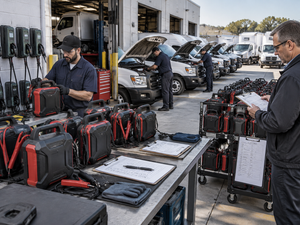
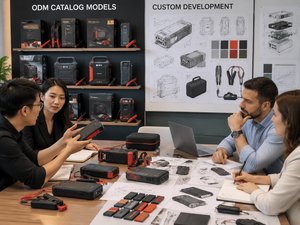
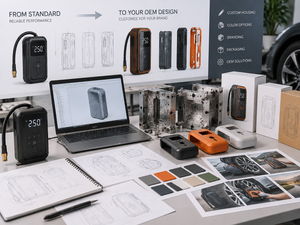
When an automotive brand asks for a custom tire inflator, “custom” can mean very different things.
One buyer may only need a logo, branded packaging, and a different product color. Another may want a completely new housing, button layout, hose storage structure, display design, or internal configuration.
These projects require very different levels of investment.
For B2B buyers, understanding the available manufacturing options makes it easier to decide how much customization is actually necessary—and whether the commercial value justifies new tooling and engineering work.
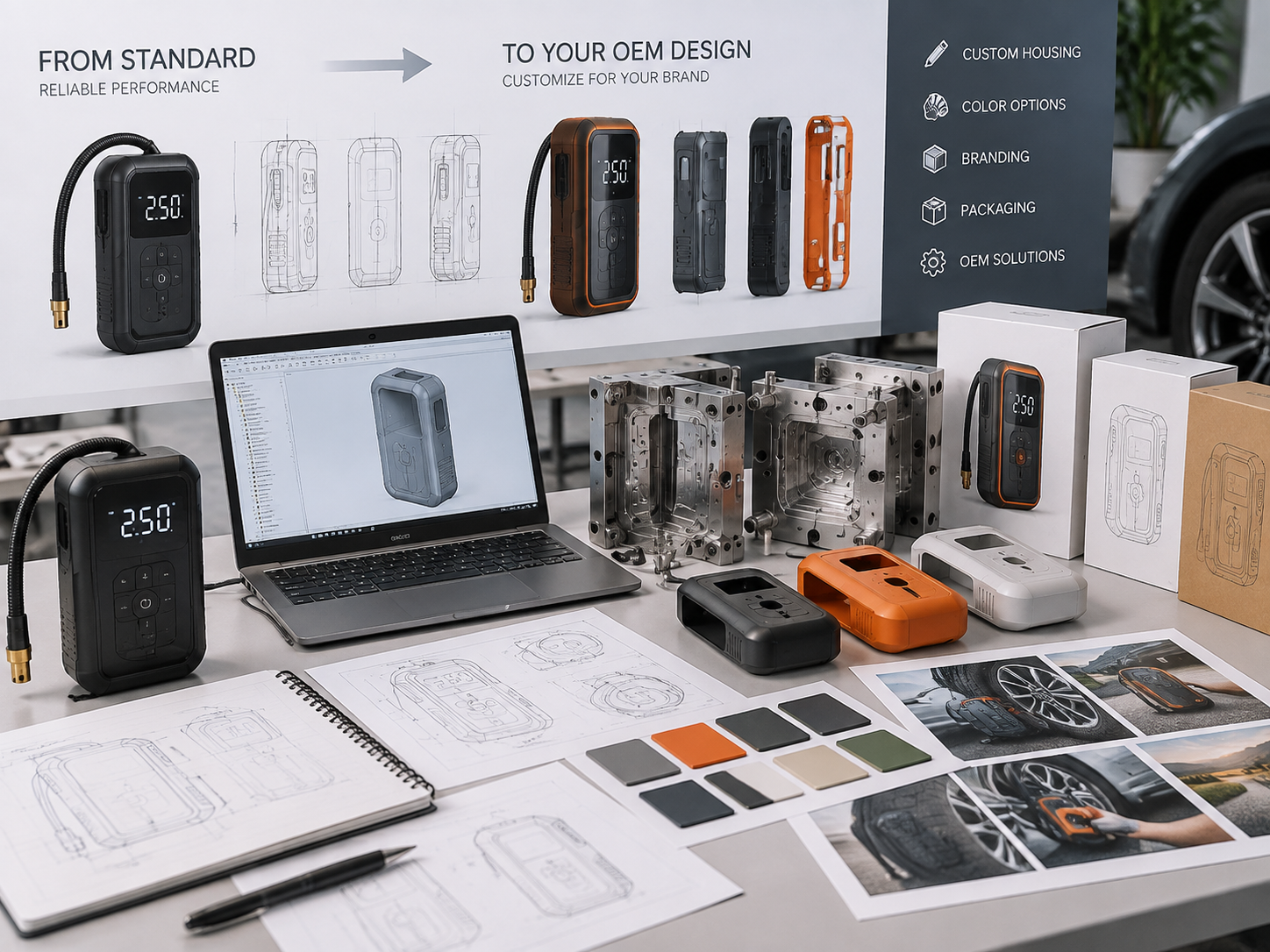
Level 1: Logo, Label, and Packaging Customization
The simplest form of tire inflator customization usually keeps the existing product structure unchanged.
The manufacturer uses an existing model while the buyer develops a branded retail package around it.
Typical options can include:
- printed or applied logo
- product labels
- retail color box
- user manual
- barcode labels
- carton markings
- storage bag
- accessory arrangement
- product photography and packaging graphics
This approach is often suitable for brands that want faster market entry or need to test a new product category before investing in unique tooling.
The main benefit is that the underlying product platform is already developed.
The buyer can focus on brand presentation, packaging, channel positioning, and customer communication instead of starting a new engineering project.
However, even simple branding should be controlled carefully.
Logo size and position, print durability, packaging contents, manuals, accessories, and product labels should all be confirmed through an approved sample before mass production.
Level 2: Color, Accessories, and Configuration Changes
The next level changes more of the commercial configuration while still using the manufacturer’s existing core platform.
Possible options may include:
- custom product color
- different hose length
- alternative tire chuck
- accessory combinations
- storage case
- power cable configuration
- charging cable
- nozzle kit
- display units
- selected software settings where supported
This level can create stronger differentiation without requiring a completely new product.
For example, one automotive retailer may want a basic emergency inflator with a simple accessory set, while another brand may want a storage case, additional nozzles, and different packaging for a premium channel.
The key question is whether the requested option already exists within the supplier’s production system.
Choosing an existing hose, connector, case, or accessory is very different from designing a new one.
Buyers should therefore ask suppliers to separate existing configuration options from new development requirements.
Level 3: Custom Housing and Mold Development
A new outer housing is where the project usually becomes much more involved.
If a brand wants a tire inflator that looks clearly different from other products in the market, custom molding may be necessary.
Possible custom molded areas include:
- complete outer housing
- top or bottom shell
- handle
- display window
- button panel
- hose storage area
- accessory compartment
- ventilation structure
- connector covers
- decorative parts
A custom housing can create strong visual differentiation, but appearance is only one part of the project.
Changing the shell may also affect internal mounting points, airflow, motor positioning, battery space, cable routing, display installation, assembly sequence, and packaging dimensions.
That is why a custom mold project should not be treated as simply “making a different plastic cover.”
The housing is part of the complete product architecture.
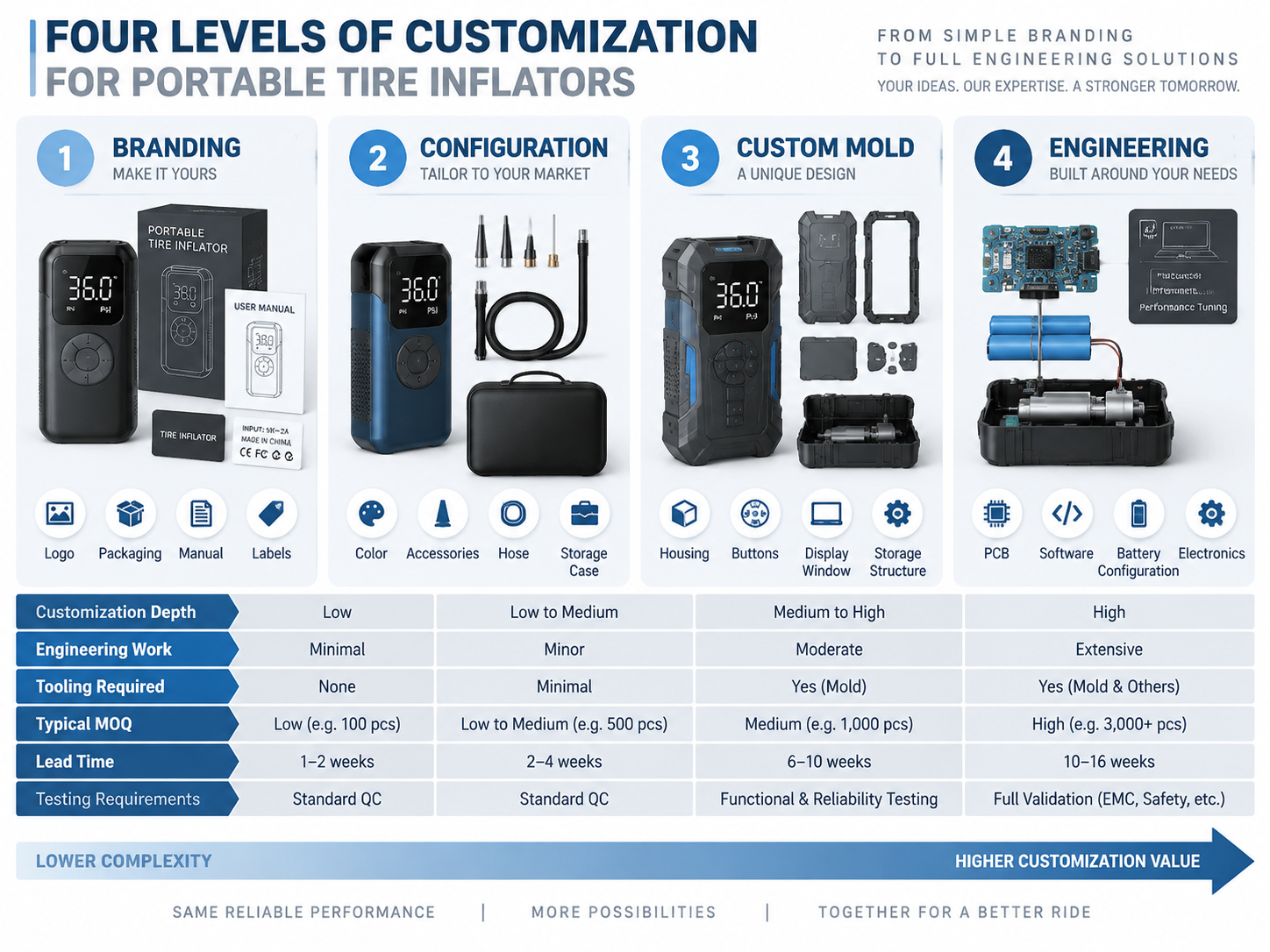
Level 4: Interface, Electronics, and Function Customization
Some brands want differentiation beyond appearance.
For digital or rechargeable tire inflators, this may involve:
- screen interface
- button functions
- pressure units
- preset logic
- automatic shut-off behavior
- operating modes
- charging interface
- battery configuration
- PCB changes
- control software
- lighting functions
The development difficulty depends on what the existing platform can already support.
Changing a screen icon or available preset may be relatively straightforward on some products.
Moving the screen, changing the number of buttons, adding a new function, or modifying the electrical architecture can require hardware changes as well as software work.
For buyers, it is useful to ask the supplier to classify each request as:
- existing standard function,
- configurable software option,
- component modification,
- PCB or electrical redesign.
This helps prevent a simple customization discussion from turning into an unexpectedly large development project.
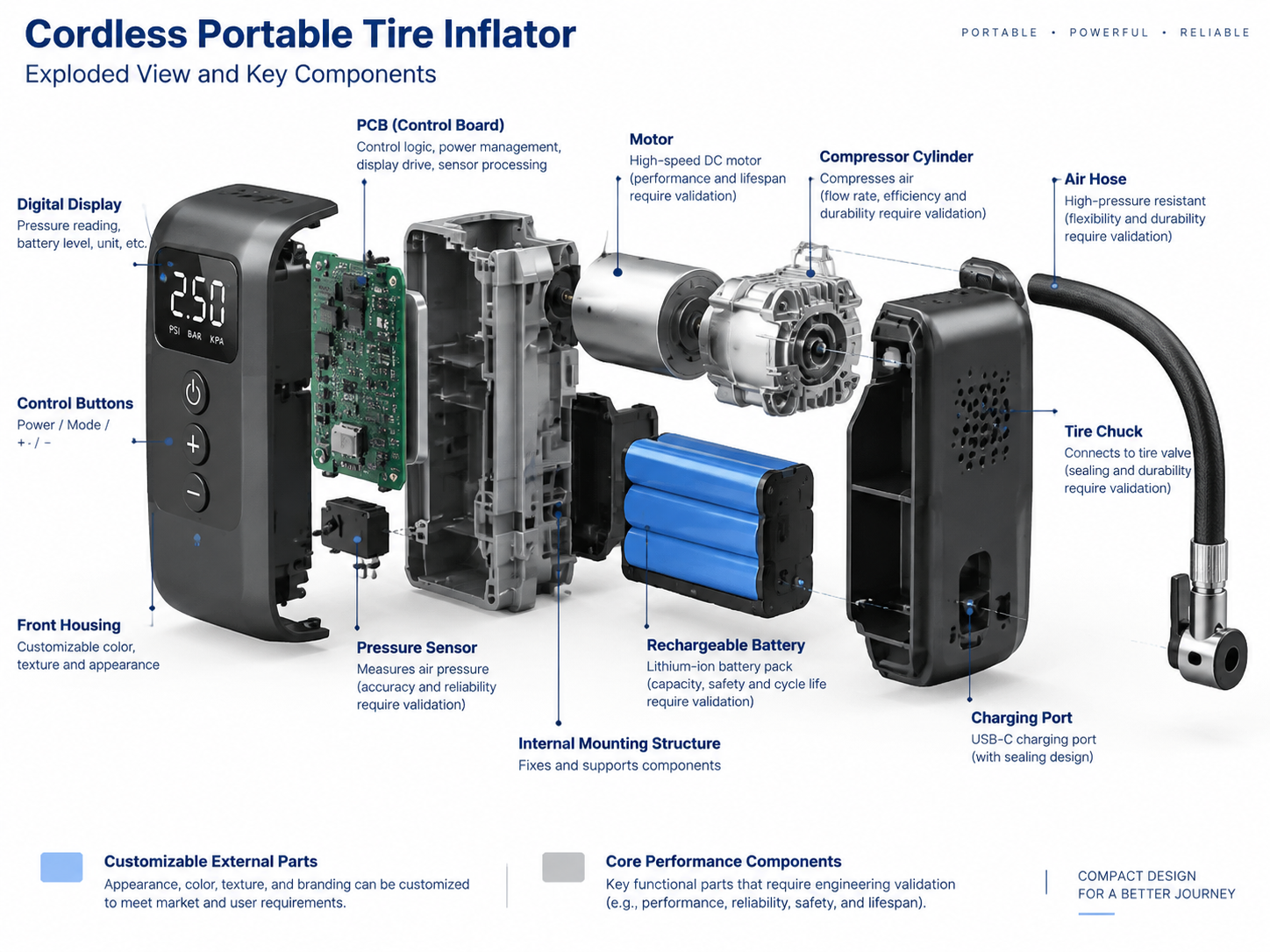
Custom Mold Does Not Always Mean Custom Everything
A useful OEM strategy is often to customize only the parts customers can see or that directly improve the product experience.
A brand may create a unique housing while keeping a proven motor, cylinder, pressure sensor, and internal compressor platform.
Another project may retain the existing housing but develop a better hose, tire chuck, or accessory system.
This hybrid approach can reduce development risk.
For many B2B projects, the objective should not be to redesign every component. It should be to identify which changes create enough value to justify the added cost, tooling, MOQ, testing, and development time.
A completely new product is not automatically a better commercial product.
 portable tire inflator noise testing
Prototype and Sample Approval Before Tooling
Before a buyer approves new molds, the design should be reviewed as thoroughly as possible.
Depending on the project, prototype evaluation may include:
- overall dimensions
- shape and appearance
- grip and handling
- button location
- display visibility
- hose storage
- accessory storage
- charging port position
- ventilation
- packaging fit
- basic assembly structure
After tooling, trial samples should also be evaluated functionally.
For tire inflators, relevant checks can include:
- inflation performance
- pressure reading
- air leakage
- hose and chuck connection
- operating noise and vibration
- heat development
- battery and charging operation
- automatic shut-off
- display and buttons
- repeated operation
A beautiful custom housing has little value if the final product is difficult to use or performs worse than the original platform.
How Customization Affects MOQ, Cost, and Lead Time
Customization level directly affects project economics.
A useful way to think about it is:
| Customization Level | Typical Development Impact | Best Fit |
|---|---|---|
| Logo + Packaging | Low | Private label / market testing |
| Color + Accessories | Low to moderate | Retail differentiation |
| Existing Function Configuration | Moderate | Brand-specific positioning |
| Custom Housing | Higher | Strong visual differentiation |
| New Molded Components | Higher | Exclusive structural features |
| PCB / Electronics Changes | High | Unique functions |
| Complete Product Development | Highest | Long-term exclusive platform |
This does not mean every deeper project automatically has a specific MOQ or cost.
Actual requirements depend on the number of custom parts, materials, tooling, production process, component suppliers, testing, and order forecast.
B2B buyers should therefore request a development breakdown rather than asking only for one “OEM price.”
Branding Should Remain Consistent Across the Whole Product
Custom branding is not only about putting a logo on the housing.
A professional private label project should keep the brand presentation consistent across:
- product
- packaging
- user manual
- accessory bag
- labels
- storage case
- carton
- online product images
- marketplace listing
The physical product and marketing content should also show the same configuration.
If the sales image shows one hose, clamp, cable, or accessory package while the delivered product contains another, the branding project is not truly controlled.
This is why final artwork and final product configuration should be confirmed together before mass production.
What Buyers Should Ask Before Starting a Custom Mold Project
Before approving a custom tire inflator project, buyers should ask:
- Which parts can use existing tooling?
- Which parts require new molds?
- Can existing internal components remain unchanged?
- What functions can be changed through software?
- Which requests require PCB or hardware changes?
- What prototype process is available?
- What tests need to be repeated after modification?
- What MOQ applies to each customization level?
- Who owns or controls newly developed molds?
- What is the expected development and trial-production process?
- How will the final approved sample be controlled during mass production?
- Can the platform support future upgrades or repeat orders?
These questions help buyers understand the real scope of the project before committing to tooling.
Conclusion
Tire inflator customization can range from simple private labeling to complete OEM product development.
Logo, packaging, color, and accessory changes may be enough for brands that need fast market entry. Custom molds can create stronger visual differentiation, while interface, PCB, and structural development can support deeper product exclusivity.
The right choice depends on the brand’s target market, expected volume, development budget, launch schedule, and need for differentiation.
For B2B buyers, the best approach is usually to customize where the change creates real customer or channel value rather than redesigning components simply for the sake of being different.
YANTU supports tire inflator projects ranging from private label branding and packaging to deeper OEM customization. If you are developing a custom tire inflator, our team can help discuss existing platforms, custom housings, tooling, accessories, product configuration, sample testing, packaging, and bulk production requirements.