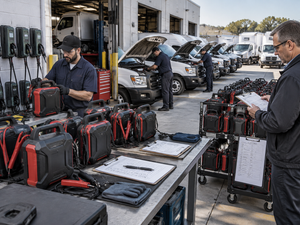
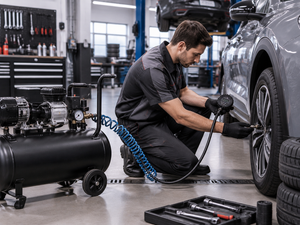
For an auto shop, a tire inflator is not only an emergency tool. It may be used repeatedly across passenger cars, SUVs, customer vehicles, service vans, and workshop jobs throughout the day.
This changes how the product should be evaluated.
Consumer buyers often focus on maximum PSI. Professional buyers need to look more closely at airflow, inflation speed, pressure performance, duty cycle, heat management, power supply, and repeated-use capability.
CFM, or cubic feet per minute, can be an important part of that evaluation. But CFM should never be considered alone.
For workshop purchasing, the real question is:
How much useful air can the inflator deliver under the actual pressure and workload of the shop?
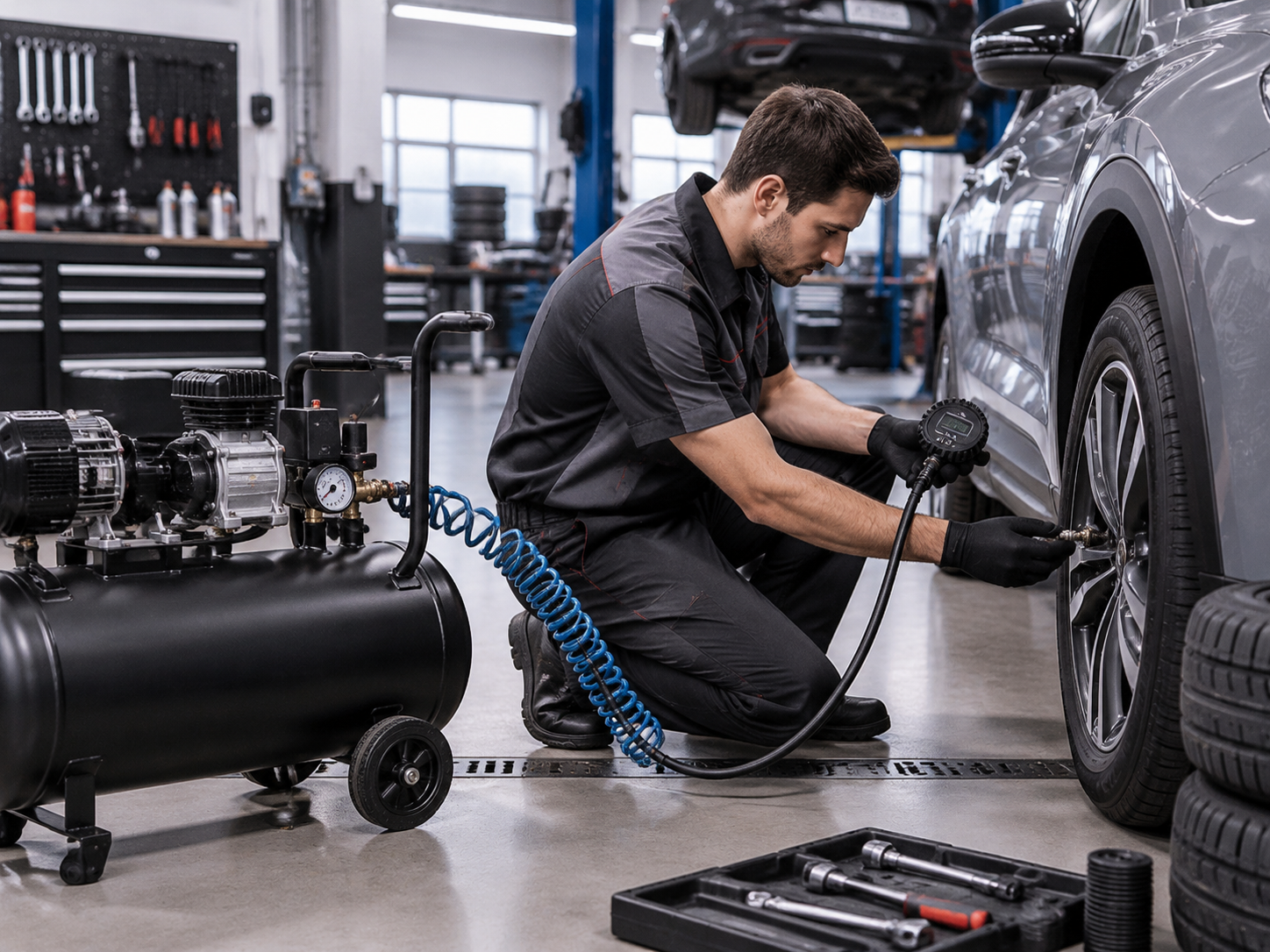
What CFM Means for Tire Inflators
CFM describes airflow volume.
In simple terms, a higher airflow capability can help move more air into a tire in less time.
This matters because automotive tires contain much more air than bicycle tires and because professional shops may need to inflate multiple tires one after another.
However, one CFM number does not tell the entire story.
Airflow can change as pressure increases.
An inflator may move air quickly at low pressure but deliver less airflow as the tire pressure rises. Therefore, buyers should understand how the manufacturer measured the CFM figure.
Questions include:
- Was airflow measured with no pressure load?
- Was it measured at a specific pressure?
- What voltage was used?
- Was the unit already warm?
- Was the measurement taken during continuous operation?
- Is the figure based on the complete finished product?
Without test conditions, two CFM figures may not be directly comparable.
 commercial tire inflator CFM ratings
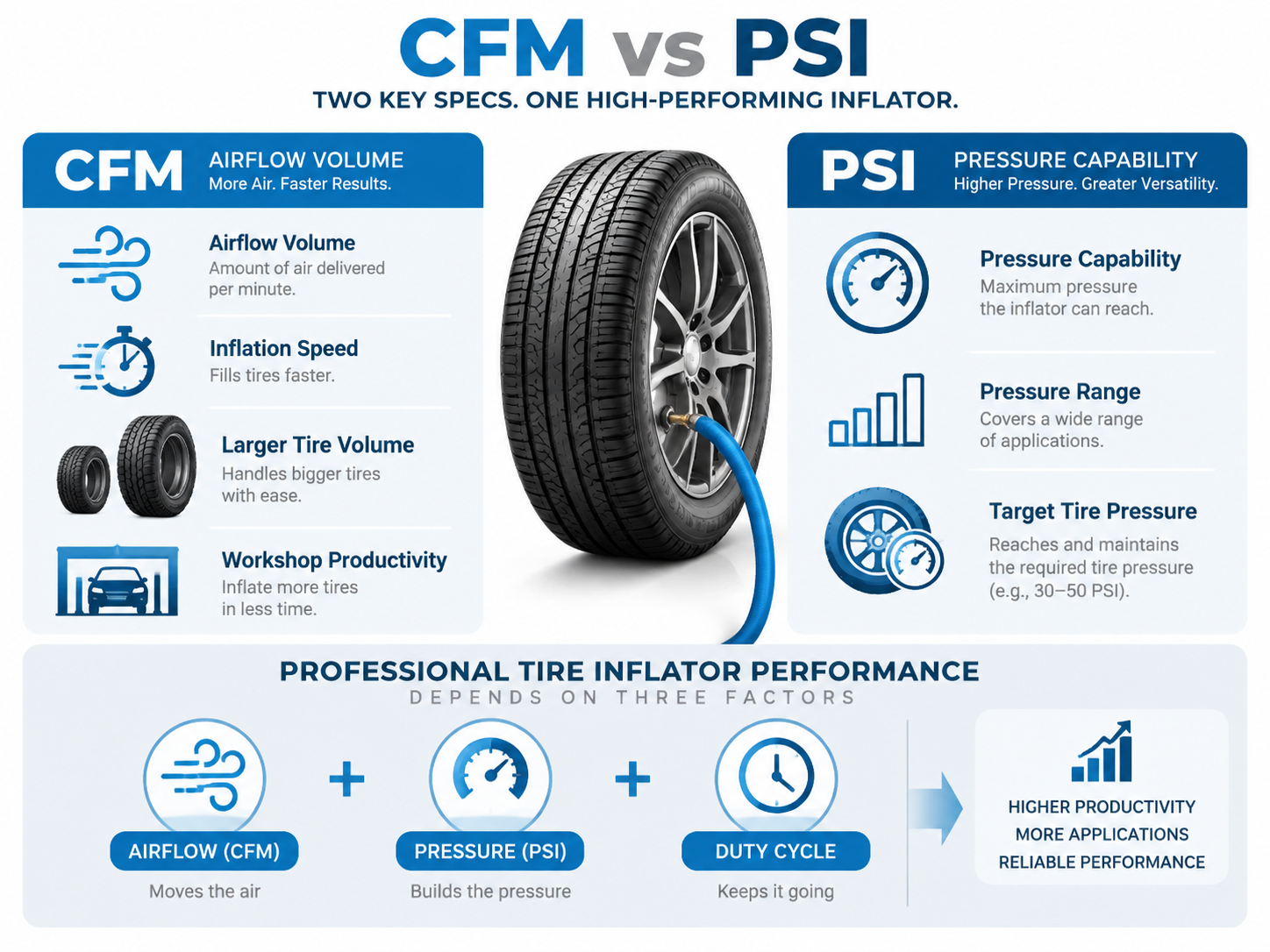
CFM and PSI Measure Different Things
One of the most common mistakes in tire inflator sourcing is treating PSI and CFM as if they describe the same performance.
They do not.
PSI describes pressure capability.
CFM describes airflow volume.
A tire inflator can theoretically have a high maximum pressure rating without being particularly fast at filling a large tire.
Likewise, strong airflow at lower pressure does not automatically mean the inflator maintains the same performance near its upper pressure range.
For auto shops, both matter.
A useful professional inflator needs enough pressure for its intended vehicle applications, but it also needs practical airflow so technicians do not spend excessive time waiting for tires to inflate.
This is why workshop buyers should compare real inflation performance in addition to headline specifications.
Tire Size Changes the Airflow Requirement
Professional workshops may service very different tire sizes.
A compact passenger-car tire and a larger SUV or light-commercial tire do not contain the same air volume.
The larger the tire volume, the more important airflow becomes.
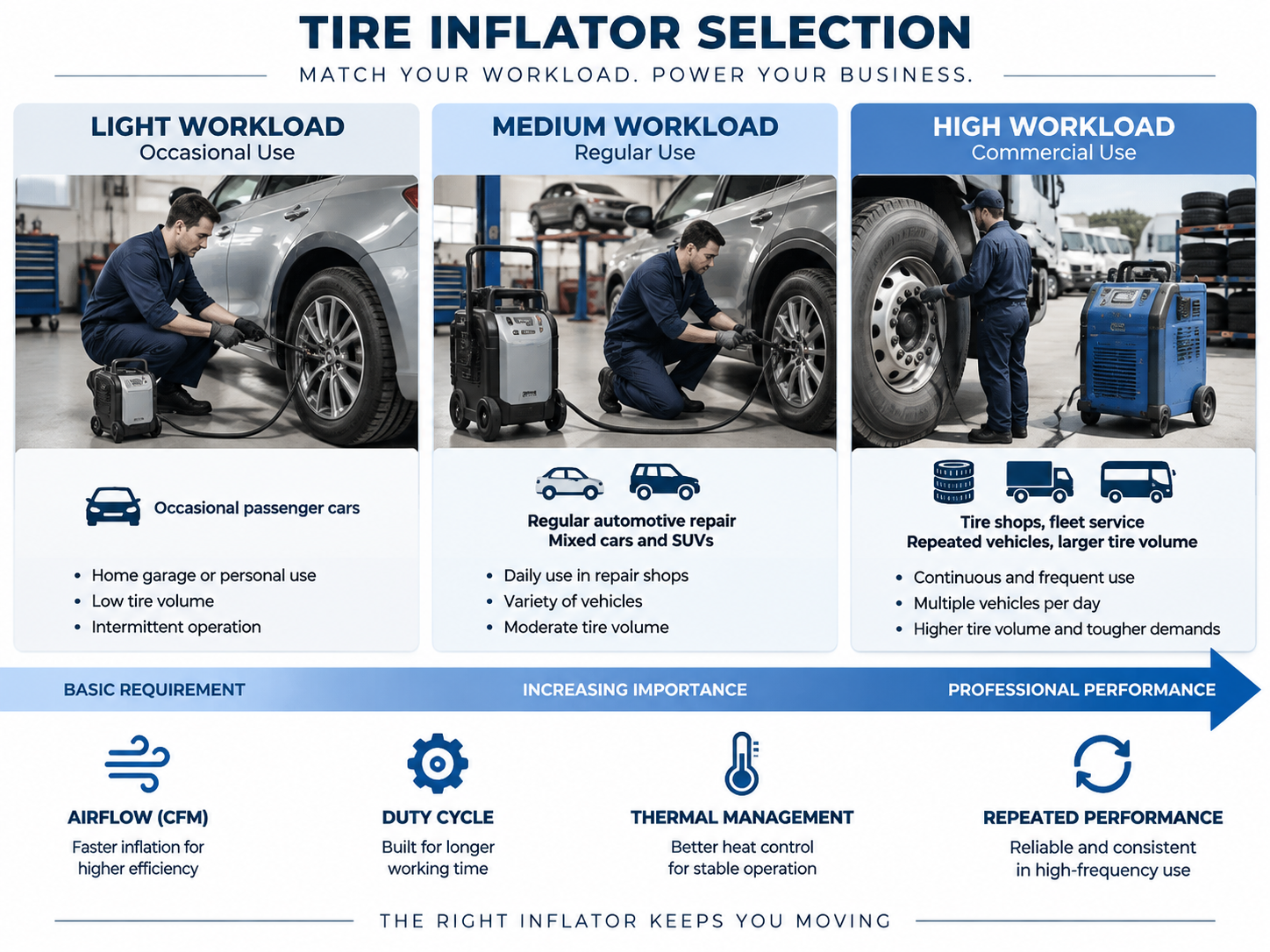
For a shop mainly handling passenger cars, one performance level may be sufficient.
A business regularly working on:
- SUVs
- pickups
- larger passenger vehicles
- service vans
- commercial fleets
may place greater emphasis on airflow and repeated operation.
This does not mean buyers should simply choose the product with the highest CFM number.
The right product should match the shop’s typical workload.
Before sourcing, buyers should identify:
- the vehicle categories normally serviced,
- typical starting and target pressures,
- how many tires may be inflated in one working period,
- whether the tool is used occasionally or continuously,
- how much waiting time is acceptable.
This creates a much more useful specification than “we need a powerful inflator.”
Inflation Time Is Often Easier to Understand Than CFM
CFM is useful for technical comparison, but workshop staff often understand inflation time more easily.
A practical sample test can measure how long the inflator takes to move a representative tire from a defined starting pressure to a target pressure.
For example, buyers can use the same:
- tire size
- starting pressure
- target pressure
- power source
- ambient condition
- test procedure
for every supplier sample.
The specific numbers should be selected according to the buyer’s real market and workshop use.
The important point is consistency.
If one supplier tests a small tire under light load while another tests a larger tire under more demanding conditions, the results cannot be compared fairly.
For B2B sourcing, a repeatable inflation test is often more useful than comparing isolated CFM claims.
Duty Cycle Matters in Professional Workshops
A workshop inflator may perform well during one tire inflation but behave differently after repeated use.
Motors, cylinders, electronics, and other components generate heat during operation.
As the product heats up, performance and reliability can become more important than the initial speed.
Professional buyers should therefore ask about:
- recommended operating time
- required cooling intervals
- thermal protection
- behavior during repeated inflation
- temperature after multiple cycles
- whether performance changes as the unit heats up
This is where a consumer-oriented portable inflator and a professional workshop tool may differ significantly.
A product used once during a roadside emergency does not face the same workload as an inflator used repeatedly in a busy service environment.
For auto shops, duty cycle should be evaluated together with airflow.
High airflow has limited value if the product cannot sustain the required working pattern.
Power Supply Affects Real Performance
Professional tire inflators may use different power sources.
Depending on the product design, these may include:
- 12V vehicle power
- direct battery connection
- rechargeable battery
- AC workshop power
- other professional power configurations
Buyers should confirm what power source was used when performance data was measured.
Voltage drop, battery condition, cable design, connector quality, and electrical configuration can all affect the final product’s operation.
For cordless units, battery condition can also influence repeated-use performance.
For wired models, cable length and conductor design may affect the power reaching the motor.
This is why shop inflator power requirements should be evaluated as part of the complete system rather than as one isolated motor specification.
Gauge Accuracy and Airflow Work Together
Fast inflation is useful, but professional technicians also need control.
If the inflator moves air quickly but the pressure reading is difficult to read or unreliable, workflow can become less efficient.
Professional products may use:
- analog gauges
- digital displays
- automatic shut-off
- preset pressure
- external workshop gauges
The best configuration depends on the application.
For B2B buyers, sample testing should evaluate both speed and control.
Useful checks include:
- gauge readability
- pressure response
- stability near target pressure
- automatic shut-off behavior where available
- ease of making small pressure adjustments
- consistency across repeated tests
Professional performance is not only about getting air into the tire quickly. It is also about reaching the desired pressure efficiently.
CFM Ratings Need Clear Test Conditions
When a supplier quotes airflow, buyers should ask how the number was obtained.
A useful specification should ideally be connected to clear test conditions.
For comparison purposes, ask:
- What pressure condition was used for the airflow test?
- Was the measurement free-flow or under load?
- What power supply was used?
- What was the ambient temperature?
- Was this a cold-start test or repeated-operation test?
- Was the number measured on a finished production unit?
- Can sample testing reproduce the result?
This does not mean every buyer needs laboratory-level testing.
The objective is simply to avoid comparing numbers that were measured under completely different conditions.
For procurement teams, repeatability matters more than an impressive headline figure.
Quick Professional Inflator Evaluation Table
| Factor | Why It Matters | What Auto Shops Should Check |
|---|---|---|
| CFM / Airflow | Influences inflation speed | Test conditions and airflow under load |
| Maximum Pressure | Defines pressure capability | Match intended vehicle applications |
| Inflation Time | Shows real workshop efficiency | Test a representative tire |
| Duty Cycle | Affects repeated use | Operating and cooling requirements |
| Heat Control | Influences reliability | Temperature after repeated cycles |
| Power Supply | Affects real output | Voltage, cables, battery, connectors |
| Gauge / Display | Supports pressure control | Readability and consistency |
| Hose & Chuck | Affects daily workflow | Length, sealing, connection quality |
| Noise & Vibration | Influences workshop usability | Stable operation without abnormal sound |
| Sample Consistency | Indicates production control | Compare multiple units where possible |
What Auto Shop Buyers Should Ask Suppliers
Before ordering professional tire inflators, buyers should ask:
- How is the CFM specification measured?
- Is airflow measured under pressure?
- What tire was used for inflation-time testing?
- What power source was used?
- How does performance change during repeated operation?
- What duty cycle is recommended?
- What thermal protection is included?
- How is pressure accuracy checked?
- What hose and tire chuck configuration is supplied?
- Are spare parts available for professional channels?
- Can multiple samples be tested before bulk ordering?
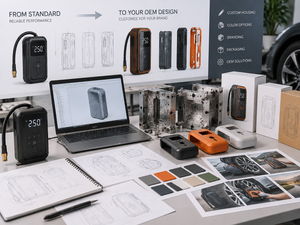
- Can the supplier support private label, packaging, and workshop-channel requirements?
These questions help turn a simple specification comparison into a real professional-use evaluation.
Conclusion
Professional tire inflator CFM matters because airflow directly affects workshop efficiency, especially when larger tires or repeated inflation jobs are involved.
But CFM alone does not define a professional inflator.
Auto shops should evaluate airflow together with pressure capability, inflation time, tire size, duty cycle, heat control, power supply, gauge performance, hose quality, and repeated-use behavior.
The most useful purchasing approach is to test representative tires under consistent conditions and compare how each product performs throughout the complete inflation cycle.
For professional channels, the best inflator is not necessarily the model with the biggest CFM or PSI number. It is the model that delivers predictable performance for the shop’s real workload.
YANTU supports tire inflator projects for automotive distributors, service shops, workshop channels, fleets, and private label brands. If you are selecting professional tire inflators for workshop use, our team can help discuss airflow, inflation testing, pressure performance, duty cycle, product configuration, samples, packaging, and bulk production requirements.