Size is an important factor when buyers compare portable tire inflators. A smaller inflator may be easier to store, ship, and sell online, while a larger model may offer stronger performance, better heat control, or more durable components.
For wholesalers, distributors, and automotive tool brands, the right size is not simply the smallest product. The best choice depends on target users, sales channel, packaging requirements, and expected performance.
This article explains how portable tire inflator size affects wholesale purchasing decisions.

Size Affects Product Positioning
Portable tire inflators are often described as compact, mini, cordless, or heavy-duty. These size descriptions help customers understand how the product should be used.
A small portable tire inflator is usually better for personal car owners, emergency kits, glove box storage, and online retail. It is easy to carry and simple to present in product images.
A larger tire inflator may be better for SUVs, light trucks, outdoor users, or customers who care more about power and durability than pocket-size storage.
For B2B buyers, size should match the product position. If the product is marketed as an emergency car accessory, compact size is a strong selling point. If it is positioned for heavier use, a slightly larger body may be acceptable.

Compact Size Helps Online and Retail Sales
Compact tire inflators are attractive for online sellers and retail buyers because they are easier to package, display, and explain.
For Amazon, Walmart, and independent store sellers, smaller dimensions may help with shipping cost, storage space, and product photography. A compact product is also easier to show as a convenient emergency tool for daily drivers.
In physical retail stores, compact packaging can fit better on shelves and peg displays. This matters when retailers compare multiple automotive accessories within limited shelf space.
For wholesale buyers, compact size can improve channel flexibility. The same product may work for online sales, retail shelves, promotional kits, and private label programs.
However, buyers should not choose compact size without checking performance. A small tire inflator must still provide acceptable inflation speed, pressure range, and heat control.
Larger Models May Support Stronger Performance
A larger tire inflator is not always a disadvantage. In some cases, it allows better internal design.
More space can support a stronger motor, larger cylinder, better cooling structure, longer hose storage, or more stable housing. These features may improve performance and durability.
For customers with SUVs, pickup trucks, outdoor vehicles, or frequent tire inflation needs, a larger model may feel more reliable. It can also support a more professional product image.
From a wholesale perspective, this means buyers should compare size together with performance. A larger product may be suitable for higher price points, tool brands, auto shops, or outdoor accessory channels.
The purchasing question is not “Which inflator is smaller?” but “Which size fits the user expectation and price segment?”
Packaging and Carton Size Affect Wholesale Cost
Size directly affects packaging design, carton quantity, storage, and shipping cost.
A compact tire inflator may allow smaller color boxes and more units per carton. This can reduce warehouse space and improve shipping efficiency. For distributors and e-commerce sellers, this can be a real cost advantage.
Larger tire inflators may require stronger packaging, more protective inserts, and lower carton quantity. This may increase cost, but it can be necessary if the product has higher power, more accessories, or a premium positioning.
Before placing bulk orders, buyers should ask suppliers for:
- product dimensions
- color box size
- carton size
- units per carton
- gross weight
- packaging material
- accessory layout
These details help buyers calculate landed cost more accurately. For wholesale tire inflator purchasing, packaging size can affect profit as much as the unit price.

Size Also Changes User Experience
Portable tire inflator size affects how customers use and store the product.
A compact model is easier to keep in a car trunk, under a seat, or inside an emergency kit. It feels convenient and less intimidating for general users.
A larger model may be easier to hold, more stable during operation, and better for repeated use. It may also provide more space for clearer buttons, larger displays, or better cable management.
For B2B buyers, user experience should match the target customer. A commuter or daily driver may prefer simple storage. An outdoor driver may accept larger size for stronger performance.
This is why buyers should avoid comparing size only by dimensions. The better question is whether the product size supports the expected use scenario.
What Buyers Should Check Before Ordering
Before selecting a portable tire inflator for wholesale, buyers should review both size and performance.
Important checks include:
- Product dimensions and weight
- Color box and carton size
- Inflation speed for target tire types
- Pressure range and auto shut-off function
- Heat control during repeated use
- Hose and cable storage design
- Accessory configuration
- Retail display and online listing suitability
Sample testing is important. A product may look compact in photos but feel too heavy in hand. Another model may look large but perform better for the target market.
For wholesalers and distributors, the right tire inflator size should support both customer satisfaction and supply chain efficiency.
Quick Comparison Table
| Size Type | Main Advantage | Purchasing Meaning |
|---|---|---|
| Mini tire inflator | Easy storage and online selling | Good for personal car owners and emergency kits |
| Compact portable inflator | Balanced size and function | Suitable for retail and marketplace channels |
| Medium-size inflator | Better usability and heat control | Good for broader customer groups |
| Larger inflator | Stronger performance potential | Suitable for SUVs, outdoor users, and tool brands |
| Premium-size model | Higher perceived value | Works for branded product lines |
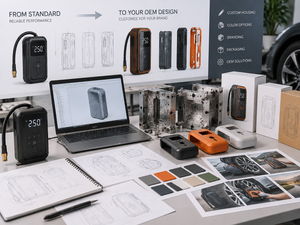
 portable tire inflator product options
Conclusion
Portable tire inflator size is not only a design detail. It affects product positioning, packaging cost, shipping efficiency, retail display, and user experience.
For wholesale buyers, the best size depends on the target market. Compact models are easier to sell through online and retail channels, while larger models may support stronger performance and higher-value positioning.
Buyers should compare dimensions together with inflation performance, packaging details, carton size, heat control, and customer use scenarios.
YANTU supports portable tire inflator projects for distributors, retailers, marketplace sellers, and automotive brands. If you are comparing compact and larger tire inflator options for wholesale, our team can help discuss product dimensions, packaging, sample testing, and bulk order requirements.