When sourcing portable tire inflators, many B2B buyers need to decide whether to choose an OEM or ODM manufacturing model. Both options can work, but they are suitable for different business goals.
ODM is usually better for faster launch, lower development risk, and private label projects based on existing product platforms. OEM is more suitable when buyers need a unique structure, exclusive design, or deeper customization.
This article explains the key differences between OEM and ODM tire inflator projects and how buyers can choose the right model.

What OEM and ODM Mean for Tire Inflator Projects
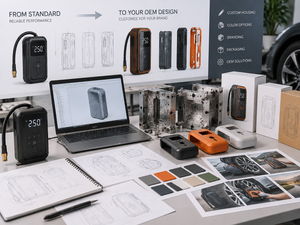
In a tire inflator project, OEM usually means the buyer provides specific product requirements and the manufacturer produces according to those requirements. This may involve custom housing, different internal structure, special display layout, new accessory configuration, or unique packaging.
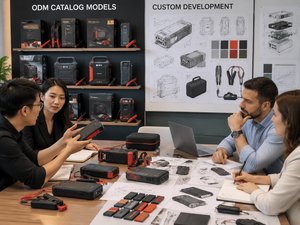
ODM usually means the manufacturer already has existing tire inflator models or mature product platforms. The buyer can choose a suitable model and customize logo, color, packaging, manual, accessories, or small configuration details.
For portable tire inflators, this difference matters because the product involves motor performance, pressure gauge accuracy, battery or power system, hose design, heat control, accessories, and safety protection.
For B2B buyers, the question is not which model sounds more advanced. The real question is which model matches the buyer’s budget, timeline, channel, MOQ, and differentiation needs.

When ODM Tire Inflators Are the Better Choice
ODM is often the better starting point for buyers who want to launch quickly.
With ODM, the supplier already has available product designs. This can reduce development time, tooling cost, engineering uncertainty, and sample approval complexity. Buyers can focus more on market positioning, packaging, product images, and sales preparation.
ODM tire inflators are suitable for:
- Amazon and marketplace sellers
- retailers adding a new product line
- regional distributors testing demand
- automotive accessory brands starting a private label project
- buyers with limited development budget
- projects that need faster delivery
For example, a seller may choose an existing cordless tire inflator model and customize the logo, retail box, manual, and accessory kit. This allows the seller to enter the market faster without developing a completely new product.
The limitation is that ODM products may not be fully exclusive. Other buyers may use similar models. For many B2B buyers, this is acceptable if speed, cost control, and supply stability are more important than full product uniqueness.
 cordless vs 12V vs rechargeable tire inflators
When OEM Tire Inflators Are the Better Choice
OEM is more suitable when buyers need deeper product differentiation.
A buyer may want a unique outer housing, special button layout, different display position, exclusive battery configuration, custom hose storage, stronger motor performance, or a new accessory structure. These requirements may go beyond simple private label customization.
OEM tire inflator projects are usually better for:
- established automotive brands
- retailers building exclusive product lines
- buyers targeting premium channels
- brands with clear product design requirements
- companies that need long-term product differentiation
- buyers with enough MOQ and development budget
OEM can create stronger brand identity, but it also requires more project management. Buyers need to confirm specifications, prototypes, tooling cost, test standards, packaging, inspection process, and production timeline.
For B2B buyers, OEM should not be treated as a simple purchase order. It is closer to a product development project. If the requirements are unclear, OEM may create delays, extra costs, or sample revisions.
Customization Scope: What Can Be Changed
Many buyers do not need a full OEM project. In many cases, ODM plus private label customization is enough.
Common customization options include:
- product logo
- product color
- retail packaging
- user manual
- pressure unit display
- accessory kit
- storage bag or case
- carton label
- product photos
- barcode or retail label area
For more advanced projects, customization may include:
- housing design
- display window
- button layout
- air hose structure
- battery capacity
- motor configuration
- internal component layout
- new mold development
The more deeply the buyer changes the product, the more likely the project becomes OEM rather than ODM.
For B2B buyers, each customization request should have a business reason. A new shell design may help brand differentiation. A better hose or chuck may reduce customer complaints. A clearer gauge layout may improve user experience.
Customization should not be added only for appearance if it increases cost without improving product value.

Cost, MOQ, and Lead Time Differences
OEM and ODM projects usually have different cost structures.
ODM projects often have lower development cost because the product platform already exists. MOQ may also be more flexible, especially for logo and packaging customization. Lead time is usually shorter because the supplier does not need to build a new product from the beginning.
OEM projects may require tooling cost, engineering work, prototype testing, mold modification, and longer production preparation. MOQ is often higher because the supplier needs to justify the development and production setup.
Buyers should compare:
| Factor | ODM Tire Inflator | OEM Tire Inflator |
|---|---|---|
| Launch Speed | Faster | Slower |
| Development Cost | Lower | Higher |
| Customization Depth | Limited to moderate | High |
| Product Uniqueness | Lower | Stronger |
| MOQ | Usually more flexible | Usually higher |
| Project Risk | Lower if model is mature | Higher if requirements change |
For B2B buyers, the lowest unit price is not always the best choice. The right model should match the buyer’s channel plan and expected order volume.
Quality Control and Testing Requirements
Whether choosing OEM or ODM, quality control is essential.
Tire inflators involve pressure measurement, motor operation, heat control, air leakage, battery or power system, hose connection, and accessory reliability. These details can affect customer reviews and after-sales risk.
For ODM projects, buyers should ask what testing is already performed on the existing model. For OEM projects, buyers should confirm how new design changes affect testing requirements.
Important checks include:
- inflation speed testing
- gauge accuracy testing
- auto shut-off testing
- heat control testing
- hose and chuck leakage testing
- battery or 12V power stability
- accessory inspection
- packaging drop or transport check
- final product inspection
- sample approval before mass production
For B2B buyers, supplier testing capability matters as much as product design. A good supplier should be able to explain how the tire inflator is tested and what inspection records can be provided.
How Buyers Should Choose the Right Model
The right choice depends on the buyer’s business stage and product goal.
ODM is usually better if the buyer wants to test the market, launch quickly, control cost, or build a private label product line from existing models.
OEM is usually better if the buyer needs exclusive design, stronger brand differentiation, special performance requirements, or long-term product control.
Before deciding, buyers should ask:
- Is this a test order or a long-term product line?
- How fast does the product need to launch?
- Is the target channel price-sensitive or premium?
- Does the buyer need a unique product appearance?
- Is the MOQ large enough for OEM development?
- Can the supplier support tooling and testing?
- Can packaging and accessories create enough differentiation?
- Are samples available for approval before bulk orders?
Some buyers may start with ODM first and move to OEM later after market validation. This can reduce risk while keeping future customization options open.
Conclusion
OEM and ODM tire inflator projects serve different sourcing needs. ODM is usually faster, lower risk, and more suitable for private label or market testing. OEM is better for buyers who need unique design, deeper customization, and long-term product differentiation.
For B2B buyers, the decision should be based on budget, MOQ, timeline, channel positioning, customization needs, and supplier capability.
A strong tire inflator project should not only look different. It should also perform reliably, pass sample testing, support clear packaging, and reduce after-sales risk.
YANTU supports OEM, ODM, and private label tire inflator projects for marketplace sellers, retailers, distributors, automotive brands, and service channels. If you are choosing between OEM and ODM tire inflator solutions, our team can help discuss product options, customization scope, packaging, sample testing, and bulk order requirements.