For buyers developing a custom bike pump, tooling cost is often one of the first questions. Some buyers see mold fees as an extra expense, but in OEM projects, tooling is part of building a product that can be produced consistently.
A custom bike pump may require new housing, handle, display area, pump head parts, or accessory components. Each custom part can affect mold investment, development time, MOQ, and unit price.
This article explains what goes into OEM bike pump tooling costs and what B2B buyers should confirm before approving mold investment.

What Tooling Cost Means in OEM Bike Pump Projects
Tooling cost refers to the investment needed to create molds and production tools for custom parts. In a bike pump project, this may include plastic molds, metal parts, rubber components, or accessory molds depending on the product design.
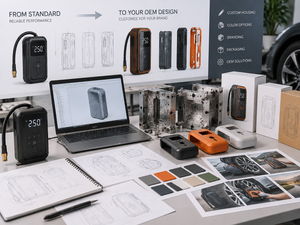
For standard private label projects, buyers may use an existing bike pump model and only customize logo, packaging, color, or accessories. In this case, tooling cost may be low or unnecessary.
For OEM bike pump projects, the buyer usually wants a more customized product. This may involve a new outer housing, special handle design, unique pump head, new display window, different button layout, or custom accessory storage.
For B2B buyers, the purchasing meaning is clear. Tooling cost is not only about paying for a mold. It is about deciding how much product uniqueness, control, and long-term production stability the project needs.

Product Structure Affects Mold Complexity
A bike pump may look simple from the outside, but its structure can include many parts.
For example, an electric bike pump may include an outer shell, display window, buttons, charging port area, air outlet, hose connection, internal fixing structure, and accessory storage design. A floor pump may include handle, base, pump barrel, gauge housing, hose holder, and pump head parts.
The more custom parts the product needs, the higher the mold complexity may become.
Buyers should understand that mold cost is affected by:
- number of customized parts
- part size and shape
- material requirements
- surface texture
- assembly structure
- tolerance requirements
- internal fixing design
- appearance requirements
A small design change may be simple if it only affects color or logo. But if it changes the product structure, it may require mold modification or a completely new mold.
This is why buyers should confirm whether the project is a true OEM development or only a private label customization.
Custom Housing, Handle, Display, and Accessories
In many OEM bike pump projects, buyers want the product to look different from existing market models. This is usually where tooling costs begin.
Common customized areas include:
| Custom Area | Possible Tooling Impact | Purchasing Meaning |
|---|---|---|
| Outer housing | New plastic mold may be required | Creates unique appearance |
| Handle design | Mold change or new part design | Improves grip and brand style |
| Display window | New structure or transparent part | Supports digital product design |
| Button area | Mold modification may be needed | Changes user interface |
| Pump head | New part or adapter design | Affects valve compatibility |
| Storage structure | Extra mold or internal design | Helps manage accessories |
For buyers, the key question is whether each customized feature creates real market value. A unique shell design may help brand differentiation. A better pump head may reduce customer complaints. A clearer display area may improve user experience.
However, not every custom idea justifies tooling investment. Buyers should focus on changes that improve product positioning, customer experience, or channel competitiveness.
Prototype Testing Before Mold Investment
Before approving mold investment, buyers should complete prototype evaluation as much as possible.
A prototype helps confirm product direction before expensive tooling decisions are made. It may not be identical to the final mass production unit, but it can help test appearance, size, ergonomics, accessory layout, and basic function.
For bike pump projects, prototype testing may include:
- product size and hand feel
- handle comfort
- display and button position
- valve connection method
- hose storage
- accessory placement
- inflation performance
- packaging fit
This step is important because mold changes after approval can increase cost and delay production. If the design is not tested carefully, the buyer may discover problems only after trial production.
For B2B buyers, prototype review is a risk-control step. It helps reduce design mistakes before the project moves into mold opening.

How Tooling Cost Affects MOQ and Unit Price
Tooling cost is closely connected to MOQ and unit price.
If the buyer pays for a custom mold, the supplier may require a certain MOQ to make the project practical. A highly customized product usually needs more production planning, material preparation, and engineering support.
There are two common ways buyers think about tooling cost:
- Pay the mold fee separately and keep the unit price more stable.
- Amortize part of the tooling cost into the product price across a larger order volume.
Both methods can work, but buyers need clear calculations.
For small orders, a custom mold may make the overall cost too high. For larger private label or brand projects, tooling investment may make sense because it creates a more differentiated product and supports long-term repeat orders.
For buyers, the real question is not only “How much is the mold fee?” It is also “How many units can this design support over time?”
Questions Buyers Should Ask Before Approving Mold Fees
Before approving OEM bike pump tooling costs, buyers should ask practical questions.
Important questions include:
- Which parts require new molds?
- Which parts can use existing tooling?
- What materials will be used?
- How many mold sets are needed?
- What is the expected tooling lead time?
- Can the supplier provide design drawings or 3D files for confirmation?
- How many prototype or trial samples will be provided?
- What happens if the mold needs modification?
- Who owns the mold after payment?
- What MOQ is required after mold completion?
These questions help buyers avoid unclear project terms. A reliable bike pump manufacturer should be able to explain the tooling scope, development timeline, sample process, and production plan clearly.
For OEM buyers, transparency is important. Mold investment should be connected to product value, not treated as an unexplained extra charge.
 bike pump manufacturer evaluation
Quick Tooling Cost Checklist
| Area | What Buyers Should Check | Why It Matters |
|---|---|---|
| Custom Parts | Housing, handle, display, pump head | Defines mold scope |
| Existing Tooling | Which parts can be reused | Reduces cost and lead time |
| Prototype | Size, structure, function, packaging fit | Reduces design risk |
| Mold Ownership | Who owns or controls the mold | Protects long-term project rights |
| MOQ | Minimum order after tooling | Affects project feasibility |
| Unit Price | Whether tooling is separate or amortized | Affects total cost planning |
Conclusion
OEM bike pump tooling costs are part of custom product development. They reflect the investment needed to create unique parts, stable production tools, and a product that can support long-term brand differentiation.
For B2B buyers, mold fees should be evaluated together with product structure, customization value, prototype testing, MOQ, unit price, and supplier capability.
Not every project needs new tooling. Some buyers may be better served by private label customization based on existing models. But for brands that need unique appearance, special structure, or stronger differentiation, OEM tooling can be a valuable investment.
YANTU supports OEM and private label bike pump projects for brands, retailers, distributors, and marketplace sellers. If you are planning a custom bike pump project, our team can help discuss tooling scope, prototype testing, packaging, MOQ, and bulk order requirements.