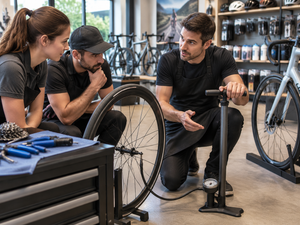
bike pumps are becoming more visible in cycling accessories, but many customers still need help understanding why they are useful. A traditional hand pump or CO2 inflator is already familiar to most cyclists. A compact rechargeable pump may look interesting, but its value is not always obvious at first glance.
For retailers, this creates a merchandising challenge. If an electric bike pump is placed on the shelf without clear explanation, customers may see only another small electronic accessory. But with the right display, signage, and product positioning, the product can quickly communicate convenience, emergency use, and riding confidence.
This article explains how bike shops, sports retailers, and cycling accessory sellers can merchandise electric bike pumps more effectively.

Why Electric Bike Pumps Need Clear Retail Communication
Electric bike pumps are still a relatively new product type for many casual cyclists. Some experienced riders understand the benefit immediately, but many customers may ask:
- Why do I need this if I already have a hand pump?
- Is it for road bikes or mountain bikes?
- Does it work with my valve type?
- How many tires can it inflate?
- Is it for emergency use or regular maintenance?
Retail merchandising should answer these questions before the customer asks them.
A good display does not need to explain every technical specification. Instead, it should help the customer understand the product in a few seconds:
- rechargeable design
- compact carry size
- preset pressure
- auto stop
- suitable for ride emergency top-ups
When the value is clear, the product becomes easier for store staff to recommend and easier for customers to consider.
Place It Near the Right Product Category
Shelf placement has a major impact on how customers understand an electric bike pump.
If the product is placed only in an electronics section, customers may not connect it with cycling use. If it is placed near traditional bike pumps, CO2 inflators, tire repair kits, or saddle bags, the use case becomes clearer.
Retailers can consider placing electric bike pumps near:
- bike repair tools
- traditional hand pumps
- CO2 inflators
- spare tubes and patch kits
- saddle bags
- road cycling accessories
- gravel and MTB accessories
- e-bike accessories
- travel or emergency riding kits
This helps customers compare it with products they already understand.
For example, placing an electric bike pump beside CO2 cartridges can create a natural comparison: CO2 is fast and compact, while an electric pump is rechargeable and reusable. This makes the product easier to explain.

Use Simple Signage to Explain Use Cases
Signage should focus on the customer’s situation, not only the technical specification.
Instead of using only terms like “130 PSI” or “1200mAh,” retailers can use simple use-case language such as:
- Rechargeable emergency pump for rides
- Preset pressure and auto stop
- Compact carry for road, gravel, and MTB riders
- Reusable alternative for pressure top-ups
- Easy inflation without a full-size floor pump
Technical specifications still matter, but they should support the use case rather than replace it.
For B2B buyers, this is important when preparing retail packaging, shelf cards, product pages, and sales materials. A product that is easy to explain usually performs better in retail environments than a product that only lists specifications.
Show the Product in Use
Electric bike pumps are easier to understand when customers can see the usage process.
Retailers can use product photos, shelf cards, or small display graphics showing:
- the pump connected to a bicycle valve
- the digital pressure display
- the pump placed next to a saddle bag or jersey pocket
- the product being used during a roadside stop
- the size compared with a hand pump or CO2 cartridge
This type of visual communication is especially helpful for compact electric pumps. Because the product is small, customers may not immediately understand its function unless the usage scene is shown clearly.
For online sellers, the same rule applies. Main images and A+ content should not only show the device from different angles. They should also show where the product fits in the cyclist’s routine.
Highlight the Right Benefits for Different Riders
Not all cyclists buy electric bike pumps for the same reason.
Road cyclists may care about:
- high pressure capability
- compact size
- emergency top-up use
- Presta valve compatibility
Gravel riders may care about:
- portability
- mixed terrain emergency use
- reliable pressure adjustment
Mountain bike riders may care about:
- wider tire compatibility
- trail-side convenience
- repeated low-pressure adjustment
E-bike riders may care about:
- convenience
- easy operation
- not needing much physical effort
Retail signage and product pages should match the main customer group of the store. A road cycling shop may emphasize compact high-pressure emergency use. A general bike store may emphasize easy inflation for different bike types.
Bundle and Cross-Sell Ideas
Electric bike pumps can be merchandised as part of a broader riding support kit.
Useful bundle ideas include:
- electric bike pump + tire repair kit
- electric bike pump + spare tube
- electric bike pump + saddle bag
- electric bike pump + mini multi-tool
- electric bike pump + valve adapter set
- electric bike pump + CO2 inflator backup kit
Bundling helps customers understand that the pump belongs in a real riding scenario, not just on a shelf.
For retailers, cross-selling can also increase basket value. A customer who is buying a pump may also need a patch kit, spare tube, or storage bag. A customer buying a saddle bag may be interested in a compact emergency pump that fits inside.
Make Staff Explanation Easy
Retail merchandising is not only about shelf design. It also supports staff communication.
A simple sales explanation might be:
“This is a rechargeable mini pump for ride emergencies. You preset the pressure, connect it to the valve, and it stops automatically when it reaches the target pressure.”
This explanation is much easier than describing battery chemistry, motor structure, or every pressure specification.
For B2B buyers supplying retailers, sales materials should help store staff explain the product quickly. Clear packaging icons, short product cards, and simple comparison charts can make a big difference.
What B2B Buyers Should Prepare
Retail buyers and brands should consider preparing several support materials before launching electric bike pumps:
- clear product photos showing real bike use
- simple valve compatibility explanation
- pressure range and battery performance information
- shelf display or packaging icons
- comparison points against hand pumps and CO2 inflators
- short product explanation for retail staff
- cross-sell suggestions for stores
These materials help reduce customer confusion and make the product easier to sell.
 compact electric bike pump options
Retailers building a cycling accessory range can review different compact electric bike pump options to match shelf display, riding scenarios, and target customer groups.
Conclusion
Merchandising electric bike pumps is not just about putting a new product on the shelf. Because the category is still unfamiliar to many customers, retailers need to show the product’s purpose clearly.
The best retail communication focuses on use cases: emergency top-ups, compact carry, rechargeable convenience, preset pressure, and compatibility with common cycling needs.
For bike shops, sports retailers, and online sellers, the goal is simple: help customers understand in a few seconds why an electric bike pump belongs in their riding kit. When the product is placed near the right accessories, supported by clear signage, and shown in real use, it becomes much easier to explain and sell.