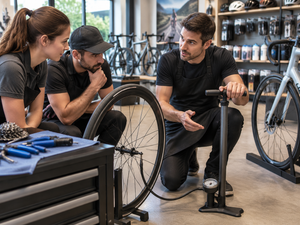
Industrial and shop tire inflators are both designed for professional use, but they are not the same category.
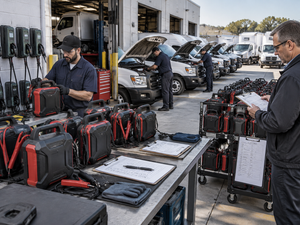
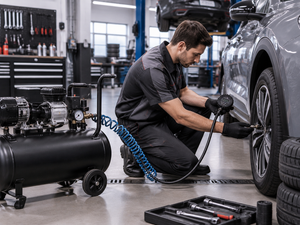
A shop tire inflator may be used in an automotive repair shop, tire store, dealership, or small fleet service area. An industrial tire inflator may operate in a factory, large fleet depot, truck service center, mining site, construction yard, or other demanding environment.
Both may be described as heavy duty, but the real differences are found in workload, airflow demand, installation, power source, structural durability, control systems, and maintenance expectations.
For B2B buyers, understanding these differences helps prevent two common mistakes: choosing an oversized industrial system for a basic workshop, or expecting a compact shop inflator to handle continuous industrial work.
This article compares industrial and shop tire inflators and explains where each type fits best.

What Is a Shop Tire Inflator?
A shop tire inflator is designed for professional automotive service environments where employees inflate or adjust tires throughout the working day.
Typical applications include:
- independent repair shops
- tire stores
- car dealerships
- motorcycle service centers
- small fleet workshops
- vehicle inspection stations
- mobile repair services
Shop inflators may be portable, wall-mounted, connected to an air compressor, or powered electrically.
The main goals are usually:
- accurate tire pressure adjustment
- easy operation
- moderate repeated use
- compatibility with common vehicle tires
- manageable size and cost
- simple maintenance
A shop unit may be used frequently, but the workload is often intermittent rather than fully continuous.
What Is an Industrial Tire Inflator?
An industrial tire inflator is designed for more demanding operating conditions.
Typical applications may include:
- large fleet maintenance depots
- truck and bus service centers
- logistics yards
- construction equipment maintenance
- agricultural machinery service
- mining and off-road operations
- manufacturing plants
- high-volume tire service facilities
Industrial inflators may need to support larger tire volumes, higher airflow, longer hoses, remote inflation, automatic control, or integration with a compressed-air system.
The operating environment may also be harsher, with:
- dust
- moisture
- oil
- vibration
- temperature variation
- outdoor exposure
- multiple work shifts
Industrial systems are therefore evaluated less as portable accessories and more as part of a larger service or maintenance process.
1. Workload and Duty Cycle
Workload is one of the clearest differences between shop and industrial inflators.
Shop Inflators
A shop inflator may be used many times during the day, but each task is usually relatively short. A technician may check or adjust four passenger-car tires, then move to another job.
The product needs to be reliable, but it may still have periods of rest between uses.
Industrial Inflators
Industrial systems may need to support:
- longer inflation tasks
- larger tires
- multiple vehicles in sequence
- continuous shifts
- high-volume operations
- centralized service stations
This requires a stronger duty cycle and more effective heat management.
For B2B buyers, “heavy duty” should therefore be translated into actual operating conditions:
- How many tires per hour?
- What tire sizes?
- How many operating hours per day?
- Is the system used continuously or intermittently?
- What cooling time is required?
These answers are more useful than a general heavy-duty label.
2. Airflow and Tire Size Coverage
Industrial applications often require higher airflow because the tires are larger.
Passenger-car tires need much less air volume than:
- truck tires
- bus tires
- agricultural tires
- off-road tires
- construction equipment tires
A shop inflator designed for normal passenger vehicles may reach the required pressure, but it may take too long to inflate a much larger tire.
This is why maximum PSI alone is not enough.
B2B buyers should evaluate:
- airflow rate
- tire volume
- hose diameter
- inlet pressure
- inflation time
- compressor capacity
- connector restriction
For industrial systems, the inflator must also match the available compressed-air supply. A high-flow inflator cannot perform properly if the compressor, hose, or fittings restrict airflow.
3. Power and Air Supply
Shop and industrial inflators may use different power arrangements.
Common Shop Configurations
Shop inflators may use:
- rechargeable batteries
- 12V vehicle power
- AC electrical power
- existing workshop air compressors
- portable compressor systems
Portability and convenience are often important.
Common Industrial Configurations
Industrial systems may use:
- centralized compressed air
- high-capacity electric compressors
- fixed installation
- vehicle battery clamps
- industrial AC power
- remote control stations
The system may include regulators, filters, valves, hose reels, or automatic inflation controls.
For B2B buyers, the inflator should be selected as part of the entire supply system. Power availability, compressor output, hose length, pressure loss, and worksite layout all matter.

4. Construction and Environmental Protection
Shop inflators usually operate in controlled indoor environments, although they may still face dust, oil, and accidental impact.
Industrial inflators may need stronger protection against:
- heavy vibration
- water spray
- dust
- chemicals
- outdoor exposure
- impact
- extreme temperatures
This may require:
- reinforced housings
- metal frames
- stronger connectors
- industrial-grade hoses
- protected control panels
- sealed electrical components
- secure mounting systems
For B2B buyers, durability should be evaluated according to the environment. A stronger housing adds cost and weight, but it may be necessary in harsh industrial applications.
5. Accuracy and Control Requirements
Both shop and industrial users need accurate inflation, but the control requirements may differ.
Shop Applications
A shop technician may use:
- a handheld digital inflator
- a trigger-style inflation gun
- a pressure gauge
- a preset digital unit
The operator remains close to the tire and controls the process directly.
Industrial Applications
Industrial systems may require:
- automatic pressure setting
- remote inflation
- multiple tire connections
- large digital displays
- audible alerts
- pressure logging
- operator safety distance
- programmable inflation cycles
For large or high-pressure tires, remote operation can improve safety by allowing the operator to stand away from the tire during inflation.
This is particularly important where tire failure could create a serious hazard.
6. Portability vs Installation
Shop inflators often benefit from portability.
A technician may need to move the unit between service bays, vehicles, or work areas. Compact design, hose management, handles, wheels, or cordless operation can improve efficiency.
Industrial inflators are more likely to be:
- wall-mounted
- bench-mounted
- installed in a service station
- connected to hose reels
- integrated into a centralized system
The right choice depends on workflow.
A portable unit offers flexibility. A fixed system offers consistency, easier hose management, and reliable connection to high-capacity air supply.
7. Maintenance and Serviceability
Maintenance requirements also differ.
Shop Inflator Maintenance
Typical attention points include:
- hose condition
- connector wear
- gauge calibration
- battery condition
- power cable inspection
- cleaning
- pressure sensor checks
Industrial Inflator Maintenance
Industrial systems may also require:
- air filter inspection
- moisture drainage
- regulator servicing
- hose-reel maintenance
- valve replacement
- system leak testing
- compressor maintenance
- control-system inspection
Because industrial downtime can affect a larger operation, spare parts and technical support are more important.
B2B buyers should ask whether the supplier provides:
- replacement hoses
- connectors
- gauges or sensors
- valves
- seals
- control modules
- maintenance instructions
- service documentation
Quick Comparison Table
| Factor | Shop Tire Inflator | Industrial Tire Inflator |
|---|---|---|
| Typical environment | Repair shop or tire store | Fleet depot, factory, truck or equipment service |
| Workload | Frequent but intermittent | High-volume or continuous |
| Tire coverage | Passenger cars, motorcycles, light vehicles | Trucks, buses, agricultural and off-road equipment |
| Airflow demand | Moderate | High |
| Installation | Portable, wall-mounted, or compressor-connected | Often fixed or integrated |
| Controls | Manual or preset digital control | Automatic, remote, or programmable |
| Environmental protection | Standard shop protection | Stronger industrial protection |
| Maintenance | Basic inspection and calibration | System-level maintenance and spare parts |
| Main priority | Convenience and service efficiency | Productivity, durability, and operational safety |
Which Inflator Fits Which Application?
A shop tire inflator is usually suitable when:
- most vehicles are passenger cars or light commercial vehicles
- inflation tasks are short
- portability is useful
- the environment is controlled
- the budget is moderate
- simple operation is preferred
An industrial inflator is more appropriate when:
- the operation handles large tires
- inflation volume is high
- the equipment runs across long shifts
- remote inflation is required
- the worksite is harsh
- downtime has a high cost
- spare-parts support is essential
Some operations may need both.
For example, a fleet depot may use a fixed industrial inflation station for trucks while also keeping portable shop inflators for quick pressure checks on service vehicles.

What B2B Buyers Should Verify
Before selecting a system, buyers should confirm:
- Maximum tire size and application
- Required airflow
- Available air or power supply
- Expected number of inflation tasks per day
- Continuous operating requirements
- Hose length and pressure loss
- Indoor or outdoor environment
- Need for remote operation
- Accuracy and calibration requirements
- Spare-parts and maintenance support
- Installation requirements
- Warranty coverage under commercial or industrial use
These questions help prevent under-specification and unnecessary overspending.
Common Selection Mistakes
One common mistake is choosing by maximum PSI alone. A shop inflator may reach high pressure but still lack the airflow or duty cycle required for industrial tires.
Another mistake is assuming every industrial customer needs the largest system. If the operation mainly services passenger cars, a well-designed shop inflator may be more efficient and economical.
Buyers should also avoid ignoring the existing air supply. The inflator, compressor, hose, and fittings must work as one system.
Finally, terms such as industrial, professional, and heavy duty should always be supported by specific technical and service information.
 commercial vs consumer tire inflators
Conclusion
Industrial and shop tire inflators serve different operating environments.
Shop inflators focus on convenience, accuracy, portability, and repeated but intermittent automotive service. Industrial inflators focus on higher airflow, longer duty cycles, larger tires, stronger construction, system integration, and serviceability.
For B2B buyers, the right decision depends on workload, tire size, environment, power supply, safety requirements, and maintenance capability.
An industrial inflator is not simply a more expensive shop inflator. It is part of a larger operational system.
Likewise, a shop inflator can provide better value when flexibility and everyday service efficiency matter more than industrial-scale output.
The best solution is the one that matches the real application rather than the strongest marketing label.