When sourcing tire inflators, many buyers start by comparing unit prices. This is understandable, but the lowest quotation is not always the lowest total cost.
For B2B buyers, the real sourcing cost may include samples, testing, packaging, manuals, accessories, quality inspection, warranty support, spare parts, logistics, and repeat-order management.
This checklist explains the hidden costs buyers should review before accepting a tire inflator quotation.

Why the Lowest Quotation May Not Be the Lowest Total Cost
A tire inflator quotation can look simple: model, quantity, unit price, packaging, lead time, and payment terms. But many project costs are not always visible in the first quotation.
A low unit price may exclude important items such as a storage bag, nozzles, printed manual, color box, barcode label, inspection process, replacement parts, or custom packaging files. In some cases, the product may meet the basic price target but create problems later in customer use, retail display, online listing, or after-sales handling.
For B2B buyers, the total cost should include everything required to launch, sell, deliver, and support the product.
This is especially important for tire inflators because they are functional automotive products. Customers care about pressure accuracy, inflation speed, power type, hose quality, accessory completeness, and safe operation. If one of these areas is weak, the buyer may pay more later through returns, complaints, replacement shipments, or damaged channel reputation.
The key purchasing question is not “Which supplier has the lowest price?” It is “Which quotation gives the best controlled cost for the full project?”

Sample, Testing, and Development Costs
Samples are usually the first hidden cost in a tire inflator project.
A buyer may need to test several models before choosing one: cordless tire inflators, 12V inflators, rechargeable models, heavy-duty inflators, or compact emergency inflators. Each sample may include product cost, express shipping, customs clearance, internal testing time, and feedback rounds.
Testing should not be skipped. A tire inflator should be checked for real inflation performance, gauge accuracy, auto shut-off function, hose temperature, cable length, noise, accessory fit, and packaging protection.
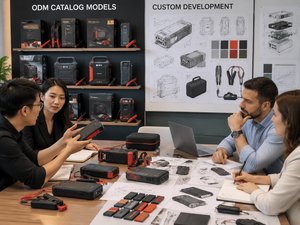
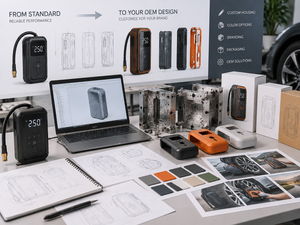
For OEM or private label projects, development costs may also appear. These may include color matching, logo placement, packaging design, manual translation, mold adjustment, accessory changes, or custom carton labels.
For B2B buyers, sample cost is not just a small pre-order expense. It is part of risk control. A properly tested sample can prevent a larger loss after mass production.
Before ordering, buyers should ask whether sample fees can be deducted from bulk orders, whether testing reports are available, and how sample revisions are handled.
Packaging, Manuals, Labels, and Private Label Costs
Packaging is one of the most common areas where hidden costs appear.
A standard neutral box may be included in the base quotation, but retail-ready color packaging, private label design, barcode placement, insert cards, multilingual manuals, and carton marks may cost extra.
For marketplace sellers, packaging must protect the product during shipping and help customers understand the accessories after unboxing. For retail channels, packaging must explain product features clearly on the shelf.
Important packaging-related cost items may include:
- color box design
- printing setup
- private label packaging MOQ
- barcode or sticker placement
- inner tray or protective insert
- multilingual manual
- warning labels
- carton mark
- product photography for packaging
- packaging sample approval
For tire inflators, packaging should clearly show power type, pressure range, auto shut-off, included nozzles, suitable use cases, and storage method.
For B2B buyers, packaging should be confirmed early. If packaging is added late, it can delay production and increase cost.
Accessory Configuration and Spare Parts Costs
Tire inflator prices can vary significantly based on accessories.
Two suppliers may quote the same model, but one includes only the main unit and basic nozzles, while another includes a storage bag, longer hose, better chuck, extra adapters, fuse, manual, and retail packaging.
Buyers should check the accessory list carefully.
Common accessory cost factors include:
- air hose length and material
- tire chuck type
- nozzle set
- power cable length
- charging cable for rechargeable models
- storage bag or hard case
- replacement fuse
- adapter set
- instruction card
- retail insert
Spare parts should also be considered, especially for distributors, fleet channels, and commercial users. Hose, chuck, cable, gasket, nozzle, and storage bag availability can reduce after-sales pressure.
For B2B buyers, a lower price without proper accessories may not be cheaper. If customers later need replacement parts or complain about missing items, the real cost increases.
A good quotation should clearly list what is included in the box.
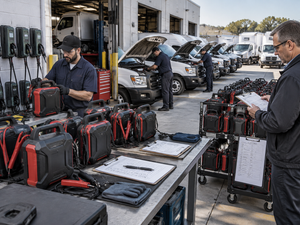
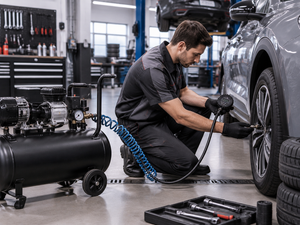
 industrial tire inflator maintenance
Warranty, After-Sales, and Quality-Control Costs
Warranty cost is often ignored during sourcing.
A tire inflator may pass a basic visual inspection but still create after-sales issues if the motor, hose, gauge, battery, switch, or power cable is not stable enough for the target use case.
Buyers should evaluate how the supplier controls quality before shipment.
Important quality-control checks may include:
- incoming material inspection
- motor performance testing
- pressure accuracy check
- auto shut-off testing
- hose leakage testing
- cable and plug inspection
- battery charging test for cordless models
- packaging drop or protection check
- final function test
- carton inspection
After-sales cost also includes communication time, replacement parts, refund handling, customer complaints, and lost repeat business.
For B2B buyers, warranty terms should be clear before the order. Buyers should understand what is covered, what is excluded, how problems are reported, and whether replacement accessories can be supplied.
A supplier with stronger QC may quote slightly higher, but the total project risk may be lower.
Logistics, Delivery, and Repeat Order Planning
Logistics can also create hidden costs.
Tire inflators may vary in size, weight, packaging volume, battery type, and carton quantity. A small change in packaging size or accessory configuration can affect shipping cost. For rechargeable models with batteries, buyers may also need to confirm transport requirements with the logistics provider.
Delivery planning matters for seasonal products. Tire inflators may sell better before winter, road trip seasons, or promotional periods. A late delivery can affect channel performance even if the unit price is attractive.
Buyers should confirm:
- carton size and weight
- units per carton
- packaging volume
- battery transport requirements if applicable
- production lead time
- inspection schedule
- delivery method
- spare parts availability
- repeat order lead time
- supplier production capacity
For distributors and retailers, repeat order planning can be more important than the first shipment. A supplier should be able to support stable quality and predictable delivery after the first order.
Quick Hidden Cost Checklist
| Cost Area | What Buyers Should Check | Why It Matters |
|---|---|---|
| Samples | Product cost, express freight, sample revisions | Reduces mass production risk |
| Testing | Inflation speed, pressure accuracy, heat, battery, auto shut-off | Confirms real product performance |
| Packaging | Color box, manual, labels, carton marks | Supports marketplace and retail launch |
| Accessories | Hose, chuck, nozzles, storage bag, cables | Affects user experience and perceived value |
| QC | Function test, leakage test, battery test, final inspection | Reduces returns and complaints |
| Warranty | Terms, replacement process, spare parts | Controls after-sales cost |
| Logistics | Carton size, weight, battery transport, lead time | Affects landed cost and delivery planning |

Conclusion
Hidden costs in tire inflator sourcing can affect the real profitability of a project. A low unit price may become expensive if it excludes samples, testing, packaging, manuals, accessories, QC, warranty support, spare parts, or logistics planning.
For B2B buyers, a strong quotation should clearly show what is included and what is not included. Buyers should review the full project cost before confirming a supplier.
The best tire inflator sourcing decision is not always the cheapest first quote. It is the product and supplier combination that supports stable quality, clear packaging, reliable delivery, and manageable after-sales cost.
YANTU supports portable tire inflator projects for marketplace sellers, retailers, distributors, automotive brands, and OEM customers. If you are reviewing tire inflator quotations, our team can help discuss product configuration, packaging, sample testing, QC requirements, and bulk order planning.