Roadside assistance fleets need tools that are portable, reliable, and ready for unpredictable service calls. A tire inflator used by a fleet technician is different from a consumer product stored in a private car.
For roadside support, service vehicles, and mobile maintenance teams, cordless tire inflators can offer useful mobility. They allow technicians to work without relying on a vehicle power socket during every inflation task.
This article explains how B2B buyers should evaluate cordless tire inflators for roadside assistance fleets.

Why Roadside Assistance Fleets Need Portable Inflation Tools
Roadside assistance work is practical and time-sensitive. Technicians may need to help drivers in parking lots, highways, residential areas, service stations, or remote locations. In these situations, tool portability can affect service speed.
A traditional 12V tire inflator can be useful, but it usually needs a connection to a vehicle power outlet. This may be inconvenient if the vehicle position is difficult, the cable is too short, or the technician needs to move around quickly.
A cordless tire inflator can reduce some of these limitations. It can be carried directly to the tire, used around different sides of the vehicle, and stored as part of a mobile service kit.
For B2B buyers, the key purchasing meaning is not simply “cordless is better.” The question is whether the cordless design improves fleet workflow without sacrificing performance, durability, or readiness.
Battery Capacity and Service Readiness
Battery capacity is one of the first specifications buyers check in a cordless tire inflator. For roadside assistance fleets, battery performance is especially important because technicians may handle several service calls before returning to base.
However, battery capacity should not be judged only by the mAh number. Real performance depends on tire size, pressure level, inflation time, motor efficiency, temperature, and battery condition.
Fleet buyers should check:
- how many typical top-up tasks one charge can support
- how long the product takes to recharge
- whether battery indicators are clear
- whether the unit can be charged inside a service vehicle
- whether spare units or rotation plans are needed
- how performance changes in cold or hot conditions
For fleet use, readiness matters as much as capacity. A cordless inflator that performs well but is often uncharged may create operational problems.
This means charging management should be part of the purchasing decision. Buyers should think about how each service vehicle will store, charge, and check the inflator before daily use.
Inflation Performance for Real Roadside Scenarios
Roadside tire inflation is often not the same as casual home use.
A technician may need to top up a low tire, help a customer reach a safe driving pressure, or support a temporary repair before the vehicle moves to a service location. The product must perform reliably under real tire conditions.
Buyers should evaluate:
- inflation speed for standard passenger car tires
- performance with SUVs or light trucks if required
- pressure range
- auto shut-off accuracy
- heat buildup during use
- hose length and connection stability
- ability to handle repeated tasks
A cordless tire inflator may be compact, but it still needs enough performance for the target fleet. If the fleet supports larger vehicles, buyers should test the product with realistic tire sizes before placing bulk orders.
For B2B buyers, product claims should be connected to service scenarios. A consumer-level cordless inflator may be suitable for light emergency use, but roadside assistance fleets may need stronger specifications and better durability.
Durability and Daily Tool Handling
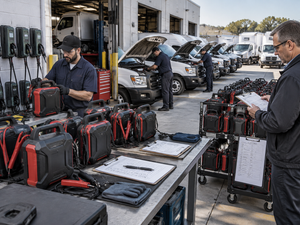
Fleet tools are handled differently from consumer products. They may be stored in vans, moved between technicians, used outdoors, placed on rough surfaces, or packed together with other roadside equipment.
This makes durability important.
Buyers should check the product’s housing, buttons, display, hose, chuck, battery cover, charging port, and storage case. Small weak points can become repeated after-sales problems when the product is used across a fleet.
Important durability points include:
- impact-resistant housing
- protected display
- durable air hose
- secure chuck connection
- reliable buttons
- heat control
- dust and storage protection
- strong carry case or storage bag
For roadside assistance fleets, durability affects both tool cost and service reliability. A product that breaks easily can interrupt service and create replacement costs.
For distributors and fleet suppliers, durability also affects long-term customer trust and repeat orders.
Charging, Storage, and Fleet Management
A cordless tire inflator is only useful if it is charged and easy to manage.
Fleet managers should plan how the products will be stored and maintained across service vehicles. This includes charging routines, inspection schedules, accessory checks, and replacement planning.
Useful fleet management questions include:
- Where will the inflator be stored in the service vehicle?
- Can it be charged during driving or between calls?
- Is the battery level easy to check?
- Are accessories stored together with the product?
- Can technicians quickly confirm the unit is ready?
- Is there a backup unit if one product is charging?
- How often should units be inspected?
- Can the supplier provide manuals for fleet use?
For B2B buyers, these questions matter because cordless products require readiness discipline. A strong product with poor fleet management may still fail to deliver good service performance.
Packaging and manuals should also explain charging and storage clearly. Fleet users do not need decorative packaging as much as clear operating guidance and reliable accessory organization.

Accessories That Matter for Roadside Use
Accessories can strongly affect roadside service experience.
A cordless tire inflator for fleet use should include accessories that are practical, organized, and easy to identify. Loose or unclear accessories can slow down service calls.
Buyers should check:
- air hose quality
- tire chuck design
- additional nozzles
- charging cable
- vehicle charging option if available
- storage bag or hard case
- user manual
- spare accessory availability
For roadside assistance, the tire chuck and hose are especially important. A poor connection can waste time and frustrate both technician and customer.
Accessory storage is also important. If nozzles, cables, or adapters are easy to lose, the product becomes less reliable in fleet use.
For B2B buyers, the accessory set should be evaluated as part of the full product, not as a small add-on.
Quick Fleet Evaluation Checklist
| Evaluation Area | What Buyers Should Check | Why It Matters |
|---|---|---|
| Battery Readiness | Capacity, charging time, battery indicator | Supports daily service calls |
| Inflation Performance | Tire size, pressure range, speed | Matches real roadside needs |
| Durability | Housing, hose, chuck, display, buttons | Reduces fleet replacement cost |
| Heat Control | Repeated use and cooling behavior | Supports multiple tasks |
| Storage Design | Case, accessory organization, vehicle storage | Keeps tools ready |
| Supplier Support | Manuals, samples, packaging, spare parts | Supports fleet deployment |
Conclusion
 portable tire inflator product options
Cordless tire inflators can be useful tools for roadside assistance fleets, especially when mobility, quick access, and flexible service work are important.
For B2B buyers, the decision should not be based only on cordless convenience. Buyers should also evaluate battery readiness, real inflation performance, durability, heat control, accessory storage, charging management, and supplier support.
A good cordless tire inflator for fleet use should help technicians work more efficiently while reducing service interruptions and after-sales issues.
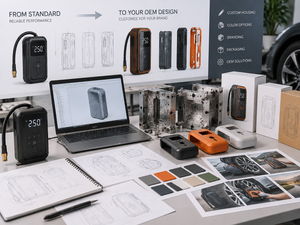
YANTU supports portable tire inflator projects for roadside assistance fleets, automotive distributors, retailers, service channels, and OEM customers. If you are evaluating cordless tire inflators for fleet or roadside service use, our team can help discuss specifications, sample testing, packaging, and bulk order requirements.