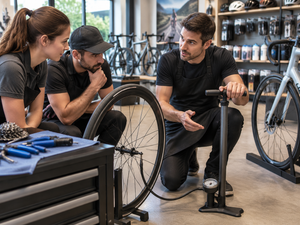
Floor pumps are used much more frequently in bike shops than in home garages. A pump that works well for occasional personal use may fail faster when it is used every day by shop staff and customers.
For bike shops, retailers, and distributors, common floor pump problems are not only maintenance issues. They affect service speed, customer experience, tool replacement cost, and product reputation.
This article explains common floor pump issues in bike shops and what B2B buyers should check before choosing professional floor pumps.

Why Floor Pumps Fail Faster in Bike Shops
Bike shop floor pumps face a tougher working environment than consumer pumps.
In a shop, a pump may be used many times a day for repairs, new bike setup, tire pressure checks, customer service, and product demonstrations. Different staff members may use the same pump, and customers may also handle it during purchase decisions.
This repeated use puts pressure on the pump head, hose, handle, base, and gauge. If the pump is designed mainly for home use, it may wear out quickly in a professional setting.
For B2B buyers, the purchasing meaning is clear. A bike shop floor pump should not be judged only by maximum pressure or appearance. Durability, stability, valve compatibility, and serviceability are just as important.
A professional floor pump should be selected as a shop tool, not only as a consumer accessory.
Air Leakage Around the Pump Head or Hose
Air leakage is one of the most common floor pump problems.
It may happen around the pump head, hose connection, valve adapter, or internal sealing parts. In bike shops, this problem can be especially frustrating because staff need fast and reliable inflation during service.
Common causes include:
- worn sealing rings
- loose hose connection
- poor pump head fit
- damaged valve adapter
- weak internal air sealing
- frequent pulling or twisting of the hose
For customers, air leakage may feel like product failure. For shop staff, it slows down daily work and creates repeated interruptions.
B2B buyers should check whether the pump head is suitable for frequent use and whether the hose connection feels secure. If replacement parts are available, that can also improve long-term value for shop channels.
For professional shop pumps, sealing quality is not a minor detail. It directly affects service efficiency and customer confidence.

Gauge Inaccuracy After Repeated Use
A floor pump gauge may become less reliable after repeated use, impact, vibration, or rough handling.
In a bike shop, gauge accuracy matters because staff often inflate tires for different bike types: road bikes, gravel bikes, mountain bikes, city bikes, and e-bikes. Customers may also rely on the shop’s pressure reading when buying a pump or checking tire setup.
If the gauge becomes inaccurate, several problems may appear:
- road bike tires may be underinflated or overinflated
- customers may question the shop’s service quality
- staff may need another tool to confirm pressure
- product trust may decline
- after-sales complaints may increase
For B2B buyers, gauge quality should be checked carefully. A large, readable gauge is useful, but readability is not enough. The gauge should remain stable during repeated shop use.
Buyers should ask suppliers about gauge accuracy tolerance, protection design, and whether the gauge position reduces impact risk.
 high-pressure pump for road bike shops
Unstable Base and Handle Wear
A floor pump base and handle may seem simple, but they affect daily usability.
In a busy shop, the pump needs to stand firmly on the floor while staff pump quickly. If the base is too narrow, too light, or slippery, the pump may move during use. This can make inflation slower and less comfortable.
Handle wear is another common issue. A weak or uncomfortable handle may become loose, cracked, or difficult to use after repeated operation.
For professional floor pumps, buyers should check:
- base width and stability
- anti-slip design
- handle material
- handle comfort
- body structure
- connection between pump shaft and handle
- resistance during high-pressure inflation
For bike shop use, stability is a purchasing factor. A stable floor pump helps staff work faster and reduces frustration during repeated service tasks.
This is especially important for shops serving road cyclists, where higher pressure requires more controlled pumping.
Poor Valve Compatibility and Customer Complaints
Valve compatibility can create many floor pump problems in bike shops.
Shops usually serve customers with different bikes. Road bikes often use Presta valves, while mountain bikes, city bikes, and kids’ bikes may use Schrader valves. Some customers may not know which valve their bike uses.
If the floor pump does not support both valve types clearly, shop staff may need extra adapters or repeated explanations. Customers may also think the pump is broken when the real problem is incorrect valve connection.
For B2B buyers, valve compatibility should be easy to understand and easy to operate.
A good shop floor pump should offer:
- reliable Presta compatibility
- reliable Schrader compatibility
- simple pump head operation
- secure valve connection
- clear adapter storage if needed
- packaging or manual explanation
This reduces customer confusion and makes the pump more suitable for retail sale as well as shop service.
How Buyers Can Choose More Durable Shop Pumps
Before ordering floor pumps for bike shops, buyers should evaluate the product under real shop conditions.
Important questions include:
- Is the pump designed for frequent daily use?
- Does the pump head seal well with Presta and Schrader valves?
- Is the hose durable and flexible?
- Is the pressure gauge readable and protected?
- Does the base stay stable during high-pressure inflation?
- Is the handle comfortable for repeated use?
- Are replacement parts available?
- Can the supplier support packaging, manuals, or private label needs?
Sample testing is important. Buyers should test the pump with real road bike, mountain bike, and city bike valves. They should also check how the pump feels after repeated operation.
For distributors and retailers, a durable shop pump can reduce complaints and support repeat orders. For bike shops, it helps improve daily workflow and customer service.
Quick Problem-Solving Table
| Common Problem | Possible Cause | What Buyers Should Check |
|---|---|---|
| Air leakage | Worn seal, loose hose, poor pump head fit | Pump head quality and hose connection |
| Gauge inaccuracy | Impact, vibration, low-quality gauge | Gauge tolerance and protection design |
| Unstable use | Narrow or light base | Base size, material, and anti-slip design |
| Handle wear | Weak material or poor structure | Handle strength and comfort |
| Valve mismatch | Unclear Presta / Schrader support | Dual-valve compatibility and instructions |
| Short service life | Consumer-level design | Shop-use durability and sample testing |
Conclusion
Common floor pump problems in bike shops usually come from frequent use, unclear valve compatibility, weak sealing, poor gauge stability, unstable base design, or low durability.
For B2B buyers, the best solution is to choose floor pumps based on real shop use instead of only price or maximum pressure. A professional floor pump should support daily service, clear pressure reading, stable operation, and reliable Presta and Schrader compatibility.
Before placing bulk orders, buyers should test samples in real bike shop scenarios and confirm whether the supplier can support product specifications, packaging, manuals, and private label requirements.
YANTU supports bike pump projects for bike shops, retailers, distributors, and OEM customers. If you are selecting professional floor pumps for shop use, our team can help discuss product options, sample testing, packaging, and bulk order requirements.