Commercial and consumer tire inflators may look similar from the outside, but they are often designed for very different workloads.
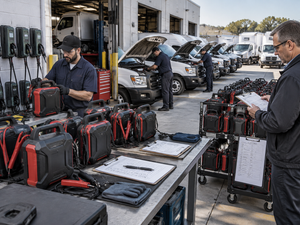
A consumer tire inflator is usually intended for occasional pressure top-ups, roadside emergencies, or household use. A commercial tire inflator may be used repeatedly in repair shops, fleet yards, tire service points, or professional tool environments.
For B2B buyers, choosing between the two is not only about price or maximum PSI. The important differences are usually found in duty cycle, airflow, heat control, structural durability, power system, and after-sales support.
A consumer model placed in a high-frequency commercial environment may overheat, wear prematurely, or create customer complaints. At the same time, a commercial model may be unnecessarily large or expensive for ordinary retail customers.
This article explains five key technical differences between commercial and consumer tire inflators and how buyers can match each type with the right channel.

1. Duty Cycle and Continuous Working Time
The first major difference is duty cycle.
Duty cycle describes how long an inflator can operate before it needs to stop and cool down. It is especially important because compressing air generates heat in the motor, piston, cylinder, wiring, and housing.
Consumer Tire Inflators
Consumer models are usually designed for short, occasional tasks such as:
- topping up one or more passenger-car tires
- correcting a low-pressure warning
- inflating bicycle or motorcycle tires
- emergency roadside use
A compact consumer inflator may work well for these situations but require a cooling period after extended operation.
This is not necessarily a product weakness. It reflects the intended use. Compact size and lower price often require a more limited continuous working time.
Commercial Tire Inflators
Commercial models are expected to handle:
- more inflation tasks per day
- repeated pressure cycling
- multiple operators
- different tire sizes
- shorter intervals between uses
As a result, they usually need stronger heat management, a more durable motor system, and a longer duty cycle.
For B2B buyers, duty cycle should be discussed in actual minutes and operating conditions rather than described only as “heavy duty.”

2. Airflow and Inflation Performance
Maximum PSI is often highlighted in product listings, but airflow is usually more important when comparing commercial and consumer performance.
PSI tells buyers the pressure a pump can theoretically reach. Airflow indicates how quickly it can move air.
Consumer Models
Consumer tire inflators are often optimized for:
- passenger cars
- compact size
- emergency top-ups
- moderate airflow
- easy storage
A small inflator may reach a high PSI, but it may take longer to inflate a large-volume tire.
For typical household use, this may be acceptable. Most consumers are not inflating multiple tires from flat every day.
Commercial Models
Commercial inflators generally need stronger airflow because time matters in professional environments.
A repair shop or fleet maintenance team may need to service several vehicles without long waiting periods. Higher airflow helps reduce inflation time and improve workflow.
However, buyers should not compare airflow claims without test conditions. Inflation time depends on:
- tire size
- starting pressure
- target pressure
- hose length
- connector sealing
- voltage stability
- ambient temperature
A useful commercial specification should connect airflow and inflation time with a clearly defined tire test.
3. Motor, Cylinder, and Housing Construction
Commercial and consumer inflators may also differ in internal construction.
Consumer Construction
Consumer models are commonly designed around:
- compact plastic housing
- lightweight motors
- smaller cylinders
- integrated digital controls
- portable battery systems
- lower retail price
These features make the product easy to carry and attractive for online or retail sales.
The design may still be reliable, but it is generally optimized for intermittent rather than repeated professional use.
Commercial Construction
Commercial inflators may use:
- larger or dual cylinders
- stronger motor components
- more metal structural parts
- reinforced hoses and connectors
- improved ventilation
- heavier housings or frames
- vibration-resistant mounting
These features can improve durability and repeated-use performance, although they also increase size, weight, and cost.
For B2B buyers, “commercial” should not be accepted as a marketing label alone. The supplier should be able to explain which structural features support commercial use.
4. Power System and Operational Flexibility
Power design is another important difference.
Consumer Power Options
Consumer inflators commonly use:
- 12V vehicle power
- built-in rechargeable batteries
- dual-power battery plus 12V systems
Cordless models are popular because they are convenient and easy to use. They work well for roadside emergencies, household use, and online retail channels.
However, battery runtime and charging habits may limit repeated commercial use.
 different tire inflator power types
Commercial Power Options
Commercial inflators may use:
- higher-capacity DC power systems
- AC workshop power
- larger removable batteries
- vehicle battery clamps
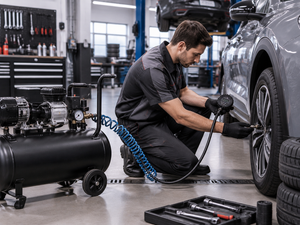
- compressed-air infrastructure in professional shops
The right power system depends on where the product will operate.
For example, a mobile roadside service team may value battery or vehicle-powered flexibility. A fixed workshop may prefer continuous AC power or a larger professional compressor.
B2B buyers should therefore match power design with operational workflow, not simply choose the most convenient-looking option.
5. Serviceability and After-Sales Expectations
Consumer and commercial users also have different after-sales expectations.
Consumer Products
Consumer tire inflators are often sold as complete sealed products. If the battery, control board, or motor fails, the usual solution may be replacement rather than repair.
For retail and e-commerce channels, buyers often prioritize:
- simple warranty handling
- low return rate
- clear user instructions
- easy replacement process
- stable batch quality
Commercial Products
Commercial users may expect:
- replaceable hoses
- available connectors
- serviceable batteries
- spare fuses or cables
- troubleshooting support
- repair guidance
- longer warranty options
Downtime has a direct cost in commercial environments. A shop or fleet may prefer a product that can be serviced rather than fully replaced.
For B2B buyers, spare-parts availability and supplier technical support can be as important as the original unit price.
Quick Comparison Table
| Factor | Consumer Tire Inflator | Commercial Tire Inflator |
|---|---|---|
| Typical use | Occasional top-ups and emergencies | Repeated shop, fleet, or service use |
| Duty cycle | Short or moderate | Longer and more frequent |
| Airflow | Suitable for household use | Higher airflow for faster workflow |
| Construction | Compact and lightweight | Reinforced and more durable |
| Power system | 12V or rechargeable battery | Higher-capacity or continuous power |
| Serviceability | Often replaced as a complete unit | More spare parts and repair support |
| Main selling point | Convenience and portability | Reliability and productivity |
Which Type Fits Which Sales Channel?
Consumer tire inflators are usually a stronger fit for:
- Amazon and Walmart.com sellers
- supermarkets
- automotive accessory retailers
- travel and emergency product programs
- household tool ranges
- promotional and gift channels
Commercial tire inflators are more suitable for:
- repair shops
- tire service centers
- fleet maintenance
- commercial vehicle support
- professional tool distributors
- industrial and workshop channels
Some brands may need both.
A balanced product line can include a compact consumer model for retail and a stronger commercial model for professional channels. The important point is to prevent overlap and make each model’s role clear.

What B2B Buyers Should Verify
Before selecting either type, buyers should verify:
- Recommended continuous working time
- Cooling interval and thermal protection
- Airflow under defined test conditions
- Supported tire size and vehicle category
- Motor and cylinder structure
- Hose and connector durability
- Power input and battery capacity
- Spare-parts availability
- Warranty coverage by use scenario
- Whether commercial use is included or excluded from warranty
The last point is especially important. A product may look suitable for shop use, but the warranty may only cover normal consumer use.
Common Positioning Mistakes
One common mistake is marketing a compact consumer inflator as a commercial product simply because it reaches high PSI.
High PSI does not guarantee a long duty cycle, strong airflow, or repeated-use durability.
Another mistake is offering a heavy commercial inflator to users who mainly need portability. More power and heavier construction may not create value for an ordinary driver.
B2B buyers should also avoid unclear terms such as “professional,” “industrial,” or “heavy duty” unless they are supported by specific performance and structural evidence.
Conclusion
Commercial and consumer tire inflators are designed for different working conditions.
Consumer models focus on portability, simple operation, compact size, and occasional use. Commercial models focus more on duty cycle, airflow, heat management, structural durability, and serviceability.
For B2B buyers, the right decision depends on how often the inflator will be used, which tires it will serve, who will operate it, and how downtime or maintenance will be handled.
A commercial tire inflator is not simply a larger consumer model. It should be designed and supported for repeated professional work.
Likewise, a consumer inflator does not need commercial construction to provide excellent value in the right retail and emergency-use scenarios.
The best product strategy is to match the technical design with the real workload and sales channel.