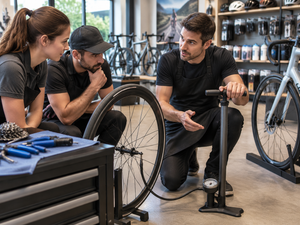
When buyers ask a bike pump manufacturer for an “OEM product,” they may be referring to anything from a printed logo to a completely new product structure.
This creates confusion during sourcing.
Changing the color of an existing pump is very different from designing a new housing, pump head, internal air path, or electronic control system.
For B2B buyers, the useful question is not simply whether a supplier offers OEM or ODM. It is which parts of the bike pump can be customized using an existing platform and which changes require deeper engineering, new tooling, testing, and development.
Understanding the component breakdown helps buyers estimate cost, MOQ, lead time, and project risk more accurately.
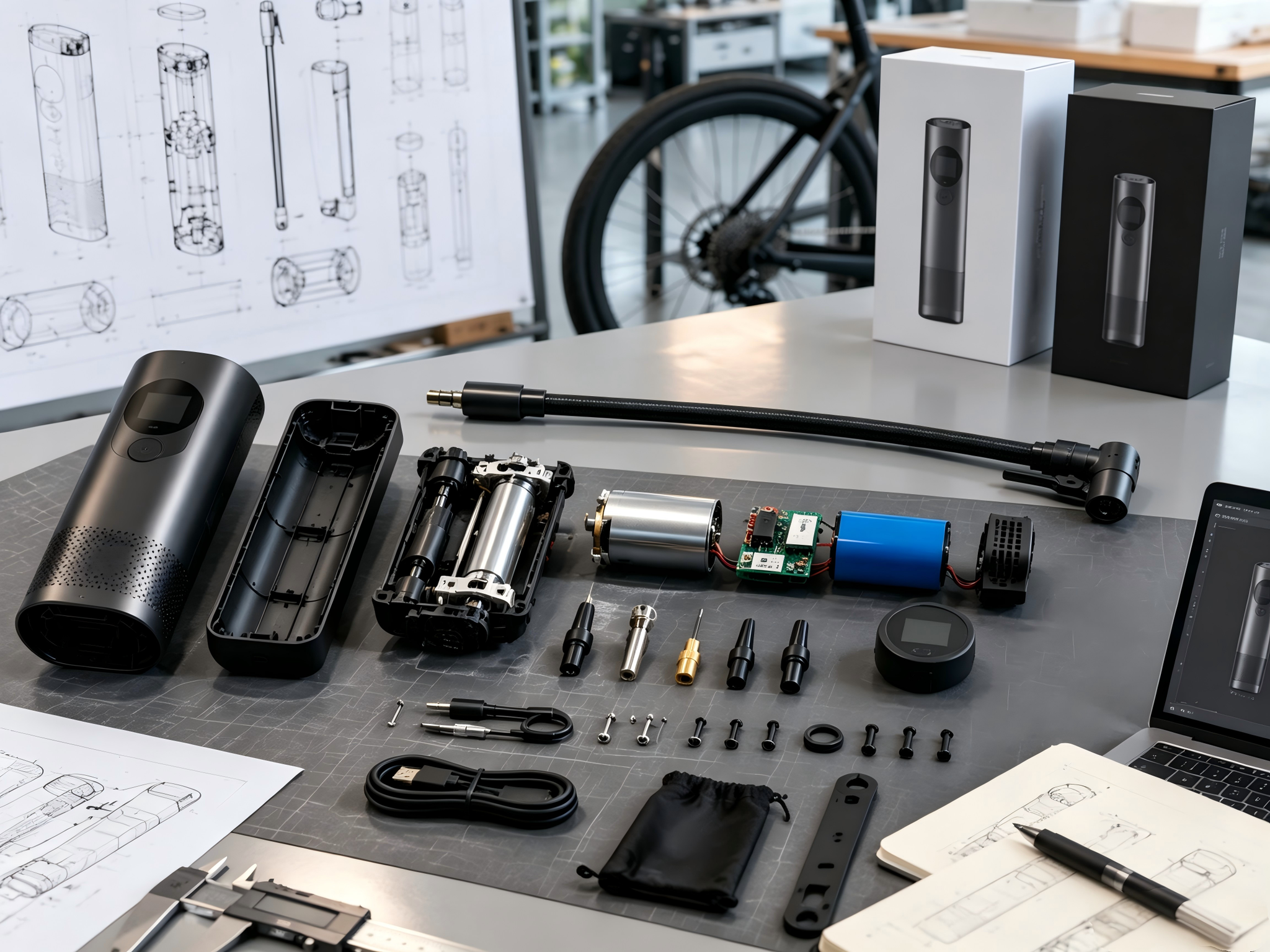
Start with the Existing Product Platform
Most ODM bike pump projects begin with a product that the manufacturer has already developed.
The basic structure, molds, internal components, assembly process, and production method already exist.
Depending on the model, buyers may then customize areas such as:
- logo
- product color
- packaging
- instruction manual
- accessories
- valve adapters
- storage bag
- labels
- selected surface finishes
These changes can create a private label product without redesigning the complete pump.
For many distributors, retailers, and marketplace sellers, this is enough.
The existing platform reduces development work and allows buyers to focus on branding, product configuration, packaging, and channel positioning.
However, once the buyer begins changing structural components, the project may move beyond normal ODM customization.

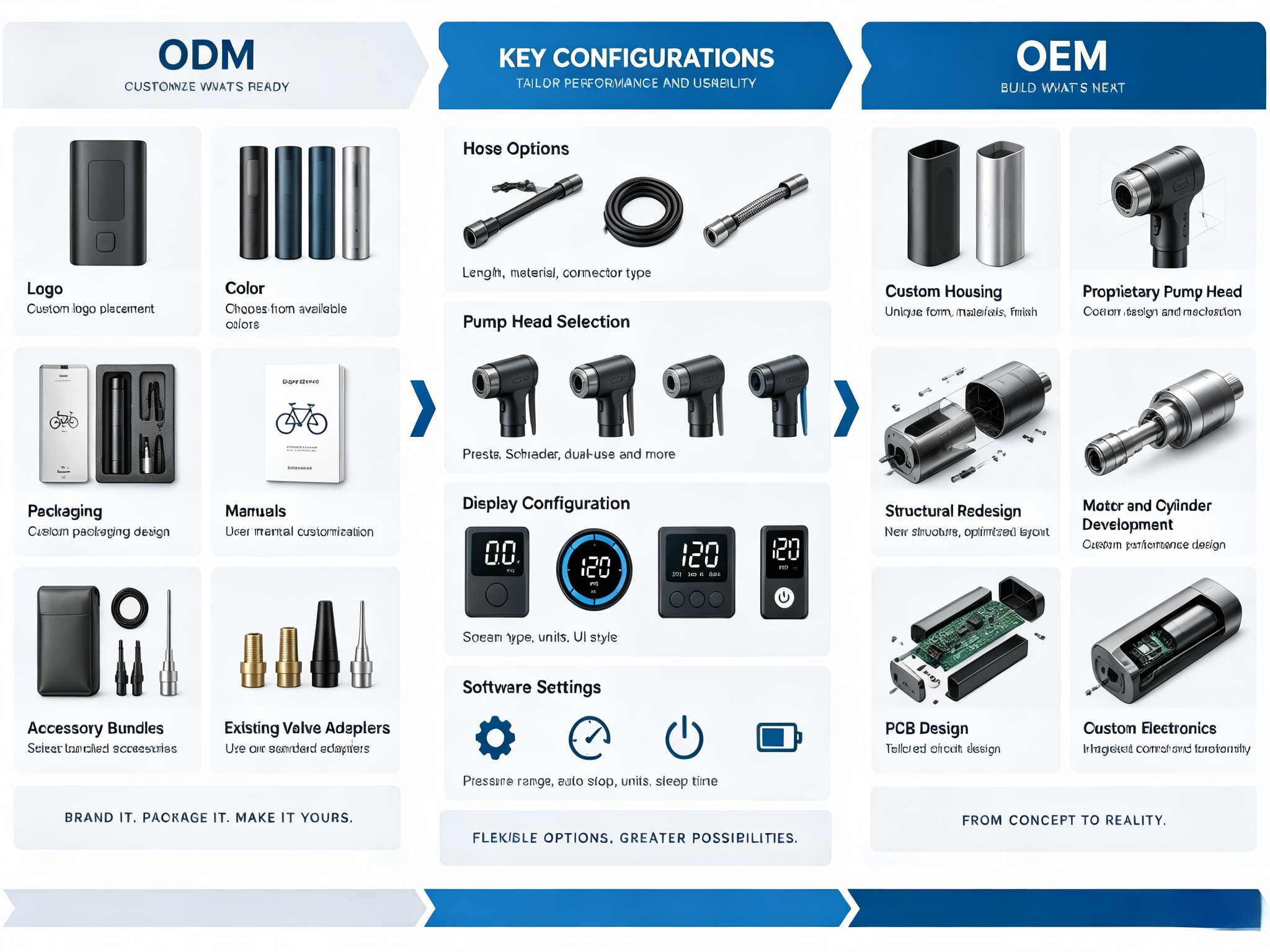
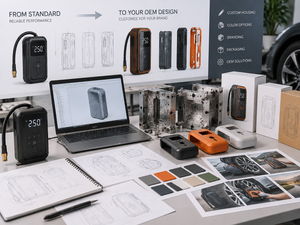
Housing and Exterior Design
The outer housing is one of the clearest examples of the ODM-to-OEM boundary.
Using an existing housing with a different logo or color is normally relatively simple.
Changing the shape of the housing is different.
A new exterior may require:
- industrial design
- 3D drawings
- structural engineering
- new plastic molds
- internal mounting changes
- assembly verification
- prototype testing
Even a small visual change can become a structural project if it affects screw positions, airflow, display placement, battery space, hose storage, or internal components.
For buyers, this means “custom appearance” needs to be defined carefully.
A custom color is not the same as a custom housing.
Before requesting a quotation, buyers should tell the supplier whether they want brand differentiation through surface customization or through a physically exclusive product design.
Pump Head, Hose, and Valve Components
Valve compatibility is a major part of bike pump usability.
Depending on the target market, buyers may need compatibility with Presta, Schrader, or multiple valve types.
For an ODM project, the manufacturer may already have several existing options for:
- pump heads
- threaded connectors
- hoses
- Presta adapters
- Schrader connections
- ball needles
- inflatable nozzles
Selecting from existing accessories is usually easier than developing a completely new valve system.
However, an OEM project may involve a custom pump head, different locking mechanism, new connector geometry, special hose storage, or a proprietary adapter design.
These changes can affect more than appearance.
They may influence:
- sealing performance
- air leakage
- user operation
- pressure loss
- durability
- compatibility
- assembly method
For this reason, custom valve-related components should be tested functionally rather than approved only from drawings.
Gauge, Display, Buttons, and User Interface
Manual and electric bike pumps create different customization possibilities.
A manual floor pump may use an analog or digital pressure gauge. A compact electric pump may include a screen, buttons, pressure presets, charging indicators, and different inflation modes.
For an ODM project, buyers may be able to choose from existing displays, button labels, screen interfaces, or available software settings.
Typical customization can include:
- logo shown on packaging or housing
- button markings
- pressure units
- available inflation modes
- selected preset settings
- screen graphics where supported
Deeper changes may require new PCB design, software development, housing modification, or display tooling.
For example, moving the screen to a different position is not simply a graphic change. It may affect the outer housing and internal component layout.
Buyers should therefore ask whether a requested interface change is:
- an existing selectable option,
- a software-level modification, or
- a hardware-level redesign.
These three levels can have very different MOQ, development cost, and lead time.
Internal Mechanical and Electrical Components
Internal components are where buyers should be especially careful about assuming that everything is easily customizable.
In a manual pump, the internal system may include the barrel, piston, seals, check valves, pressure path, and connecting parts.
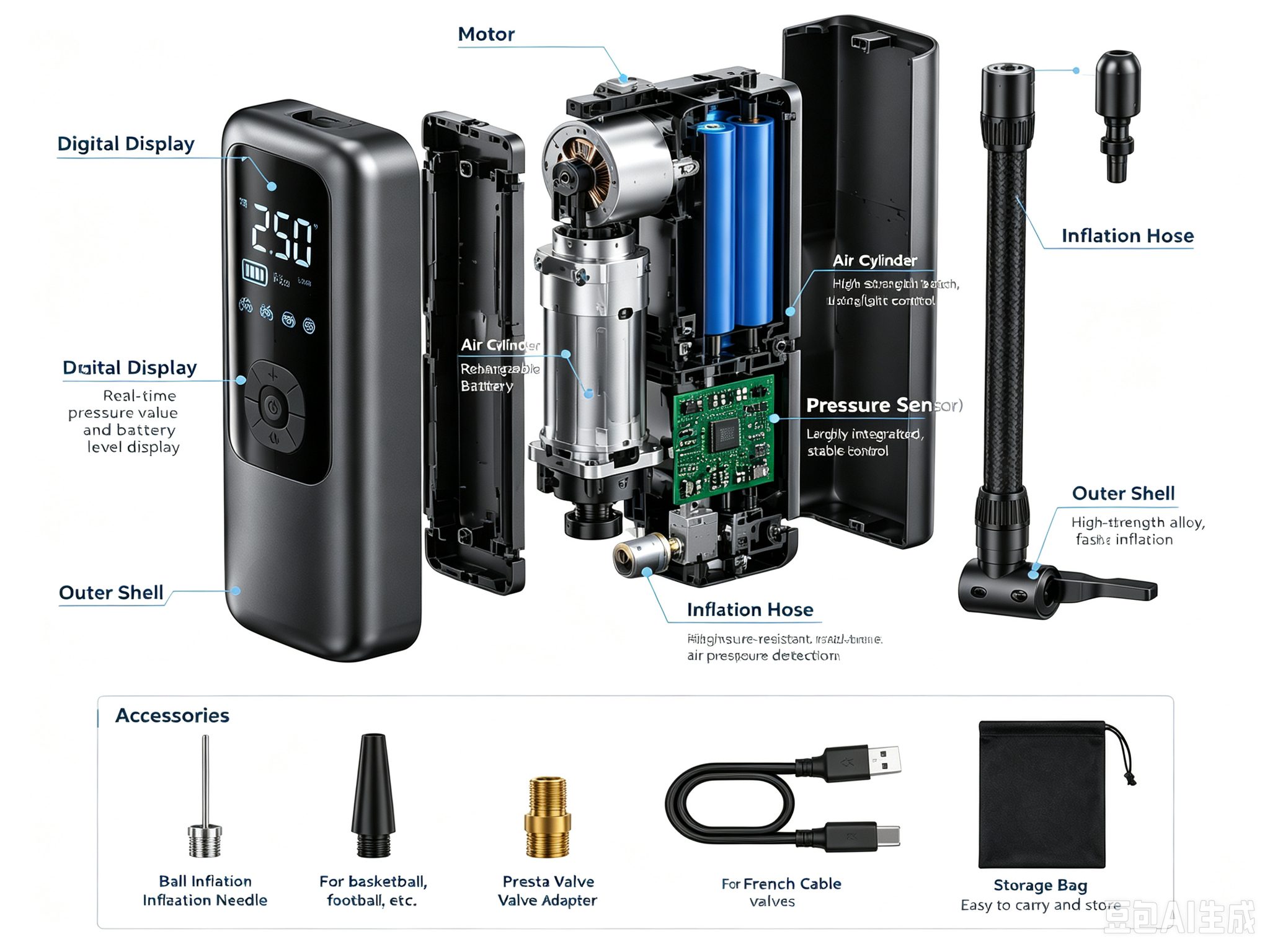
An electric bike pump can add:
- motor
- cylinder
- battery
- PCB
- pressure sensor
- charging circuit
- thermal protection
- internal wiring
Replacing a visible accessory is one thing. Changing the motor, cylinder, battery configuration, or pressure system can alter the overall product performance.
A deeper OEM change may require new validation of:
- inflation speed
- maximum working pressure
- pressure accuracy
- heat generation
- battery runtime
- operating noise
- durability
- safety protection
B2B buyers should therefore avoid treating internal component customization as a simple sourcing substitution.
If the approved platform already performs well for the intended channel, keeping the core internal structure unchanged can sometimes reduce development risk.
Packaging and Accessories Are Usually the Most Flexible
Packaging is often one of the easiest areas for brands to create differentiation without redesigning the product itself.
Depending on order quantity and supplier capability, buyers may customize:
- retail color box
- manual
- barcode labels
- product inserts
- storage bags
- accessory combinations
- carton markings
- brand graphics
Accessory bundles can also help create different SKUs from the same base model.
For example, one retailer may want a basic pump with Presta and Schrader compatibility, while another may add ball needles, inflation nozzles, storage bags, or charging accessories.
For buyers testing a new market, this can be more efficient than investing immediately in new product tooling.
The base product remains proven while the commercial package is adapted to the target customer.
Typical ODM vs OEM Component Breakdown
| Component | Typical ODM Approach | Deeper OEM Development |
|---|---|---|
| Logo | Print or label on existing product | Integrated brand structure or custom molded branding |
| Color | Existing material/color options | Special materials or multi-part custom appearance |
| Packaging | Custom box and manual | Usually no deep engineering needed |
| Accessories | Choose existing accessory combinations | Develop proprietary accessories |
| Pump Head | Select existing head/adapters | New locking or valve mechanism |
| Hose | Existing length/type options | Custom routing, connector, or storage design |
| Housing | Existing mold with branding | New housing and mold |
| Display | Existing screen/interface | New screen position or hardware |
| Software | Existing settings where supported | Deeper function or control development |
| Motor / Cylinder | Existing validated system | New performance platform |
| Battery / PCB | Existing approved configuration | Hardware or electrical redesign |
This table is a useful starting point, but actual boundaries depend on the specific manufacturer and product platform.
What Buyers Should Confirm Before Starting Development
Before deciding whether a bike pump project should use ODM or OEM development, buyers should ask:
- Which components already have existing tooling?
- Which customization options are already available?
- Which changes require new molds?
- Which changes require engineering or PCB development?
- Can software changes be made without hardware changes?
- What MOQ applies to each customization level?
- What prototype process is required?
- Which tests need to be repeated after modification?
- Who owns any newly developed mold or design?
- Can the same custom components be used for repeat orders?
- What is the expected development lead time?
- Which changes may affect product certifications or documentation?
Breaking the project down by component makes the quotation and development process much clearer.
Conclusion
OEM and ODM are not two rigid boxes in bike pump manufacturing.
Many projects sit somewhere between the two.
A buyer may use an existing ODM product platform while customizing packaging, accessories, color, and selected functions. Another brand may keep some proven internal components but invest in a new housing, pump head, or user interface.
The important step is to identify exactly which components need to change.
For B2B buyers, a component-level approach makes it easier to understand tooling cost, MOQ, development time, testing requirements, and product differentiation before committing to a project.
YANTU supports both existing-platform customization and deeper OEM bike pump development for brands, distributors, retailers, and private label customers. If you are planning a bike pump project, our team can help review which components can use existing solutions and which changes may require tooling, engineering, prototype testing, and production validation.