Noise is not usually the first specification buyers check when sourcing a portable tire inflator. Pressure range, inflation speed, battery capacity, and size often receive more attention.
However, once the product reaches customers, noise can quickly become part of the user experience.
A portable tire inflator contains a motor, compressor mechanism, moving components, and airflow. Some operating noise is therefore normal. The purchasing question is not whether the product is completely silent, but whether its noise and vibration feel reasonable for the product type and use scenario.
For B2B buyers, noise should be evaluated together with performance, structure, and customer expectations rather than treated as one isolated number.
Why Noise Matters for Portable Tire Inflator Customers
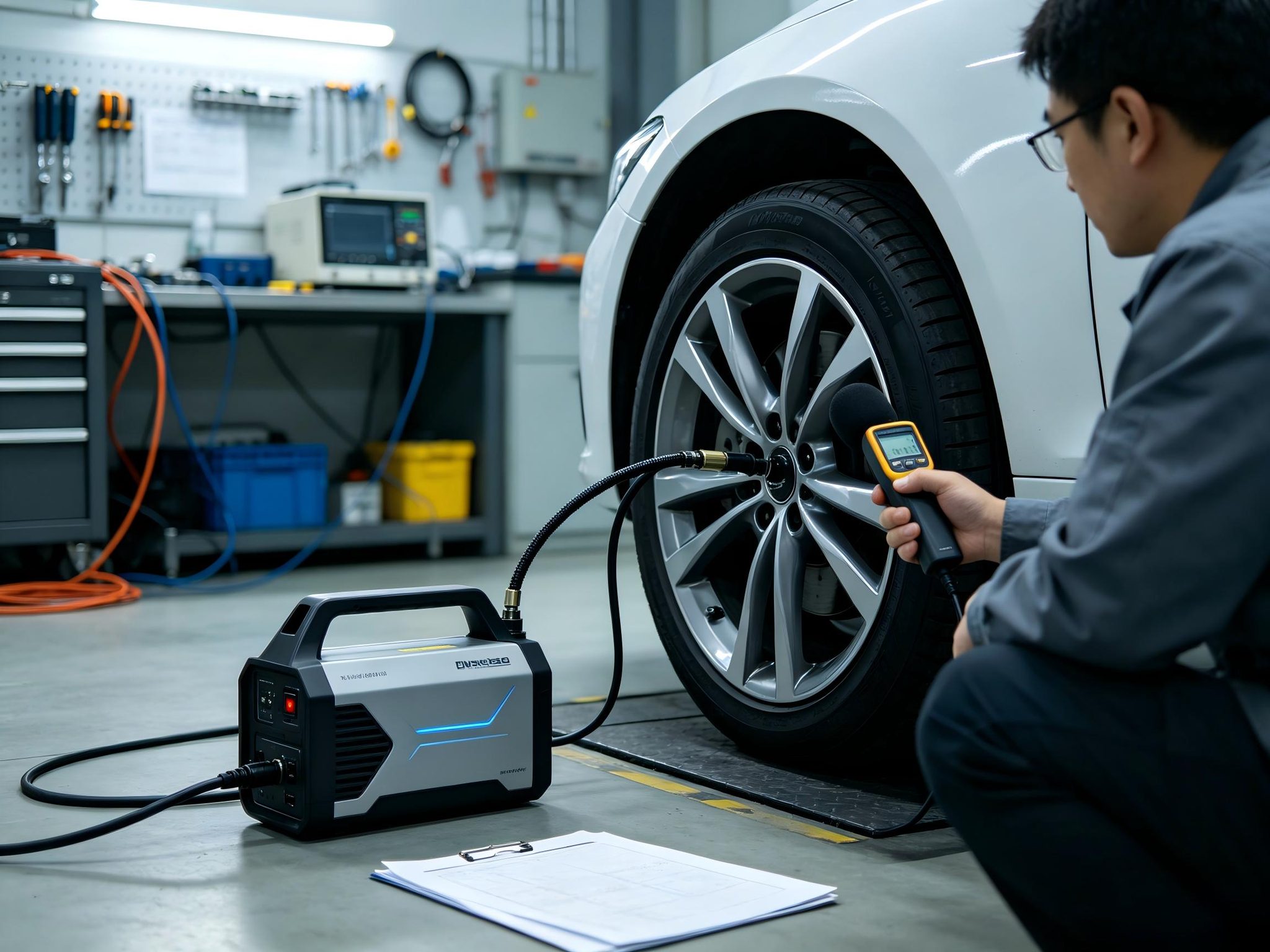
Portable tire inflators are often used close to the user.
A customer may place the inflator beside a car tire while crouching only a short distance away. This makes motor noise and vibration much more noticeable than with equipment operated farther from the user.
Noise perception can also influence how customers judge product quality.
A loud or harsh mechanical sound may make a customer think the product is working too hard, overheating, or poorly assembled, even if inflation performance is technically normal.
For brands and retailers, this means noise can affect:
- product reviews
- perceived quality
- customer comfort
- comparison with competing models
- return reasons
- product positioning
A quieter operating character can support a more refined product experience, especially for compact rechargeable models positioned toward consumer retail channels.
However, buyers should avoid promising “silent operation.” Portable compressors naturally generate sound during inflation.
Where Portable Tire Inflator Noise Comes From
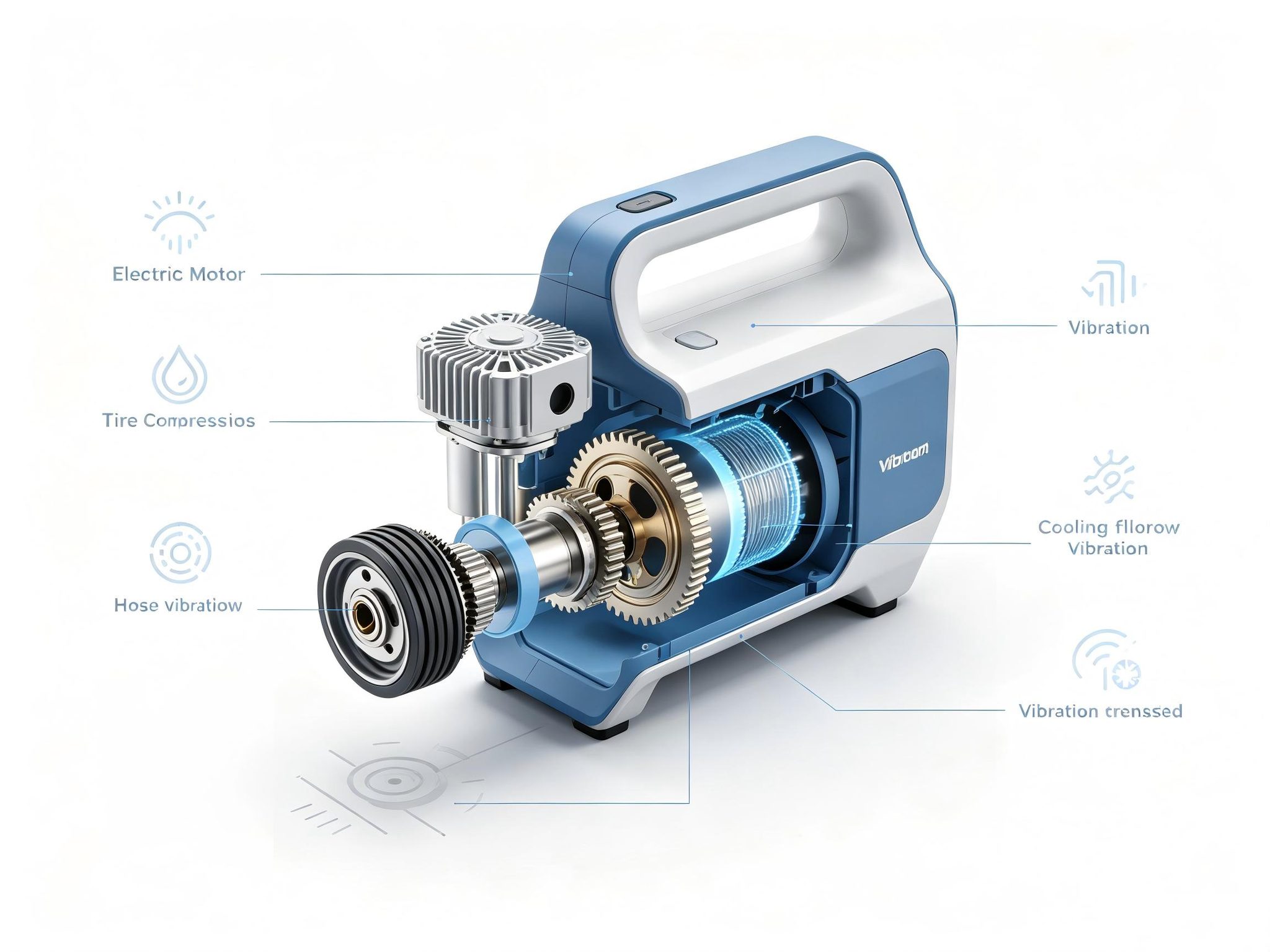
Noise is produced by several parts of the system.
The motor is one source. Higher motor speed can increase sound, especially when the inflator is working against increasing tire pressure.
The compressor mechanism also creates mechanical movement and vibration.
Other contributors may include:
- internal gears
- piston or cylinder movement
- housing vibration
- loose internal components
- cooling airflow
- contact between the inflator and the ground
- hose or connector vibration
Housing design can affect how these sounds are transmitted.
A rigid plastic shell may amplify certain vibrations if internal components are not mounted well. Rubber feet or vibration-isolation structures may help reduce the amount of vibration transferred to a hard surface.
Assembly consistency matters as well.
Two units with the same motor and compressor design should not sound dramatically different. Unusual rattling or irregular mechanical noise can indicate an assembly or component problem rather than normal operating sound.
How Noise Level Should Be Tested
A noise specification is only useful when buyers understand how it was measured.
A supplier may provide a decibel value, but the result can change depending on the test method.
Important conditions include:
- distance between the sound meter and inflator
- whether the measurement uses dB or dB(A)
- background noise
- indoor or outdoor environment
- surface material
- tire type and size
- starting pressure
- target pressure
- battery charge level
- operating stage
For example, a unit measured on a soft test surface may produce a different result from the same unit vibrating on a concrete workshop floor.
Noise may also change during inflation.
When tire pressure rises, the compressor is working under a different load. Buyers should therefore avoid evaluating only the first few seconds of operation.
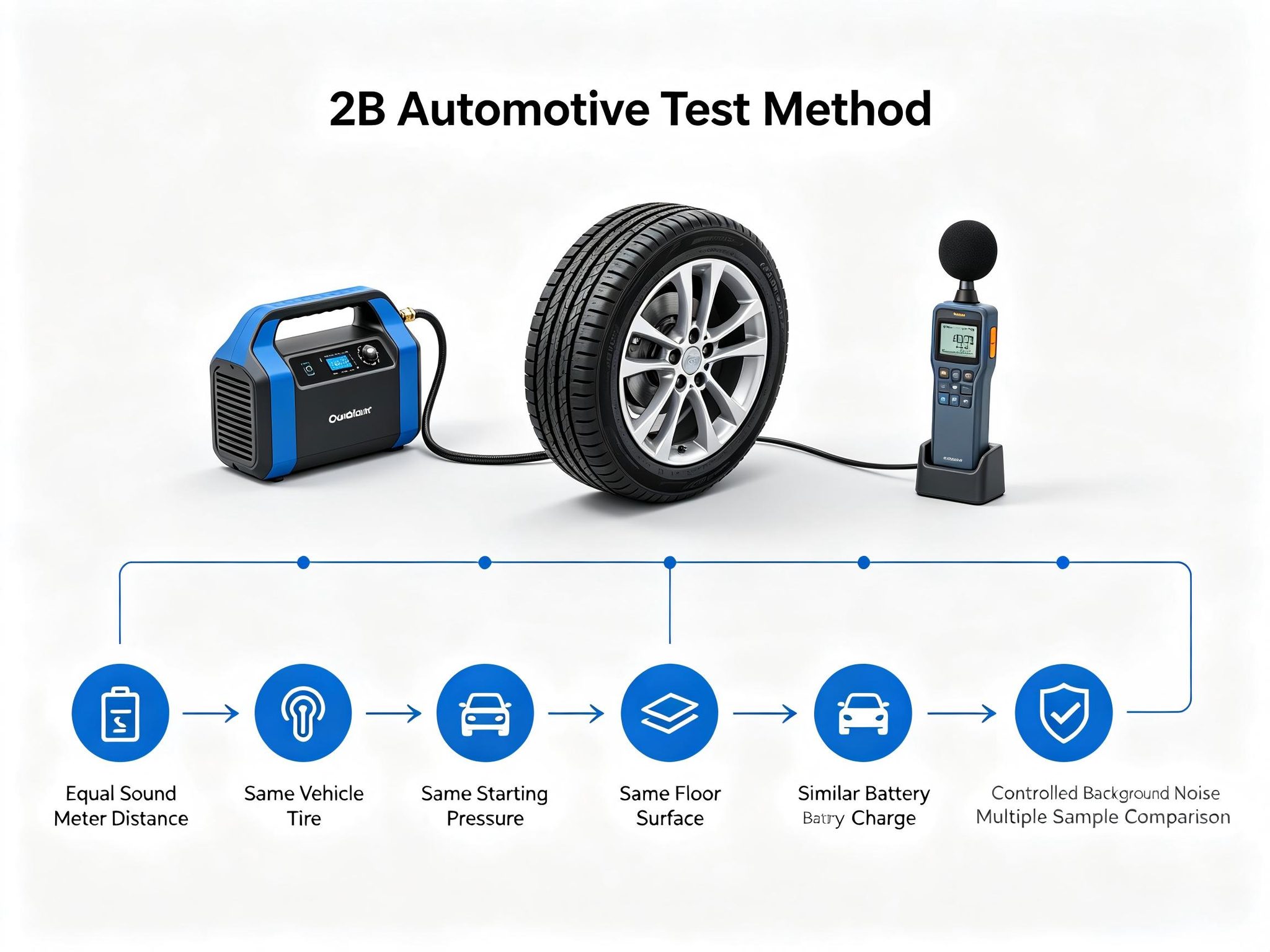
For product comparison, the most important principle is consistency.
If several samples are being compared, they should be tested under the same conditions, with the same distance, same tire, similar battery level, and similar background environment.
What Customers Actually Expect
There is no universal noise level that every customer considers acceptable.
Expectations depend on the product and its positioning.
A compact emergency inflator used for several minutes beside a vehicle may be judged differently from a large workshop compressor operating in a professional garage.
Customers buying a small rechargeable inflator may expect:
- manageable operating noise
- limited vibration
- no abnormal rattling
- stable sound during inflation
- no sudden mechanical changes
- a product that feels controlled rather than strained
Customers usually understand that an air compressor makes noise.
Problems appear when the sound seems excessive compared with the product’s size or when it suggests poor mechanical quality.
This is why brands should be careful when using marketing terms such as:
- ultra quiet
- silent
- whisper quiet
- noiseless
Unless these claims are supported by a clear test method, they may create expectations that the product cannot realistically meet.
A more credible approach is to provide verified noise information and explain the test conditions.
Noise vs Inflation Performance: Finding the Balance
Lower noise is useful, but it should not come at the expense of the product’s primary function.
A tire inflator still needs to deliver appropriate airflow and pressure.
Reducing motor speed simply to produce a quieter specification may increase inflation time. Adding more insulation may also affect size, weight, airflow, or thermal management if the product is not designed carefully.
For product development, buyers need to balance:
- inflation speed
- motor performance
- noise
- vibration
- heat control
- product size
- cost
- battery consumption
The best design is not necessarily the unit with the lowest possible sound level.
It is the unit that provides acceptable noise while maintaining the expected inflation performance and durability.
For different channels, that balance may change.
A premium consumer product may place more emphasis on refined sound and vibration. A value-focused emergency inflator may prioritize cost and inflation performance while still avoiding abnormal noise.
What B2B Buyers Should Check Before Ordering
Noise should be included in sample evaluation before bulk production.
Buyers can compare several units rather than relying on one sample.
Useful checks include:
- Is the operating sound consistent across samples?
- Is there any rattling or irregular mechanical noise?
- Does vibration increase significantly at higher pressure?
- How was the supplier’s noise figure measured?
- At what distance was the measurement taken?
- What tire and pressure conditions were used?
- Does the housing transmit excessive vibration to the floor?
- Does noise change after repeated inflation cycles?
- Does heat buildup affect the motor sound?
- Can the final mass-production sample be compared with the approved sample?
For private label brands, the user manual and listing should also avoid unsupported noise claims.
If low noise is an important selling point, buyers should agree on a measurable test method before mass production.
 portable tire inflator product options
Quick Noise Evaluation Checklist
| Evaluation Area | What Buyers Should Check | Why It Matters |
|---|---|---|
| Motor Sound | Stable and consistent operation | Affects perceived product quality |
| Mechanical Noise | No abnormal rattling or knocking | Helps identify assembly issues |
| Vibration | Housing and floor vibration | Influences user comfort |
| Test Distance | Same distance for every sample | Makes comparison meaningful |
| Operating Load | Test during realistic tire inflation | Noise changes with load |
| Sample Consistency | Compare multiple units | Checks production stability |
| Marketing Claims | Match actual test results | Reduces customer expectation gaps |
Conclusion
Portable tire inflator noise is not simply a question of finding the lowest decibel number.
For B2B buyers, the more important objective is to understand where the sound comes from, how the product behaves under real inflation load, and whether noise and vibration remain consistent across production samples.
Customers generally expect portable tire inflators to make some operating noise. What they are less likely to accept is excessive vibration, abnormal rattling, unstable sound, or marketing claims that do not match the real product experience.
Noise evaluation should therefore be part of sample testing together with inflation speed, pressure accuracy, heat control, battery performance, and durability.
YANTU supports portable tire inflator projects for automotive brands, distributors, retailers, and private label customers. If noise performance is important for your target market, our team can discuss product configuration, sample comparison, testing requirements, packaging, and bulk production planning.