Launching a sodium jump starter on Amazon requires more than uploading product photos and adding a few battery specifications.
The product combines automotive starting functions, battery technology, charging features, cables, clamps, accessories, and technical claims. If the listing does not explain these elements clearly, customers may misunderstand what the product can actually do.
For sellers and private label brands, a regular listing audit can help identify missing information, unclear claims, weak images, and differences between the listing and the actual product.
The goal is not simply to add more keywords. A healthy listing should accurately explain the product and help the right customer understand what they are buying.
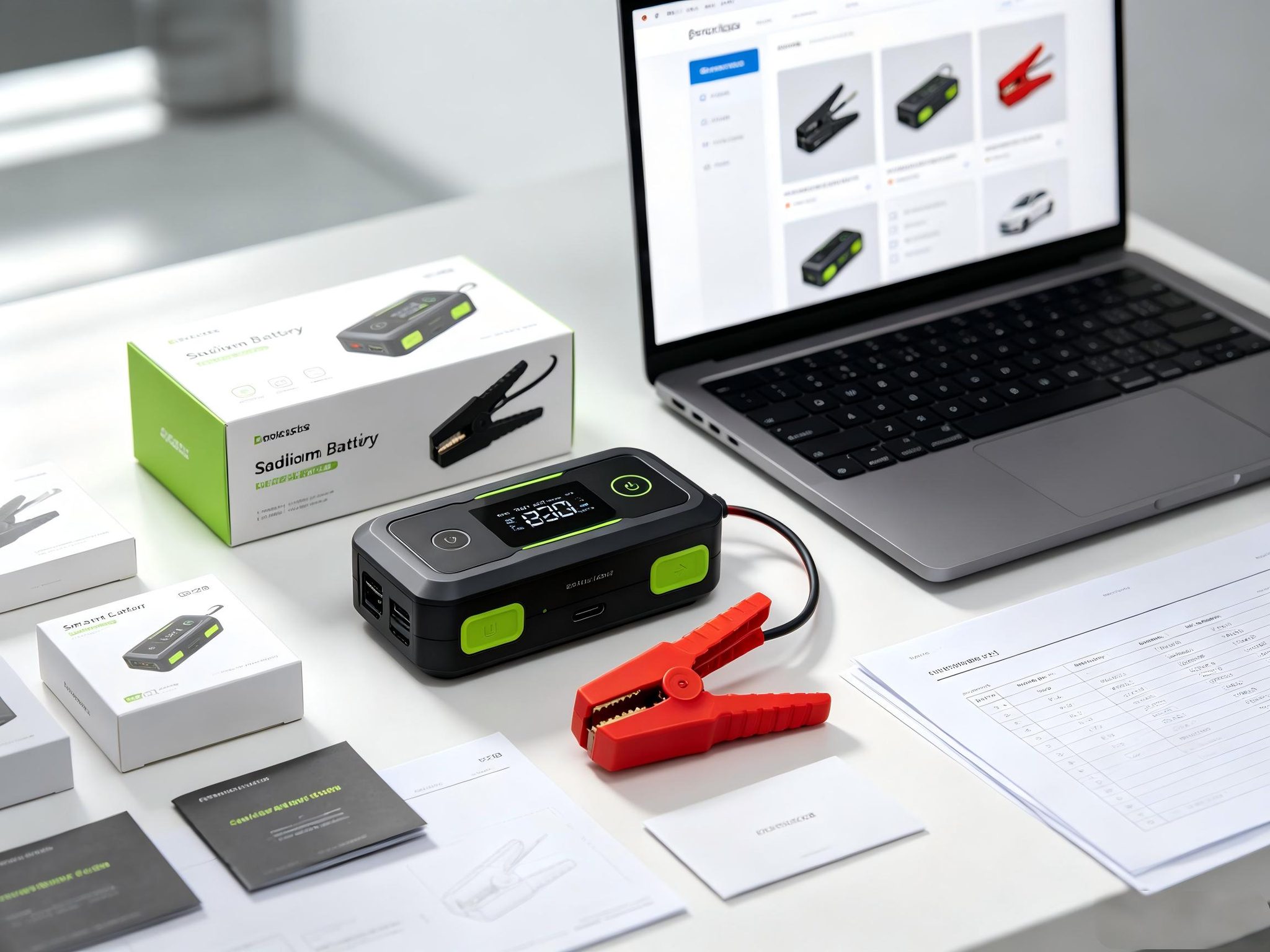
Start with the Product Title and Core Positioning
The first audit question is simple:
What is this product primarily being sold as?
A sodium jump starter may include several functions, such as vehicle starting, emergency lighting, USB charging, or other power outputs. However, trying to put every function into the title can make the positioning unclear.
The title should communicate the main product category and the most important verified product information.
Sellers should check whether the title:
- clearly identifies the product as a jump starter
- matches the actual battery technology
- avoids unsupported performance claims
- uses relevant customer search language
- matches the product configuration being shipped
- remains consistent with packaging and images
For a new battery technology, clarity is especially important.
Customers may not immediately understand what a sodium battery jump starter is or why it differs from familiar alternatives.
The listing should introduce the technology without allowing the technical story to overwhelm the main purpose of the product: helping customers start suitable vehicles when needed.
Audit Bullet Points for Real Buyer Questions
Bullet points should answer purchasing questions, not simply repeat keywords.
A useful sodium jump starter audit should check whether the listing explains:
- vehicle or engine compatibility
- starting capability
- battery capacity
- charging method
- smart clamp functions
- cable configuration
- included accessories
- storage guidance
- operating temperature information where verified
- additional output functions
Each point should match actual product specifications.
For example, if a seller wants to promote low-temperature performance, the claim should be based on real product testing rather than a general assumption about battery chemistry.
The same principle applies to standby time, cycle life, safety, and starting performance.
Sodium battery technology may provide a useful differentiation angle, but the listing should sell the tested product rather than making broad claims about all sodium batteries.
For B2B buyers developing a private label project, this means listing content should be reviewed together with supplier specifications and sample test results.
Check Product Images for Clarity and Consistency
Images are where customers often form their first practical understanding of the product.
A listing audit should check whether the image set answers important questions visually.
Useful image topics can include:
- complete product and accessories
- product size
- smart clamps and cables
- charging ports
- controls and display
- vehicle starting scenario
- emergency lighting
- storage case
- packaging contents
- key verified specifications
The main image should accurately represent what the customer receives.
Secondary images can then explain features, dimensions, accessories, application scenarios, and differences between configurations.
Consistency matters.
If an image shows one clamp design but the shipped product uses another, customers may feel misled. The same problem can occur with charging cables, storage cases, ports, packaging, or display interfaces.
For private label projects, sellers should confirm that final listing images are created from the approved mass-production configuration rather than an early engineering sample.
Review Technical Claims and Supporting Evidence
Sodium jump starters can create strong marketing opportunities because the battery technology is still unfamiliar to many customers.
That also creates risk.
Claims such as:
- long standby
- low-temperature operation
- longer cycle life
- improved safety
- fast charging
- high starting performance
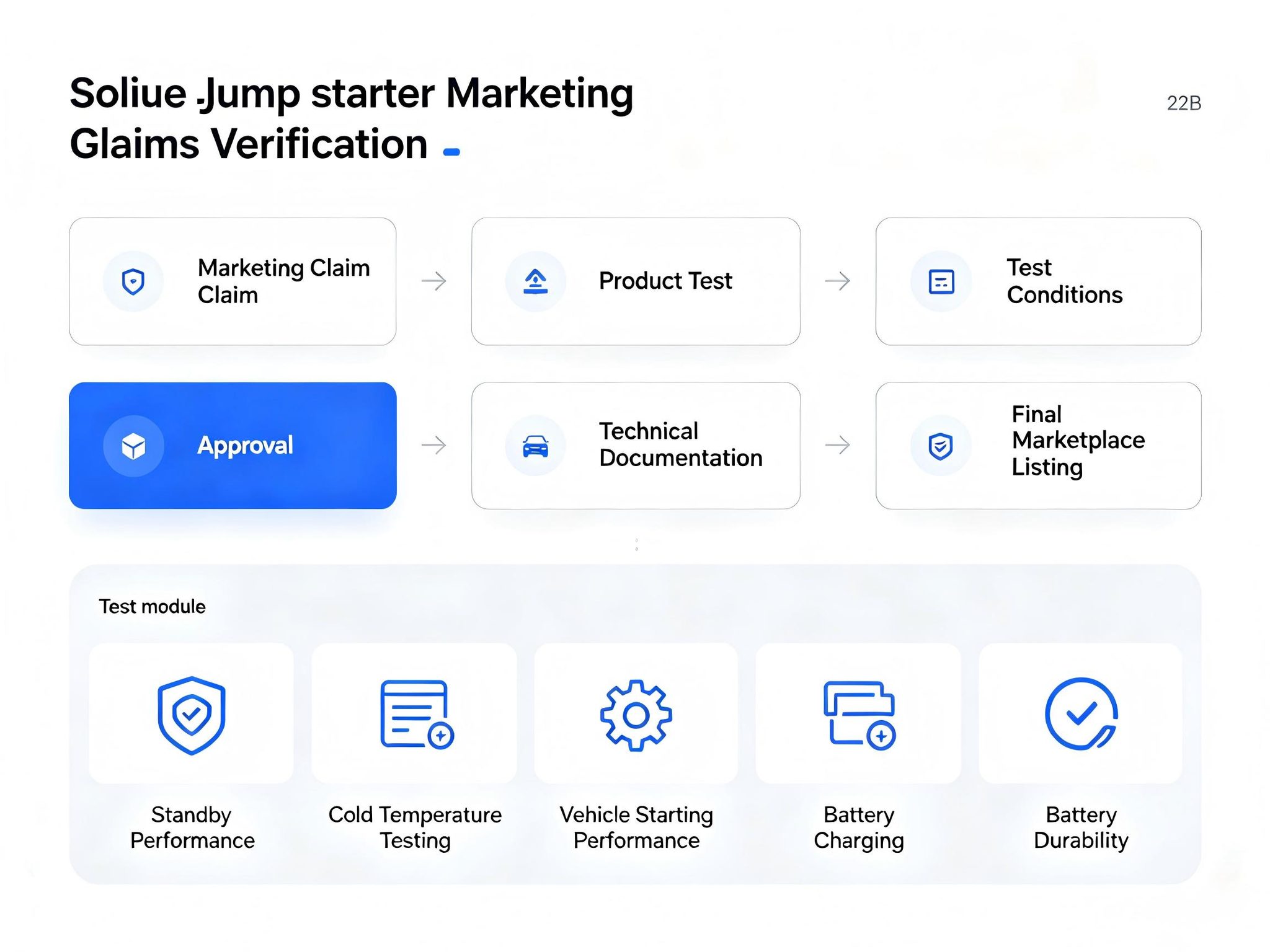
should be connected to evidence and clear test conditions.
A listing audit should ask:
- Where did this claim come from?
- Is it specific to this product?
- Has the product been tested?
- Under what conditions was it tested?
- Does the packaging make the same claim?
- Does the user manual support the same information?
- Can the supplier provide supporting documentation?
This is especially important when comparing sodium technology with lithium or lead-acid products.
A marketplace listing should not turn a technical difference into an absolute claim without support.
Accurate positioning builds more sustainable customer expectations.
 sodium vs lithium jump starter technical differences
Audit Specifications, Variations, and Included Accessories
Many listing problems are not caused by marketing copy. They come from small specification inconsistencies.
Sellers should compare the live listing directly with the approved product specification.
Check:
| Listing Area | What to Verify |
|---|---|
| Battery | Chemistry, rated capacity, voltage |
| Starting Performance | Verified starting specification and suitable application |
| Charging | Input method and supplied cable |
| Outputs | Actual available output ports |
| Clamps | Correct clamp and cable configuration |
| Accessories | Every item included in the package |
| Dimensions | Product and package dimensions |
| Weight | Correct product or shipping weight |
| Packaging | Actual retail configuration |
| Instructions | Same functions described in the manual |
If several variations are sold, each variation should be checked separately.
One configuration may include a case while another does not. Different models may use different battery capacities, clamps, charging ports, or accessories.
Copying content from one variation to another without checking can create incorrect expectations.
Look at Customer Questions, Returns, and Reviews
A listing audit should not stop at the seller’s own content.
Customer feedback can show where the listing is failing to explain the product.
Common patterns may include questions about:
- vehicle compatibility
- how to connect the clamps
- charging time
- battery indicator
- storage
- included cables
- emergency light
- power bank functions
- operating temperature
- package contents
If customers repeatedly ask the same question, the listing may need to explain that information earlier.
Returns can provide another signal.
If customers are returning the product because they expected a function that is not included, the issue may not be the product itself. It may be unclear positioning.
For sellers, this is one of the most practical reasons to audit listings regularly.
The listing should evolve as real customer questions reveal information gaps.
What Sellers Should Request from Their Supplier
A strong Amazon listing depends on accurate source information.
Before creating or updating a sodium jump starter listing, sellers should request:
- complete specification sheet
- approved product images
- accessory list
- packaging information
- user manual
- verified performance data
- battery and charging information
- storage guidance
- test information supporting major claims
- applicable product documentation
- final production sample confirmation
Sellers should also ask suppliers to notify them when important components or configurations change.
If the product changes but the listing does not, inaccurate content can quickly appear.
For private label sellers, listing preparation should therefore be part of product development rather than something completed only after the goods arrive.
Quick Sodium Jump Starter Listing Audit
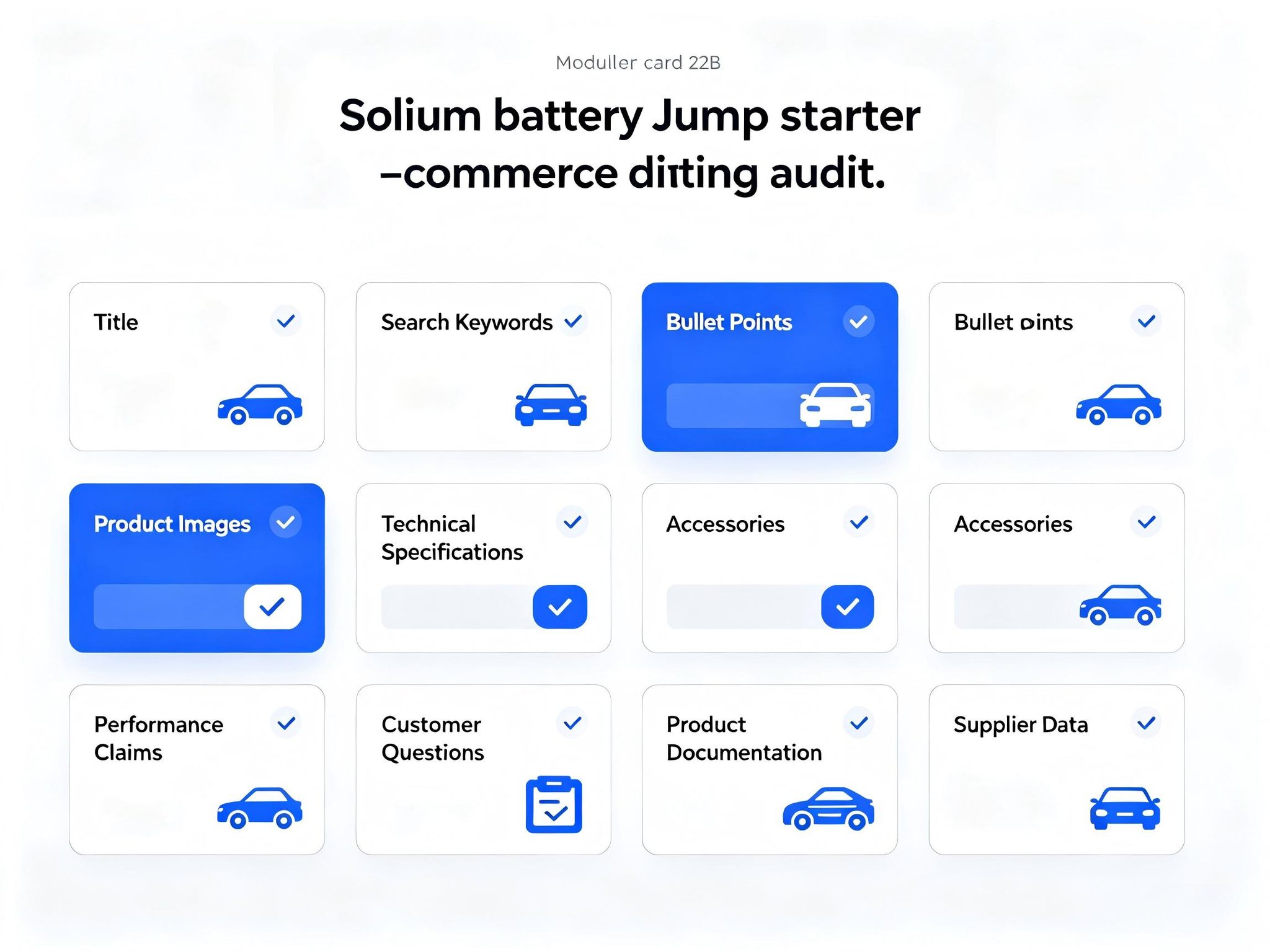
| Audit Area | Main Question |
|---|---|
| Title | Is the product clearly and accurately positioned? |
| Keywords | Do they match actual buyer intent? |
| Bullet Points | Do they answer real purchasing questions? |
| Images | Do they match the product being shipped? |
| Claims | Can important claims be supported? |
| Specifications | Are all technical details consistent? |
| Accessories | Is everything shown actually included? |
| Use Cases | Are suitable applications explained clearly? |
| Customer Feedback | Are repeated questions addressed? |
| Supplier Data | Is the listing based on current approved information? |
Conclusion
An Amazon listing audit for sodium jump starters should focus on more than keyword density.
Sellers need to check whether the title, bullet points, images, technical specifications, accessories, performance claims, and customer expectations all describe the same product.
This becomes especially important for sodium battery products because new technology can create both differentiation and confusion.
The strongest listing is not the one with the most aggressive claims. It is the one that explains the product clearly, supports important technical statements, and gives customers enough information to decide whether the jump starter fits their needs.
For private label brands, accurate listing content also depends on good supplier communication.
YANTU supports sodium jump starter projects for marketplace sellers, distributors, automotive brands, and private label customers. If you are preparing a sodium jump starter product line, our team can help discuss product specifications, sample testing, packaging, documentation, accessories, and listing-ready product information.