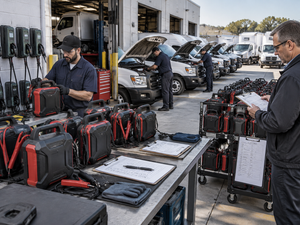
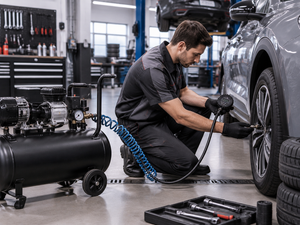
Commercial tire inflators often show higher CFM ratings than small consumer inflators. For B2B buyers, this number is important, but it should not be read as a simple “bigger is always better” specification.
CFM is related to airflow. In practical terms, it helps explain how much air the inflator can move and how suitable it may be for larger tires, repeated work, and commercial use.
This article explains what CFM means, why commercial tire inflators usually need higher airflow, and how buyers should evaluate CFM together with other specifications before placing bulk orders.

What CFM Means in Tire Inflator Specifications
CFM stands for cubic feet per minute. It describes airflow volume, or how much air a compressor or inflator can move within a given time.
For tire inflators, CFM is usually connected with inflation efficiency. A higher airflow rate can help fill larger tires faster, especially when the tire requires more air volume.
However, CFM should be understood carefully. The number can be affected by testing conditions, pressure level, product design, and whether the airflow is measured under load. A product may show a strong airflow rating, but real tire inflation performance still depends on motor power, cylinder structure, hose design, pressure range, and heat control.
For B2B buyers, the key point is this: CFM is useful, but it should not be evaluated alone. It should be checked together with inflation speed, tire size, duty cycle, durability, and supplier testing data.

Why Commercial Users Need Higher Airflow
Commercial users often work with larger tires, repeated inflation tasks, or time-sensitive service situations.
A personal car owner may use a small tire inflator only for occasional top-ups. A commercial user may need to support SUVs, pickups, fleet vehicles, service vans, workshop tasks, or roadside assistance. These use cases usually require more air volume and stronger working stability.
Higher CFM can be valuable for:
- reducing inflation time
- supporting larger tire volume
- improving workshop efficiency
- helping service teams complete tasks faster
- supporting repeated use in commercial environments
- improving product positioning for heavy-duty channels
For auto shops and fleet teams, time matters. If an inflator takes too long to bring a tire to the target pressure, it slows down work and reduces tool efficiency.
For distributors and automotive brands, a higher-CFM tire inflator can support a stronger commercial product story. But the product must also have the structure and testing to support that positioning.
CFM, Tire Size, and Inflation Speed
Tire size is one of the main reasons commercial tire inflators need higher CFM.
A small passenger car tire does not require the same air volume as a large SUV, pickup, trailer, or off-road tire. Larger tires need more air to reach the target pressure, so airflow becomes more important.
Inflation speed depends on several factors:
- tire volume
- starting pressure
- target pressure
- airflow rate
- hose and chuck design
- motor power
- cylinder structure
- heat buildup during operation
This is why buyers should ask suppliers what tire size was used during inflation testing. A claim such as “fast inflation” is not very useful unless the test condition is clear.
For example, topping up a standard passenger tire is different from inflating a larger tire from a very low pressure. The same inflator may perform well in one scenario and feel slow in another.
For B2B buyers, CFM should always be matched with target tire types and customer use scenarios.
Higher CFM Usually Requires Stronger Motor and Heat Control
Higher airflow usually requires stronger internal design.
A tire inflator that moves more air needs a motor, cylinder, air path, and housing structure that can support the workload. If the design is not strong enough, higher airflow may create more heat, more vibration, and faster component wear.
Important design factors include:
- motor power
- cylinder size and structure
- cooling design
- housing ventilation
- internal materials
- hose diameter
- chuck sealing
- power supply stability
- overheat protection
For commercial tire inflators, heat control is especially important. A product may perform well during a short test, but commercial users may need repeated inflation tasks. Without proper heat management, performance may drop and product life may be affected.
For B2B buyers, this means higher CFM should come with stronger durability. A high airflow number without heat control, duty cycle support, and material quality can create after-sales risk.
Why CFM Should Be Evaluated with Duty Cycle and Durability
CFM tells buyers about airflow, but duty cycle tells buyers how long the product can continue working before it needs rest.
These two specifications should be evaluated together.
A tire inflator may have a high CFM rating but a short duty cycle. This means it may move air quickly, but it may not be suitable for repeated or continuous commercial use. Another inflator may have moderate CFM but better working stability and longer operation time.
For commercial users, durability also matters. The hose, chuck, cable, motor, gauge, and housing must all support real work conditions.
B2B buyers should check:
- CFM rating and test condition
- tire size used in testing
- inflation speed under realistic use
- recommended duty cycle
- cooling time after operation
- heat control design
- hose and chuck durability
- repeated-use test results
- supplier inspection process
- sample performance before bulk orders
For commercial channels, the best tire inflator is not always the one with the highest airflow number. It is the product that matches the intended workload reliably.

What Buyers Should Ask Suppliers Before Ordering
Before selecting a commercial tire inflator, buyers should ask suppliers practical questions about CFM and product performance.
Useful questions include:
- How is the CFM rating measured?
- Is the airflow measured under pressure or free flow?
- What tire size was used for inflation testing?
- How long does the product take to inflate the target tire?
- What is the recommended duty cycle?
- What cooling time is required?
- What motor and cylinder structure is used?
- Does the product include overheat protection?
- How are hose leakage and chuck sealing tested?
- Can samples be tested before mass production?
These questions help buyers avoid unclear specifications. They also help buyers compare products more fairly.
A reliable tire inflator supplier should be able to explain the relationship between airflow, tire size, duty cycle, heat control, and product positioning.

Quick CFM Evaluation Table
| Evaluation Area | Why It Matters | What Buyers Should Check |
|---|---|---|
| CFM Rating | Shows airflow capability | Test condition and measurement method |
| Tire Size | Defines real workload | Passenger car, SUV, pickup, or off-road tires |
| Inflation Speed | Affects user efficiency | Time to reach target pressure |
| Motor Design | Supports airflow output | Power, structure, and stability |
| Heat Control | Affects repeated use | Ventilation and overheat protection |
| Duty Cycle | Defines commercial suitability | Working time and cooling time |
| Durability | Reduces after-sales risk | Hose, chuck, cable, housing, and gauge |
Conclusion
Commercial tire inflators often have higher CFM ratings because commercial users need stronger airflow for larger tires, faster service, and more demanding work conditions. But CFM should not be evaluated as an isolated number.
For B2B buyers, CFM should be reviewed together with tire size, inflation speed, motor design, heat control, duty cycle, durability, and supplier testing support.
A strong commercial tire inflator should not only move more air. It should also remain stable, safe, and reliable under real working conditions.
YANTU supports commercial and heavy-duty tire inflator projects for automotive brands, distributors, fleet channels, retailers, and OEM customers. If you are evaluating high-airflow tire inflators for your product line, our team can help discuss specifications, sample testing, packaging, and bulk order requirements.