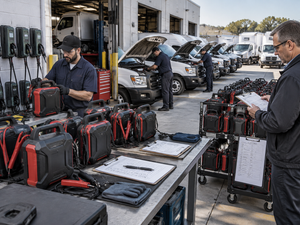
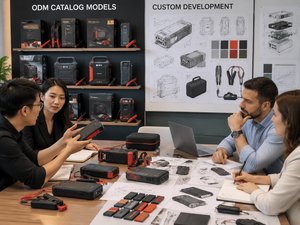
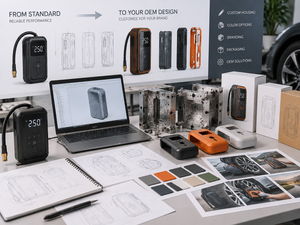
Portable tire inflators are practical automotive accessories, but they do not always sell well when they are placed randomly on a retail shelf. Customers need to understand what the product does, when they may need it, and why it belongs in their car.
For retailers, distributors, and automotive accessory buyers, merchandising affects how quickly customers notice and understand portable tire inflators.
This article explains how to display portable tire inflators in retail stores and what B2B buyers should confirm before ordering.

Why Merchandising Affects Tire Inflator Sell-Through
Portable tire inflators are not impulse products in the same way as phone holders or air fresheners. Many customers buy them because they understand a specific problem: low tire pressure, roadside emergencies, seasonal tire pressure changes, or travel preparation.
If the product is displayed without clear messaging, customers may ignore it. If the product is placed near related emergency or tire-care items, the value becomes easier to understand.
Good merchandising can help customers answer three questions quickly:
- What problem does this product solve?
- Is it suitable for my car?
- Why should I buy it now?
For B2B buyers, merchandising is part of product planning. A portable tire inflator should not only have the right specifications. It should also have packaging, display information, and retail placement that help customers make decisions.
Best Shelf Placement for Portable Tire Inflators
Shelf placement has a direct effect on customer attention.
Portable tire inflators can be placed in several retail areas, depending on the store format and target customer. The most common options include the tire-care section, car emergency section, travel accessories area, seasonal promotion area, or automotive tool section.
Each placement creates a different buying logic.
In the tire-care section, the product is connected with pressure gauges, tire repair kits, valve caps, and related maintenance products. This helps customers understand the inflator as a regular tire maintenance tool.
In the emergency car accessory section, the product is connected with jump starters, warning triangles, flashlights, first aid kits, and roadside safety products. This helps position the tire inflator as part of a vehicle emergency kit.
In a seasonal promotion area, portable tire inflators can be linked with winter driving, summer road trips, holiday travel, or back-to-school car preparation.
For retailers, the best placement depends on customer traffic and store category layout. For suppliers, packaging should be flexible enough to support different retail positions.

Cross-Merchandising with Emergency Car Accessories
Portable tire inflators often sell better when they are displayed with related car emergency products.
This is because customers may not think about tire pressure until they see a complete roadside preparation solution. When the inflator is placed beside a jump starter, flashlight, tire repair kit, or safety vest, the product use case becomes more obvious.
Useful cross-merchandising combinations include:
- tire inflator + jump starter
- tire inflator + tire repair kit
- tire inflator + pressure gauge
- tire inflator + emergency roadside kit
- tire inflator + travel organizer
- tire inflator + winter driving accessories
For B2B buyers, this creates opportunities for product bundles and promotional sets. A distributor may offer tire inflators together with other automotive emergency tools. A retailer may create a “road trip safety” display before peak travel seasons.
The key is to make the product feel connected to a real driving situation, not isolated as a small electrical device on a shelf.
Packaging Messages That Help Customers Decide
In retail stores, packaging must explain the product quickly.
Unlike online listings, store customers may not read long descriptions. They often look at the front of the box, compare a few products, and decide whether the product is useful.
For portable tire inflators, packaging should highlight practical information such as:
- power type
- pressure range
- auto shut-off function
- display type
- included nozzles
- cable or hose length
- storage size
- suitable vehicles or use scenarios
These points should be shown with simple icons and short phrases. The package should not be overloaded with technical claims that customers cannot understand quickly.
For example, if the product is 12V car-powered, that should be easy to see. If the product is rechargeable or cordless, the packaging should explain charging method and portable use. If it includes nozzles for balls, bicycles, or small inflatables, those accessories should be visible.
For B2B buyers, packaging is a sales tool. It should reduce customer hesitation and explain why the inflator is useful before the customer asks a store employee.

 cordless vs 12V vs rechargeable tire inflators
Demo Displays and Size Comparison in Retail Stores
Portable tire inflators vary in size, shape, and storage design. Retail customers often want to know whether the product is easy to keep in a car.
A demo display or open sample can help customers understand the product more quickly. They can see the hose, cable, nozzle storage, display screen, buttons, and product size.
For compact models, a size comparison can be useful. Showing the inflator beside a car glove box, trunk organizer, or emergency kit can help customers imagine where they will store it.
For larger heavy-duty models, the display should focus on performance, durability, and suitable vehicle types. These models may be better placed with automotive tools or SUV accessories rather than small travel items.
For retailers, sample displays can support higher conversion. For suppliers, this means product appearance, packaging structure, and accessory organization should be designed with retail presentation in mind.
What Retailers Should Ask Suppliers Before Ordering
Before ordering portable tire inflators for retail stores, buyers should check whether the supplier can support merchandising needs.
Important questions include:
- Can the packaging clearly show key features?
- Can the color box support retail shelf display?
- Is there space for barcode labels and store labels?
- Are product images available for shelf cards or catalogs?
- Can the supplier provide display samples?
- Can the product be packed for hanging display or shelf display?
- Are accessories arranged clearly inside the box?
- Can private label packaging be supported?
- Can multiple models be planned for different price levels?
- Can samples be tested before bulk orders?
Retail buyers should also compare packaging size, carton quantity, and shelf space. A product with good features may still be difficult to sell if the package is too large, unclear, or hard to display.
For B2B buyers, merchandising support should be part of supplier evaluation, especially for supermarkets, automotive retail chains, and regional distributors.
Quick Retail Merchandising Checklist
| Merchandising Area | What to Check | Why It Matters |
|---|---|---|
| Shelf Placement | Tire care, emergency, travel, or tool section | Helps customers understand the use case |
| Cross-Merchandising | Jump starters, tire repair kits, pressure gauges | Builds a complete emergency solution |
| Packaging Message | Power type, pressure range, nozzles, auto shut-off | Reduces customer hesitation |
| Display Format | Shelf box, hanging display, demo sample | Improves in-store visibility |
| Size Communication | Compact storage or heavy-duty structure | Supports product positioning |
| Supplier Support | Images, packaging, private label, samples | Helps retail launch execution |
Conclusion
Merchandising portable tire inflators in retail stores requires more than placing products on a shelf. Retailers should connect the product with real customer needs such as tire care, roadside emergencies, seasonal travel, and vehicle preparation.
For B2B buyers, strong retail performance depends on shelf placement, packaging messages, cross-merchandising, product size communication, and supplier support.
A portable tire inflator should be easy to understand at first glance. The right display can help customers see why they need it before an emergency happens.
YANTU supports portable tire inflator projects for retailers, automotive distributors, marketplace sellers, and private label brands. If you are planning a retail tire inflator product line, our team can help discuss packaging, display options, product specifications, sample testing, and bulk order requirements.