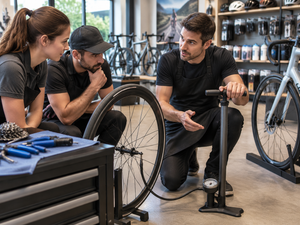
The Amazon bike pump category is already competitive. Established brands often have strong reviews, mature listings, and better customer trust. For new sellers, simply copying a best-selling product and offering a lower price is usually not a strong long-term strategy.
A better approach is to build a clearer product position, reduce direct comparison, and work with a supplier that understands marketplace needs. This article explains practical bike pump category strategies for Amazon sellers, private label brands, and B2B buyers.

Why Price Competition Alone Is Risky
Price matters on Amazon, but relying only on low pricing can create long-term problems.
A low-cost bike pump may reduce the first purchase cost, but it may also affect pressure accuracy, accessory quality, packaging presentation, and user experience. For Amazon sellers, these issues can quickly turn into poor reviews, higher return rates, and lower listing conversion.
Common risks include weak inflation performance, unclear instructions, missing accessories, poor valve compatibility, and unstable product quality.
For B2B buyers, the purchasing decision should not focus only on unit price. A slightly better product with stable quality, clear packaging, and fewer after-sales problems may be more valuable than the cheapest option. In the Amazon bike pump category, review risk is part of the real cost.
Choose a Clear Product Position
Established brands are difficult to beat when a new seller offers the same product, the same features, and a weaker review base. New sellers need a more specific product position.
A bike pump can be positioned in different ways:
- a mini portable bike pump for lightweight cycling carry
- an electric bike pump for convenient inflation
- a bike pump with gauge for pressure accuracy
- a compact emergency pump for road cyclists
- a value bundle with accessories for marketplace sellers
Each direction attracts a different customer group. A road cyclist may care about compact size and high-pressure performance. A casual rider may care more about easy operation. A marketplace buyer may prefer a product that is easier to explain through images, packaging, and listing bullet points.
For private label bike pump projects, the goal is not always to create a completely new product. The goal is to give the product a clear reason to be chosen.
Build Differentiation Around Customer Pain Points
Good differentiation should come from real user problems.
Many bike pump complaints are related to practical use: the pump is slow, the pressure is not clear, the valve adapter is confusing, or the accessories are easy to lose. These problems can become product improvement directions.
| Customer Pain Point | Product Direction | Purchasing Meaning |
|---|---|---|
| Slow inflation | Better motor or air output design | Reduces user frustration |
| Unclear pressure | Gauge or digital display | Improves user confidence |
| Valve confusion | Presta and Schrader compatibility | Reduces wrong-use complaints |
| Missing accessories | Storage bag or fixed accessory layout | Improves product completeness |
| Poor instructions | Clear manual and packaging icons | Reduces after-sales questions |
For Amazon sellers, these details are not minor. They affect customer reviews, return rates, and listing performance. When choosing a bike pump supplier, buyers should ask whether the supplier can support practical improvements instead of only providing a standard product.

Use Packaging and Bundles to Reduce Direct Comparison
When many products look similar, customers often choose the one with more reviews. Packaging and bundles can help new sellers avoid direct comparison with established brands.
For example, a private label bike pump can be sold as:
- pump only
- pump with storage bag
- pump with multiple valve adapters
- electric bike pump with charging cable
- cycling emergency kit
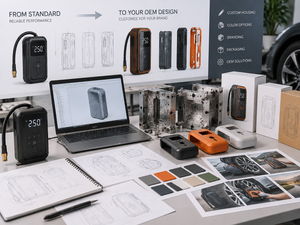
- retail-ready gift packaging
Packaging also helps customers understand the product faster. A clear package can show valve compatibility, pressure range, included accessories, use scenarios, and basic operation steps.
For Amazon and independent store sellers, this has real purchasing value. Better packaging can improve perceived value, reduce customer confusion, and support a more professional brand image.
This is why buyers should discuss packaging early with the bike pump manufacturer. A product that is suitable for bulk supply may still need better packaging to become suitable for marketplace sales.
 electric bike pump for marketplace sellers
Work with a Supplier That Understands Marketplace Requirements
Amazon sellers usually need more than a basic quotation. They need a bike pump supplier that understands product configuration, sample testing, packaging, and listing requirements.
Before choosing a supplier, buyers should check whether the factory can support:
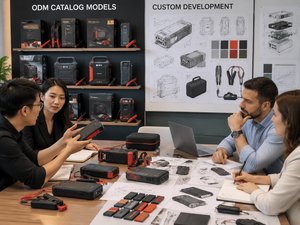
- OEM or private label packaging
- sample testing before bulk orders
- accessory configuration changes
- user manual customization
- product specifications for listing content
- stable quality inspection
- carton and packaging information
These points directly affect the selling process. If the supplier cannot confirm specifications clearly, the seller may have difficulty creating accurate listing content. If accessories are inconsistent, customer complaints may increase. If packaging is not planned properly, the product may look less professional in a competitive category.
For B2B buyers, a suitable supplier should help reduce sourcing uncertainty. The best choice is not always the lowest-price supplier, but the one that can support stable repeat orders and marketplace-ready products.
Plan a Product Line, Not Just One Product
Many sellers start by sourcing one bike pump. However, long-term category growth often requires product line thinking.
A simple bike pump product line may include:
- entry-level portable bike pump
- upgraded bike pump with gauge
- electric bike pump for convenience-focused users
- bundle version with accessories
- premium packaging version for gift or retail channels
This allows sellers to cover different price points and customer needs. It also makes future expansion easier. If the first product performs well, the seller can add a related model instead of starting from zero with a new supplier.
For distributors, retailers, and marketplace sellers, product line planning also supports repeat purchasing. A clear product structure helps the buyer test the market first, then expand based on sales feedback.

Quick Comparison Table
| Strategy Area | Weak Approach | Better Approach |
|---|---|---|
| Pricing | Compete only on low price | Balance price, quality, and positioning |
| Product Selection | Copy best sellers | Choose a clear customer segment |
| Differentiation | Use generic features | Solve real customer pain points |
| Packaging | Basic neutral box | Private label or marketplace-ready packaging |
| Supplier Choice | Choose the lowest quotation | Choose stable quality and supplier support |
| Growth Plan | Sell one product | Build a small product line |
Conclusion
Competing with established brands in the Amazon bike pump category is not easy, but new sellers still have opportunities. The key is to avoid direct price competition and build a more focused product strategy.
A strong Amazon bike pump strategy should include clear positioning, practical differentiation, better packaging, and reliable supplier support. For private label sellers, these factors can help reduce review risk, improve customer understanding, and support long-term category growth.
YANTU supports OEM and ODM bike pump projects for marketplace sellers, retailers, and cycling accessory brands. If you are planning to develop a private label bike pump product line, our team can help discuss product options, packaging, sample requirements, and bulk order solutions.