Launching a new tire inflator on Amazon is not only a product and advertising challenge. For a new listing, customer reviews can also influence purchase confidence, conversion performance, and long-term product growth.
However, building initial reviews should not be treated as a race to collect as many ratings as possible.
For tire inflator brands, the foundation should be a reliable product, accurate specifications, clear instructions, strong customer support, and a compliant process for requesting feedback.
This is particularly important for automotive products. Customers may depend on a portable tire inflator during a roadside emergency, so product quality has a direct effect on customer satisfaction.
This guide explains how brands can plan the early review-building process and what should happen during each stage of a new Amazon tire inflator launch.
Why Initial Reviews Matter for New Tire Inflators
A new Amazon listing starts with limited customer history.
Even when the product has strong specifications, potential buyers may hesitate if there is little information from previous customers.
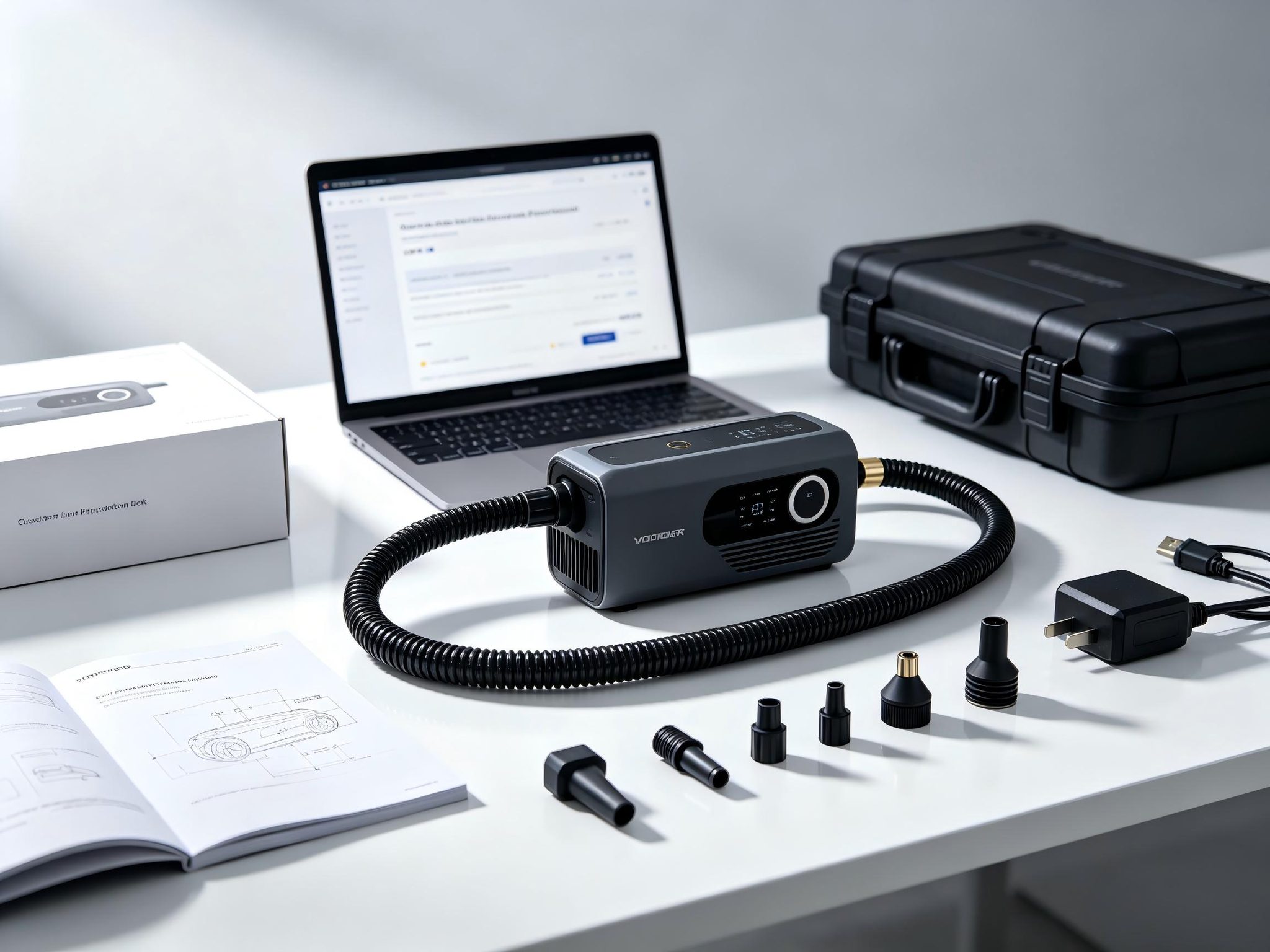
Reviews can provide additional information about:
- actual inflation performance
- battery life
- noise level
- display readability
- hose or cable usability
- portability
- charging experience
- vehicle compatibility
- everyday reliability
For automotive products, these details can be more useful to shoppers than technical specifications alone.
A seller may state that a tire inflator has a high maximum pressure, but customers often want to know whether the product is convenient to use on a real vehicle.
This makes early customer feedback valuable not only for social proof, but also for identifying product improvements.
Start With Product Quality Before Review Acquisition
The first step in building reviews should happen before the product launches.
If the product has unresolved quality problems, increasing sales can simply increase the number of negative reviews.
For tire inflators, brands should pay particular attention to:
- inflation speed
- pressure accuracy
- automatic shutoff
- battery performance
- charging reliability
- hose connection
- air leakage
- display visibility
- button operation
- thermal management
- noise
- accessory quality
Sample testing should cover more than one unit.
A single successful sample does not necessarily demonstrate production consistency.
For private label products, buyers should consider testing multiple samples from production batches and confirming that the final mass-production configuration matches the approved sample.
The objective is simple:
Build customer reviews around a product that is already ready to be reviewed.
Make the Listing Review-Ready Before Launch
Review acquisition and listing optimization should happen together.
A customer is more likely to leave useful feedback when the product page accurately explains what the product does and how it should be used.
Before launch, check:
Product Title
The title should clearly identify the product type and major use case without making unsupported claims.
Product Images
Images should explain:
- product dimensions
- accessories
- controls
- charging method
- pressure display
- use scenarios
- included components
Product Description
The description should answer common customer questions before purchase.
Instructions
The user manual should explain setup, charging, inflation, automatic shutoff, storage, and troubleshooting clearly.
A customer who cannot understand how to operate the product may leave a negative review even when the hardware itself is functioning normally.
For this reason, customer education is part of review management.
Use Compliant Methods to Encourage Customer Feedback
Brands should distinguish between requesting honest feedback and attempting to influence the content or rating of a review.
The objective should be to make it easy for customers to provide genuine feedback while following Amazon’s current policies.
Appropriate approaches can include Amazon’s own review-request functions and other permitted customer communication methods.
Brands should not:
- offer rewards in exchange for positive reviews
- ask customers to remove negative reviews
- ask only satisfied customers to leave reviews
- manipulate ratings
- create fake customer accounts
- purchase reviews
- provide compensation in exchange for a specific rating
These practices can create significant account and brand risk.
A sustainable review strategy should therefore focus on customer experience rather than manipulating the review outcome.
The product, listing, packaging, and support process should work together to create legitimate opportunities for customers to share their experiences.
A Practical 90-Day Launch Timeline
There is no guaranteed number of reviews that a new product will receive within a specific period. Review volume depends on sales volume, category behavior, customer satisfaction, and Amazon’s review ecosystem.
Instead of promising a fixed review target, brands can use a staged launch timeline.
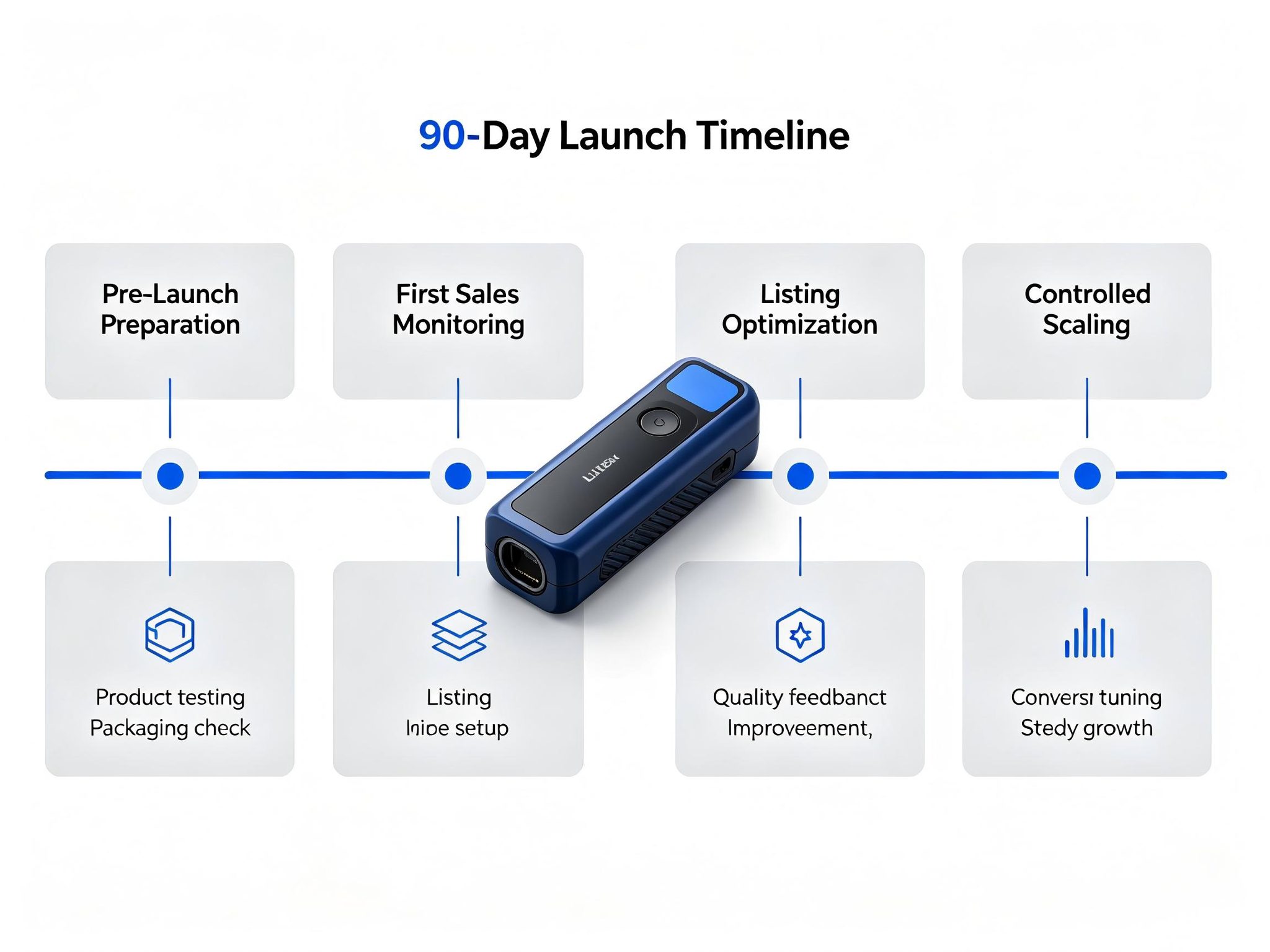
Stage 1: Pre-Launch — Product and Listing Preparation
Typical timing: 2–4 weeks before launch
Focus on:
- final sample confirmation
- production quality inspection
- product photography
- listing content
- keyword research
- packaging
- user manual
- warranty process
- customer service preparation
This is the stage where many review problems can be prevented.
If customers repeatedly ask the same basic questions, the information should be added to the listing or manual before launch.
Stage 2: First Sales — Monitor Customer Experience
Typical timing: Weeks 1–4
The priority is not simply increasing order volume.
Monitor:
- customer questions
- return reasons
- refund requests
- product complaints
- customer service cases
- common operating mistakes
- negative feedback patterns
For example, if several customers report difficulty connecting the hose, the seller should investigate whether the issue comes from product design, instructions, packaging, or customer misunderstanding.
Early feedback can therefore function as a product quality signal.
Stage 3: Optimization — Improve the Weak Points
Typical timing: Weeks 4–8
By this point, the seller may have enough customer feedback to identify recurring issues.
Potential improvements include:
- clearer instructions
- revised product images
- better accessory explanation
- improved packaging
- updated FAQ content
- product design adjustments for future batches
If the issue is related to manufacturing, the supplier should be involved rather than simply changing the listing.
Stage 4: Scale — Build Consistent Customer Experience
Typical timing: Weeks 8–12 and beyond
Once the product demonstrates stable performance, brands can increase marketing and sales activity.
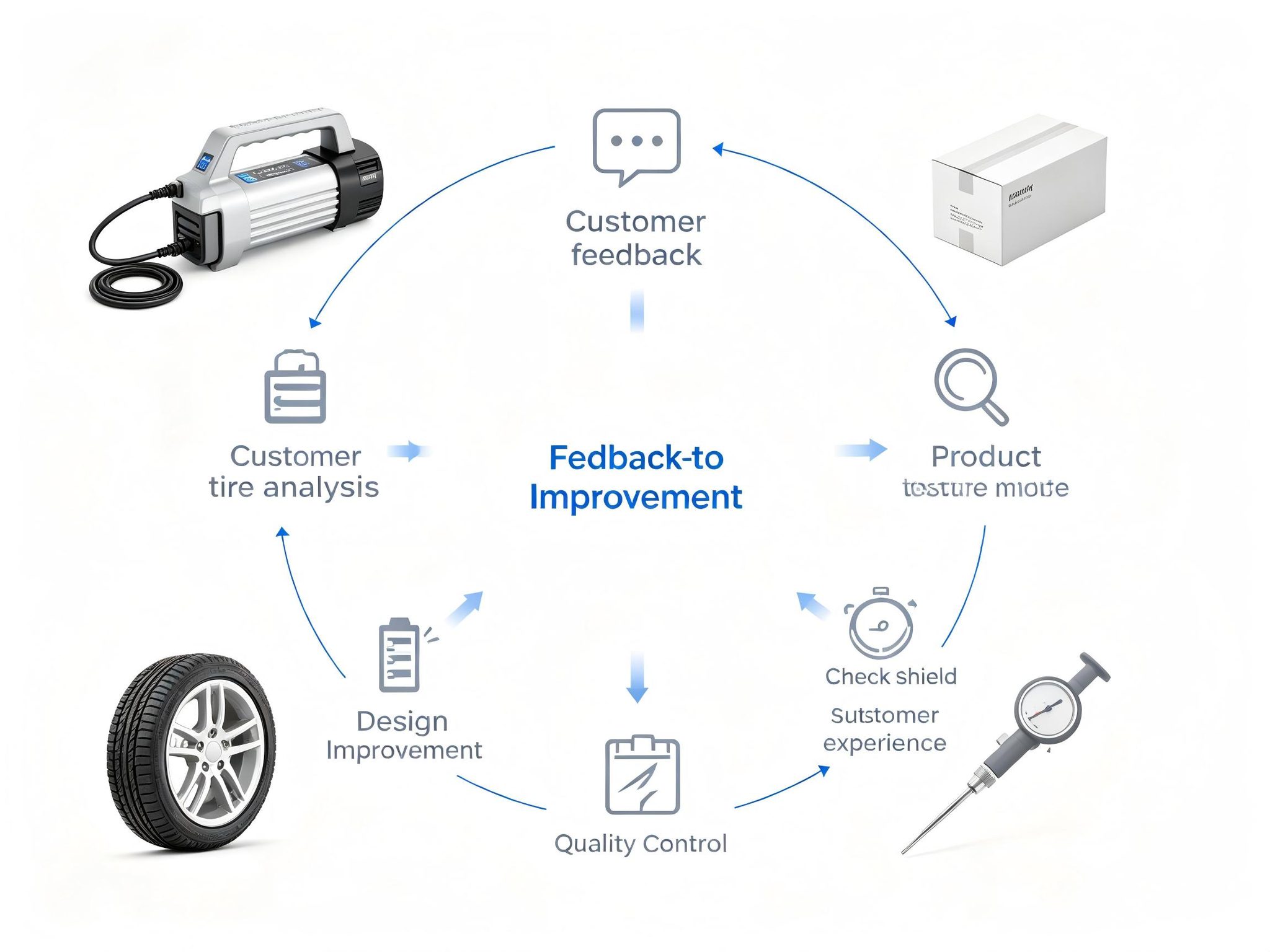
At this stage, reviews become one part of a larger flywheel:
Product quality → customer satisfaction → genuine feedback → stronger conversion → more sales → more customer feedback
The objective is not to create a short-term spike in reviews.
It is to build a product that can continue generating positive customer experiences as sales increase.
What Negative Reviews Can Teach Tire Inflator Brands
Negative reviews are not automatically useless.
For product brands, they can reveal problems that internal testing did not identify.
For example:
| Customer Feedback | Possible Root Cause |
|---|---|
| “Too slow” | Inflation performance or incorrect expectation |
| “Battery died quickly” | Battery capacity, usage pattern, or charging issue |
| “Hard to connect” | Hose or valve connection design |
| “Pressure seems wrong” | Gauge accuracy or user understanding |
| “Too noisy” | Motor characteristics or expectation |
| “Hard to read” | Display design or outdoor visibility |
| “Stopped working” | Quality, overheating, charging, or misuse |
The important step is to investigate the underlying cause rather than immediately changing the product based on one comment.
A recurring complaint is more valuable as a product-development signal.
For OEM and ODM buyers, these insights can also be used when planning the next product generation.
How Suppliers Can Support Amazon Review Performance
The supplier’s role does not end when the shipment leaves the factory.
A reliable supplier can support the seller through:
- consistent production quality
- approved sample control
- spare parts
- replacement units
- troubleshooting information
- user manuals
- packaging customization
- product specification sheets
- quality inspection
- future product improvements
For Amazon brands, consistent product quality is especially important.
If the first 500 units perform differently from the next 2,000 units, the seller may see customer complaints increase even though the listing itself has not changed.
This is why production consistency should be part of the supplier evaluation process.

Quick 90-Day Amazon Tire Inflator Launch Checklist
| Stage | Main Focus | Key Action |
|---|---|---|
| Pre-Launch | Product readiness | Test samples and finalize listing |
| Weeks 1–4 | Customer experience | Monitor questions, returns, and complaints |
| Weeks 4–8 | Optimization | Fix recurring product or content issues |
| Weeks 8–12 | Scale | Increase sales after quality stabilizes |
| Long Term | Product improvement | Use genuine customer feedback for future batches |
Conclusion
Building initial Amazon reviews for a tire inflator should be treated as a long-term product and customer-experience process rather than a simple review-generation campaign.
The strongest foundation is a reliable product, accurate product information, clear instructions, responsive support, and a compliant method of requesting genuine customer feedback.
For tire inflator brands, the first 90 days are particularly useful for identifying product issues and improving the complete customer experience.
A supplier should therefore be evaluated not only by unit price, but also by sample consistency, production quality, documentation, packaging support, spare parts, and its ability to support future product improvements.
YANTU supports tire inflator projects for Amazon sellers, automotive brands, distributors, and private label customers. If you are preparing a new tire inflator for Amazon, our team can support product configuration, samples, packaging, quality control, and bulk production planning.