A 12V tire inflator plug becoming warm during operation does not automatically mean the product has failed.
But the location, speed, and consistency of that temperature rise can tell buyers a great deal about the electrical path between the vehicle power source and the compressor.
For brands and quality teams, plug heating should therefore be treated as a diagnostic signal rather than a simple pass-or-fail observation.
The useful questions are where the heat is developing, under what operating condition it appears, whether it increases through repeated use, and whether different samples behave consistently.
A proper tire inflator plug heating test should look at the complete connection system rather than only touching the outside of the plug after inflation.
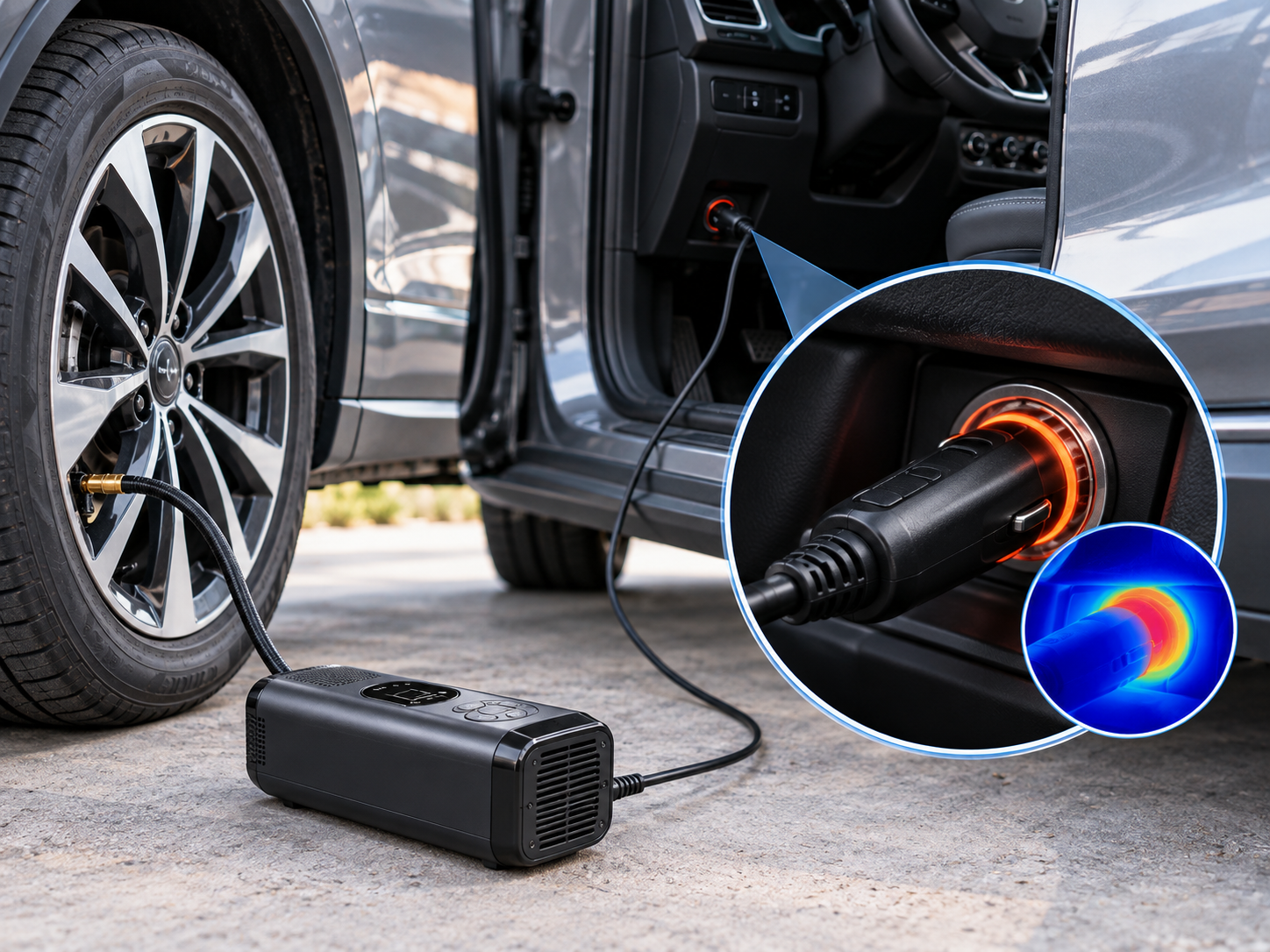
Heat Is Created Along an Electrical Path
A 12V inflator receives power through several connected components.
The path may include:
Vehicle power source → accessory socket → plug contacts → internal plug connection → power cable → PCB → motor
Every conductor and connection has some electrical resistance.
When current flows through resistance, part of the electrical energy is converted into heat.
This means temperature can rise at different locations for different reasons.
A warm cable may indicate one condition.
A concentrated hot point near the plug contact may indicate another.
A temperature increase near the cable-to-plug joint may point quality teams toward the connection or assembly area rather than the cable itself.
For this reason, recording only one surface temperature does not provide enough information to understand the product.
Start by Finding Where the Temperature Is Concentrated
The first useful observation is location.
Instead of describing the entire connector as “hot,” divide the power input area into several measurement points.
A practical map might include:
| Measurement Area | What It Can Help Evaluate |
|---|---|
| Plug contact area | Contact quality with the power socket |
| Plug body | Heat spreading through the connector assembly |
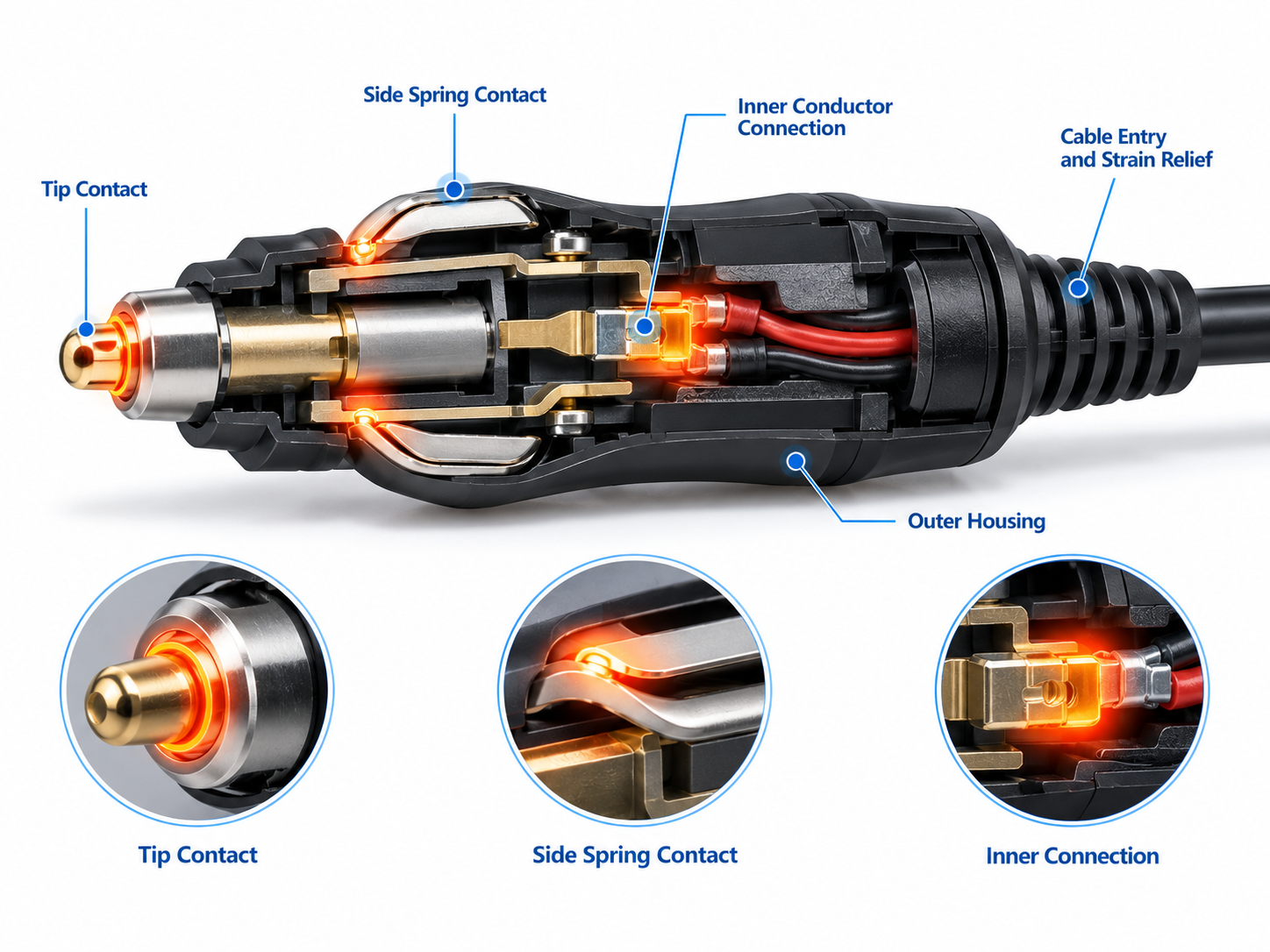
| Cable entry | Cable-to-plug joint and internal connection |
| Cable section | Conductor behavior under load |
| Inflator input side | Downstream electrical behavior |
The exact measurement positions should remain consistent when different samples are compared.
A localized temperature rise and a gradual temperature rise across the whole cable do not necessarily indicate the same issue.
Location therefore provides context that a single maximum-temperature reading cannot.
Contact Quality Can Matter as Much as Cable Size
The electrical connection between the accessory socket and plug is mechanical as well as electrical.
The plug needs to remain in contact with the conductive surfaces inside the socket while the inflator is operating.
Factors that can influence this interface include:
- plug geometry
- spring pressure
- contact material
- surface condition
- socket fit
- manufacturing tolerance
- repeated insertion
- vibration or movement during use
If contact is poor, resistance can increase at the interface.
That can create a temperature rise even when the cable conductor itself is appropriate for the application.
This is why a buyer should not judge the entire power system only by cable thickness.
The plug and socket interface is part of the product performance.
The Vehicle Socket Can Change the Test Result
One complication in plug-temperature testing is that the socket itself can influence the result.
Different vehicles may use different accessory-socket designs, contact conditions, circuit configurations, and component ages.
A worn vehicle socket can create behavior that does not appear in a controlled test fixture.
At the same time, a laboratory connection that bypasses the actual plug may hide a problem that users will experience in the vehicle.
For B2B evaluation, these two test environments serve different purposes.
A controlled socket or electrical fixture helps compare product samples under repeatable conditions.
A representative vehicle-socket test helps confirm how the finished product behaves in the intended connection method.
Using both approaches can provide more useful information than relying on either one alone.
Measure Temperature Against Time, Not Only at the End
A final temperature reading does not show how the product reached that condition.
Recording temperature during operation creates a much clearer picture.
A test can track the plug and cable at several points during one defined inflation cycle.
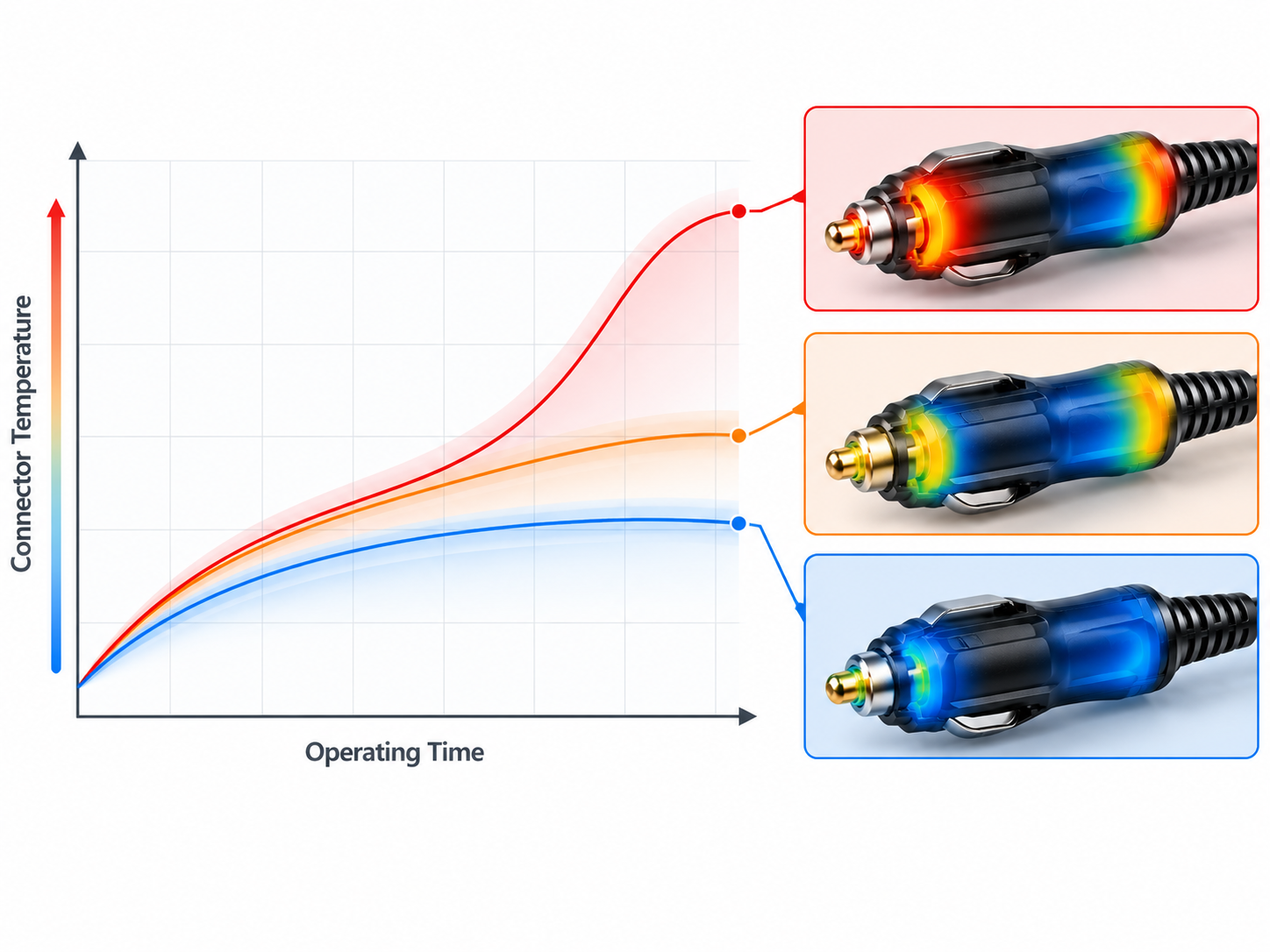
The important information is the temperature trend.
For example, buyers can observe whether:
- temperature rises gradually and stabilizes
- one area heats much faster than the rest
- temperature continues increasing throughout the test
- the connector behaves differently after repeated cycles
- different samples show noticeably different profiles
This time-based view makes supplier comparison more meaningful.
Two plugs may reach a similar final temperature but behave differently during the first part of the test.
One may warm evenly, while another develops a rapid local rise at the contact point.
Use the Same Electrical and Tire Load When Comparing Samples
Temperature comparison becomes unreliable when the inflators are not working under the same conditions.
The test should control the factors that affect electrical demand.
Useful controls include:
- same power source
- same socket or test fixture
- same tire
- same starting pressure
- same target pressure
- same cable configuration
- same operating duration
- same ambient environment
- same temperature measurement position
If one inflator runs for longer or works against a different tire pressure, its connector may naturally experience a different thermal load.
The purpose of a comparison test is to isolate product differences rather than create different workloads.
A Warm Plug and a Problem Plug Are Not the Same Thing
Electrical components can become warm when carrying current.
The objective of testing is not to demand zero temperature rise.
Instead, procurement teams should look for behavior that is inconsistent with the approved design or with comparable samples.
Examples that deserve further investigation may include:
- a sharp temperature rise at one contact point
- visible discoloration
- softened plastic
- unusual odor
- intermittent power
- repeated plug movement causing shutdown
- one sample running much hotter than the rest
- temperature increasing significantly through repeated normal-use cycles
These observations help determine whether additional electrical or assembly analysis is needed.
Temperature alone identifies the symptom.
It does not automatically identify the root cause.
Inspect the Cable-to-Plug Joint
The transition between the power cable and the plug is easy to overlook.
Inside this area, the conductor must be joined securely to the connector components.
The quality of this connection can influence electrical resistance and mechanical durability.
During sample evaluation, buyers can combine the temperature test with visual and mechanical inspection.
Areas to consider include:
- joint consistency
- strain relief
- cable movement
- connection stability
- repeated bending near the plug
- assembly differences between samples
If one sample develops localized heat near this joint while others remain stable, the finding can guide a more focused quality investigation.
Repeated Use Can Reveal a Different Pattern
A connector that behaves normally on the first inflation cycle may not behave identically after repeated use.
The plug, cable, socket, motor, and surrounding components can all become warmer as the test continues.
This is particularly relevant for inflators intended for larger tires or more demanding automotive applications.
A repeated-use test can record the same measurement locations over several defined operating cycles, following the product’s specified rest or cooling conditions.
The goal is not to deliberately overload the inflator.
It is to determine whether normal repeated operation produces a stable thermal pattern.
This is more useful for procurement than a one-time demonstration performed on a completely cold sample.
Compare Samples as a Group
Temperature testing becomes particularly valuable when several units are available.
Instead of asking whether one sample appears acceptable, quality teams can look at the distribution of results.
If five samples follow a similar temperature pattern and one behaves very differently, that outlier deserves attention.
The difference may be related to:
- connector assembly
- contact fit
- internal joint quality
- cable variation
- another electrical component
This approach helps separate normal product behavior from sample-specific inconsistency.
For OEM projects, the approved golden sample can also provide a reference profile for later production checks.
Build a Simple Connector-Temperature Record
The test record does not need to be complicated.
A practical format might include:
| Record Item | Purpose |
|---|---|
| Sample ID | Identifies the tested unit |
| Power Source | Defines the electrical input condition |
| Socket / Fixture | Identifies the connection method |
| Tire Setup | Defines the operating load |
| Starting Condition | Keeps comparisons consistent |
| Measurement Points | Keeps temperature locations repeatable |
| Temperature Trend | Records change during operation |
| Plug Stability | Records movement or intermittent contact |
| Cable Condition | Notes abnormal heating or damage |
| Repeat Cycle | Shows whether behavior changes with use |
| Visual Inspection | Records discoloration, deformation, or other observations |
| Final Status | Normal, review, or further investigation |
This record can be connected to the product’s electrical validation file rather than treated as an isolated thermal test.
Plug Heating Belongs With Other Electrical Tests
Connector temperature is only one part of the 12V power-input picture.
It becomes more useful when interpreted alongside:
- start-up current
- running current
- voltage drop
- cable behavior
- power-source stability
- protection response
- inflation performance
For example, an unusual plug temperature combined with a larger voltage drop may point the investigation toward the input connection.
A temperature difference without any corresponding performance problem may require a different interpretation.
Looking at several electrical indicators together gives buyers a more complete view of the finished product.
 12V tire inflator start-up current
Conclusion
A 12V tire inflator plug should not be evaluated only by whether it feels warm after use.
For B2B validation, the more useful approach is to understand where the temperature develops, how it changes during operation, whether the contact remains stable, and whether multiple samples behave consistently.
The test should control the power source, connection method, tire load, operating time, and measurement positions.
Buyers should also inspect the socket interface and cable-to-plug joint rather than treating the external plug housing as the entire electrical system.
Temperature is valuable because it can reveal where additional investigation is needed.
It is most useful when combined with start-up current, voltage-drop, cable, and finished-product performance data.
YANTU supports 12V tire inflator projects for automotive brands, distributors, and private-label customers. We can work with buyers on plug and cable configuration, electrical validation, sample comparison, product testing, acceptance criteria, packaging, and production requirements.