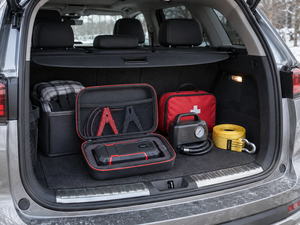
Airflow is one of the most common numbers used to compare portable tire inflators.
A higher LPM or CFM figure can make one compressor appear immediately stronger than another.
The problem is that the airflow number on a specification sheet does not always describe the condition the compressor will face when it is actually inflating a tire.
A compressor moving air with very little pressure resistance is working under a different condition from a compressor pushing air into a tire that is already pressurized.
For B2B buyers, this creates an important distinction between free-air flow and airflow under pressure.
Both can be useful.
But they answer different questions.
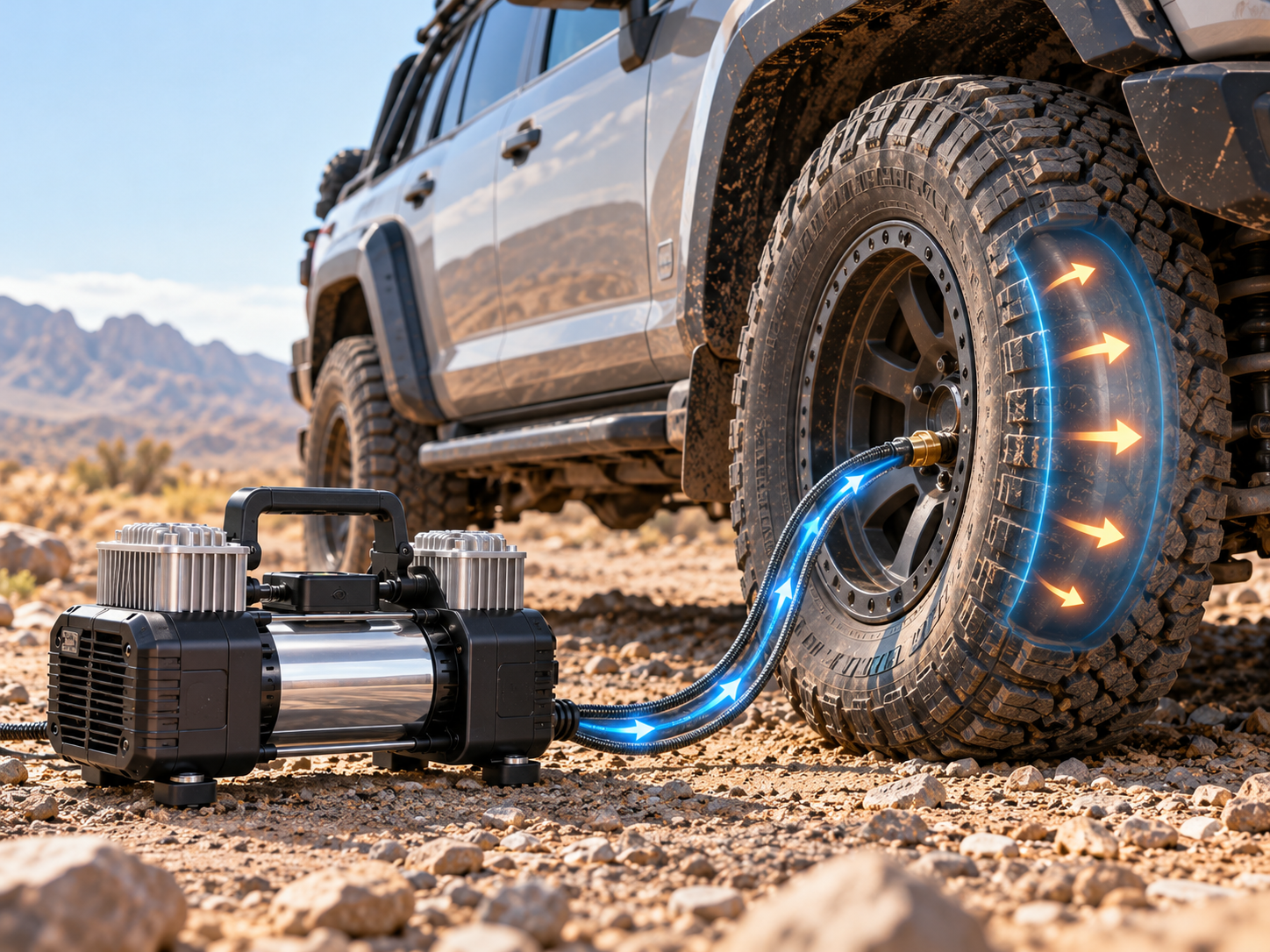
The Number on the Specification Sheet Needs Context
A supplier may provide an airflow figure without clearly stating the test condition.
That makes comparison difficult.
Before comparing two portable compressors, buyers should first understand what the stated figure represents.
Useful questions include:
- Was airflow measured with minimal outlet resistance?
- Was it measured against a defined pressure?
- Was it calculated from compressor geometry or directly measured?
- What voltage was supplied during the test?
- Was the product cold or already warm?
- Was the complete retail product tested, including its actual hose and fittings?
Without these details, two identical-looking airflow figures may not represent equivalent performance.
The number itself is only part of the specification.
The test condition gives it meaning.
What Free-Air Flow Actually Tells You
Free-air flow is useful for understanding how much air a compressor can move when it is operating with little backpressure.
It gives buyers a baseline view of the pump’s air-moving capability.
For product comparison, this can be useful when:
- evaluating compressor platforms
- comparing cylinder and motor combinations
- screening products at an early sourcing stage
- understanding general airflow positioning
But a tire does not remain at near-zero pressure during inflation.
As tire pressure builds, the compressor has to work against increasing resistance.
That is where free-air flow stops telling the whole story.
A Tire Changes the Compressor’s Working Condition
Imagine an off-road vehicle after driving on sand.
Its tires have been intentionally aired down and now need to return to road pressure.
At the beginning of inflation, the compressor is filling a relatively low-pressure tire.
Later in the cycle, it has to continue delivering air while pressure inside the tire is much higher.
The operating condition changes continuously.
This means the airflow available during the first part of inflation may not be the same as the airflow available near the final target.
The important purchasing question becomes:
How well does the compressor maintain useful airflow as pressure increases?
For off-road products, this can matter more than an impressive free-air number measured under an easy condition.
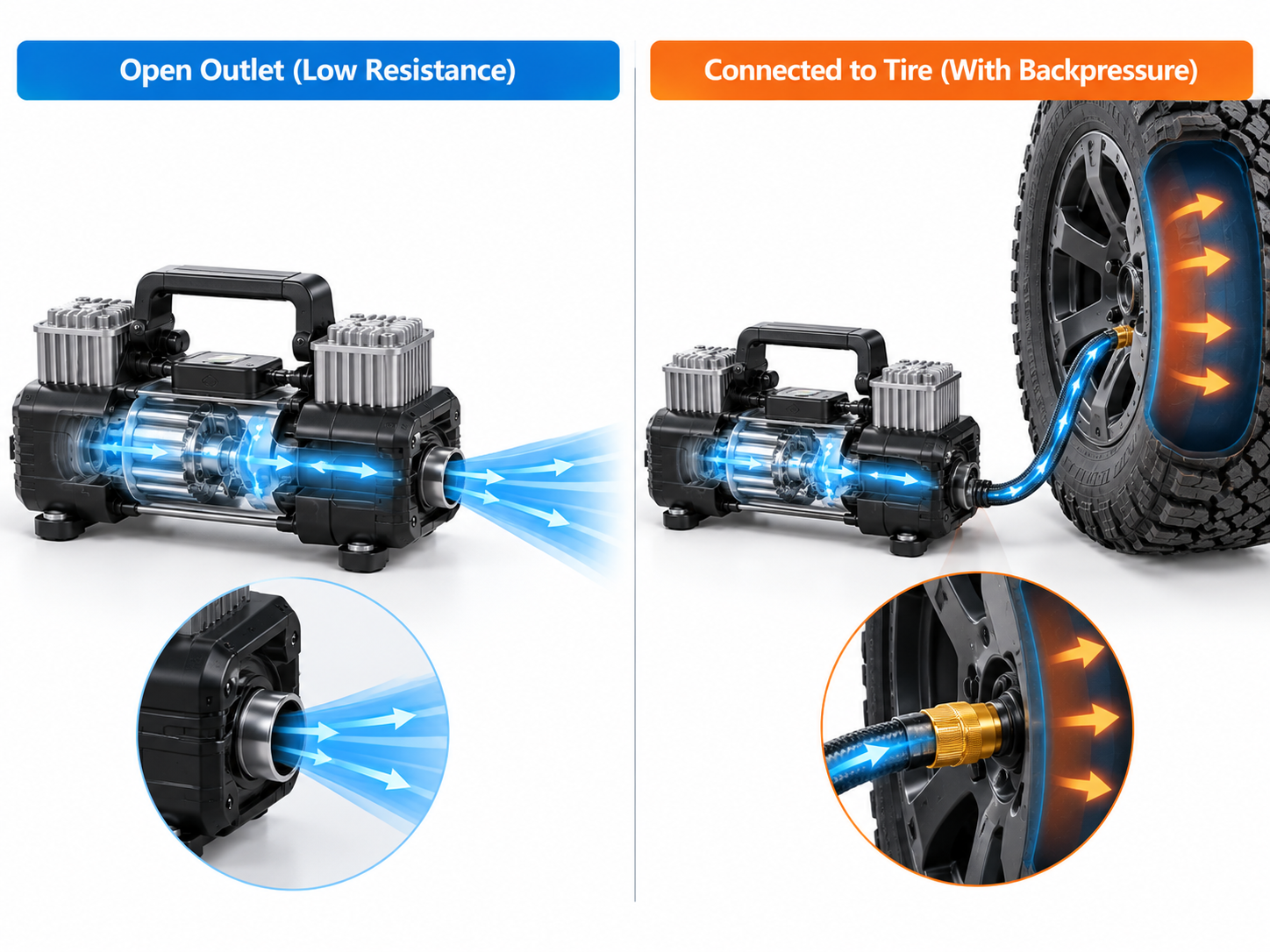
Think of Airflow as a Curve, Not a Single Number
One useful way to evaluate a compressor is to think of airflow as a relationship between flow and pressure.
A simplified performance curve may show higher airflow at lower resistance and progressively different airflow as outlet pressure rises.
The shape of this curve tells buyers more than one isolated value.
Two compressors might have similar free-air flow but behave differently once pressure builds.
Another pair might have different free-air figures but produce much closer real-tire inflation results than their headline specifications suggest.
For procurement, a flow-versus-pressure profile can therefore provide a better technical comparison than one maximum LPM or CFM claim.
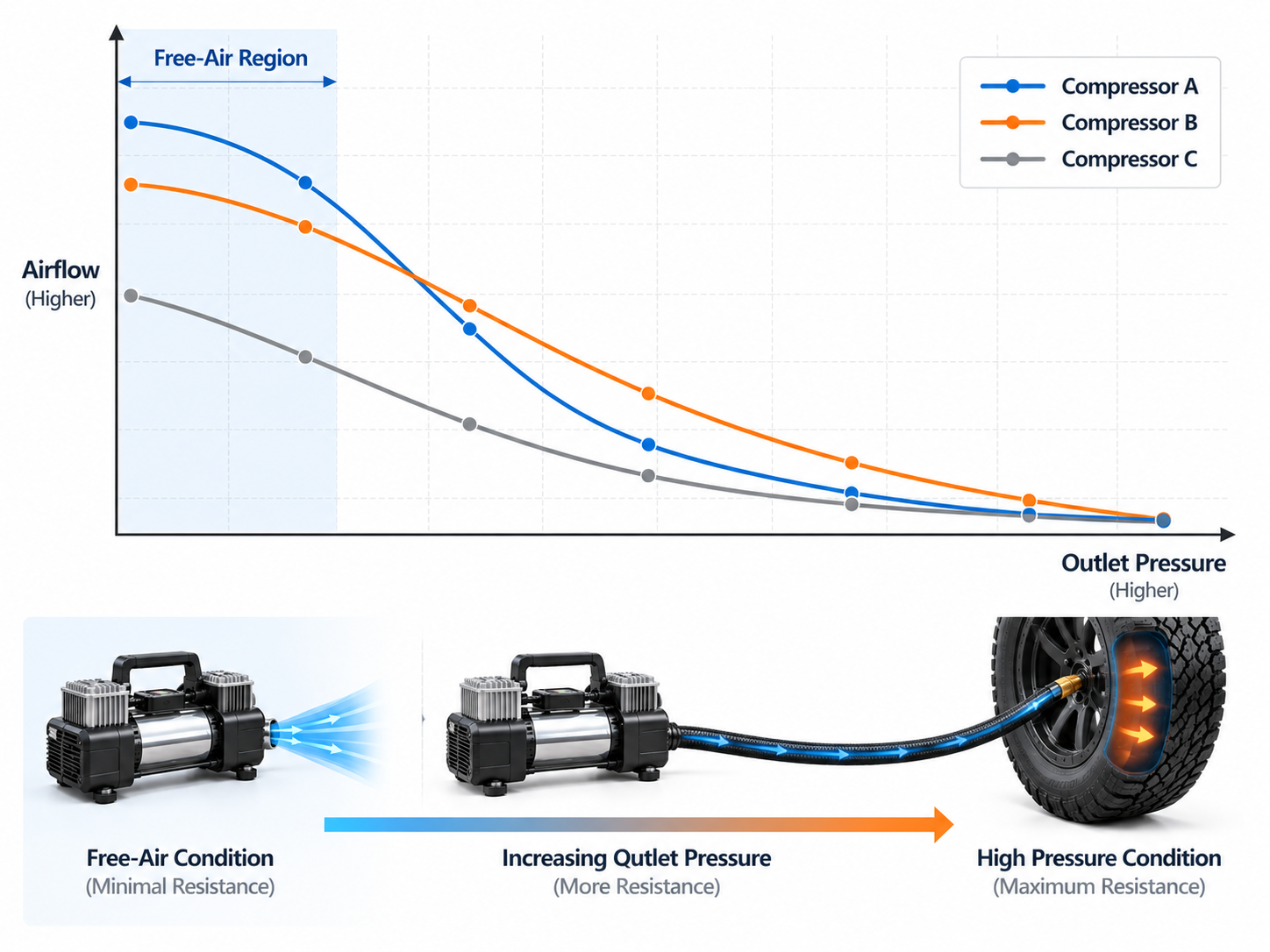
Large Tires Make the Difference Easier to See
The difference between headline airflow and real application performance becomes more noticeable when the tire contains a large volume of air.
This is one reason off-road and 4×4 applications deserve separate consideration from small emergency top-up inflators.
A larger tire can expose several product characteristics:
- airflow under sustained load
- thermal management
- motor behavior
- voltage stability
- cable and connector performance
- duty cycle
- repeated-tire capability
An inflator that feels fast during a short passenger-car top-up may behave very differently when asked to reinflate several larger all-terrain tires.
Product selection should therefore follow the real task.
Inflation Time Connects the Technical Data to the User Experience
Airflow data describes part of compressor performance.
Inflation time shows the combined result of the whole product system.
A real-tire inflation test includes the effects of:
- compressor airflow
- tire volume
- starting pressure
- target pressure
- hose restriction
- connector design
- voltage delivered to the motor
- temperature buildup
- control logic
This is why inflation time can be extremely useful for B2B comparisons.
However, it also needs clearly defined conditions.
A statement such as “inflates a tire in X minutes” is not useful unless the buyer also knows which tire, starting pressure, target pressure, and power source were used.
The most informative product evaluation combines airflow data with a defined tire inflation test.
Compare Like With Like
If buyers want to compare two portable compressors, the application should remain consistent.
A useful comparison may include:
| Comparison Item | What Should Be Controlled |
|---|---|
| Tire | Same tire size and type |
| Starting Pressure | Same initial condition |
| Target Pressure | Same final condition |
| Power Supply | Same voltage condition |
| Cable Setup | Actual approved product configuration |
| Hose and Fittings | Standard production components |
| Operating Condition | Similar starting temperature |
| Result | Inflation time and product behavior |
This creates a result that has practical meaning.
Changing tire size or starting pressure between products can make the comparison misleading.
Hose and Fittings Can Affect the Finished Product
Compressor airflow is not only about the cylinder and motor.
Air still has to travel through the product.
The flow path may include:
- internal outlet passages
- hose
- couplings
- valve connector
- optional adapters
Restrictions in this path can influence how effectively air reaches the tire.
This is another reason the finished retail configuration should be tested.
A compressor module tested without its normal hose may not produce exactly the same practical performance as the complete product.
For OEM buyers, hose length and connector configuration are therefore part of performance design, not only accessory selection.
Electrical Supply and Airflow Are Connected
Portable 12V compressors convert electrical power into mechanical compressor work.
If the product does not receive stable electrical input, its real performance can change.
The power system may influence:
- motor speed
- startup behavior
- sustained operation
- heat
- airflow under load
This connects airflow testing with other procurement topics such as cable voltage drop, connector heating, and battery-clamp versus vehicle-socket power.
A high airflow claim should therefore be evaluated using the actual production electrical configuration.
Testing the compressor on an ideal power supply and then selling it with a different cable or connector can create a gap between engineering data and user experience.
Do Not Use Free-Air Flow to Predict Every Tire Result
Free-air flow can help rank compressor platforms, but it should not be used as a direct mathematical shortcut for every real tire inflation time.
Tires have different volumes.
Starting pressures differ.
Target pressures differ.
Air temperature changes.
Compressors behave differently as load and temperature change.
For this reason, buyers should avoid assuming that one compressor with a higher headline airflow number will always inflate every tire proportionally faster.
Actual tire testing remains important.
What a Strong Supplier Comparison Should Show
For a more useful procurement comparison, a supplier can provide several layers of information.
These may include:
- free-air flow condition
- airflow at one or more defined pressure conditions
- actual tire inflation test
- power supply used
- hose and connector configuration
- continuous or repeated-use behavior
- temperature or duty-cycle notes
Not every sourcing project needs a detailed engineering test report.
But the evidence should be appropriate to the product positioning.
A compact emergency inflator and a heavy-duty off-road compressor should not necessarily be evaluated with the same purchasing priorities.
Choose the Number That Matches the Buying Decision
Different metrics answer different questions.
Free-air flow helps describe basic air-moving capacity.
Flow under pressure helps show how the compressor behaves as resistance increases.
Actual tire inflation time shows how the complete product performs in a defined application.
For early product screening, the first number may be enough to remove obviously unsuitable models.
For final supplier selection, application-based performance usually becomes more important.
The closer the buyer gets to approving an OEM product, the more the test should resemble the customer’s real use.
 12V tire inflator plug heating
Conclusion
There is no single airflow number that tells buyers everything about a portable tire inflator.
Free-air flow is useful, but it describes only one operating condition.
As tire pressure rises, the compressor works under a different load, and actual airflow behavior can change.
For off-road and higher-demand applications, buyers should look beyond one headline LPM or CFM figure and consider flow under pressure, actual tire inflation time, power input, hose configuration, and sustained performance together.
The best specification is not necessarily the largest number.
It is the performance data that most accurately represents the job the product is expected to perform.
YANTU supports portable tire inflator projects for automotive brands, off-road distributors, retailers, and private-label customers. We can work with buyers on airflow requirements, power-input configuration, tire application testing, hose and accessory selection, sample validation, packaging, and production requirements.