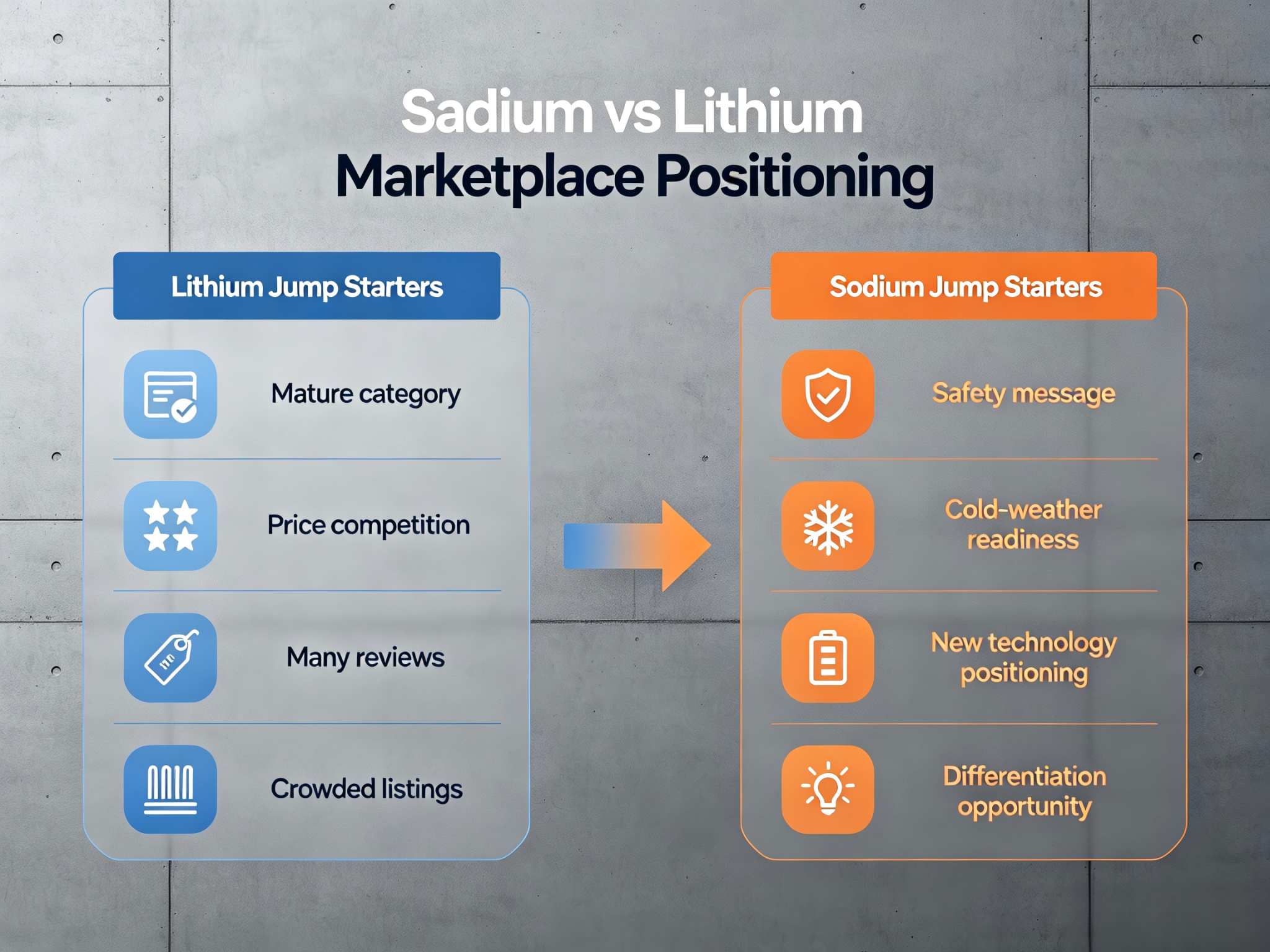
Lithium jump starters are already a mature category on major marketplaces. For many sellers, this means the product is easy to understand, but also difficult to differentiate.
Sodium jump starters are attracting attention because they offer a new battery story around safety, low-temperature performance, and product differentiation. For marketplace sellers, the question is not only whether sodium technology is new. The real question is whether it can support a stronger product position.
This article explains how B2B buyers can think about sodium versus lithium jump starter adoption from a marketplace perspective.
Why Marketplace Sellers Are Watching Sodium Jump Starters
Marketplace sellers are always looking for products that can stand out without creating too much customer education burden.
Jump starters are practical automotive emergency products. Customers understand the basic use case: starting a vehicle when the battery is weak or dead. However, when many listings offer similar lithium battery jump starters, sellers need new ways to compete.
Sodium jump starters can create a different angle. Instead of only competing on peak current, case design, cable accessories, or price, sellers may introduce sodium battery technology as part of the product value.
For B2B buyers, this does not mean sodium products will replace lithium products immediately. It means sodium technology gives sellers another positioning option. In a crowded category, even a clearer differentiation story can be valuable.
The purchasing meaning is simple: sellers should evaluate sodium jump starters as a potential product-line upgrade, not only as a replacement for existing lithium models.
Lithium Jump Starters Are Mature but Highly Competitive
Lithium jump starters have several advantages for marketplace sellers. The category is familiar, supply chains are developed, and customers already know what the product is used for.
However, maturity also creates competition.
Many lithium jump starter listings may look similar. They may use similar product shapes, similar accessory sets, similar descriptions, and similar performance claims. In this environment, sellers often compete through pricing, reviews, coupons, packaging, or small feature differences.
For new sellers, entering a mature lithium category can be difficult. For existing sellers, maintaining margin may also become harder if the product line lacks differentiation.
This does not mean lithium jump starters are no longer valuable. They remain important products in the automotive emergency market. But B2B buyers should understand that a mature category requires stronger positioning, clearer quality control, and better listing communication.
Sodium jump starters may help sellers create a new discussion point, especially in safety-focused, winter-focused, or innovation-focused product lines.
Sodium Technology Creates a New Differentiation Angle
Sodium battery technology gives sellers a different way to explain product value.
For sodium jump starters, the most common positioning angles may include safety, low-temperature readiness, storage stability, and new battery chemistry. These points can help separate the product from common lithium jump starters.
For marketplace sellers, differentiation needs to be easy to explain. A customer may not want to read a long technical article before buying a jump starter. The product page, images, packaging, and short bullet points should explain the value clearly.
Possible sodium positioning messages include:
- alternative battery technology
- safety-focused jump starter design
- suitable for cold-weather emergency kits
- stable storage for vehicle backup use
- next-generation automotive emergency tool
For B2B buyers, sodium technology should not be used as an empty marketing term. The supplier should be able to explain battery chemistry, protection design, test information, and suitable use scenarios.
A strong sodium product line needs both a market story and technical support.
 sodium vs lithium jump starter technical differences
Safety and Cold-Weather Messaging in Marketplace Listings
Safety and cold-weather performance are two important themes for sodium jump starter marketplace positioning.
Customers often store jump starters in vehicles, garages, toolboxes, or emergency kits. In some regions, storage temperature and winter readiness can become part of the buying decision. A product that communicates safety and cold-weather readiness clearly may be more attractive to customers in northern or seasonal markets.
However, marketplace sellers should avoid exaggerated claims. Safety claims should be connected to product design, protection features, and test documentation. Cold-weather claims should be supported by realistic operating or storage information.
For B2B buyers, this means product listings should be built carefully.
Useful listing content may include:
- battery technology explanation
- safe storage guidance
- temperature-related use information
- protection function icons
- emergency starting scenarios
- comparison with traditional battery types
- clear instruction manual support
The goal is not to make customers afraid of lithium products. The goal is to explain why sodium technology may be a suitable choice for certain customers and use scenarios.
Adoption Barriers: Cost, Education, and Supplier Readiness
Sodium jump starters may offer differentiation, but adoption is not automatic.
Marketplace sellers should consider three common barriers: cost, education, and supplier readiness.
First, sodium products may require different cost planning. If the unit price is higher than standard lithium models, sellers need a stronger value explanation.
Second, customers may not fully understand sodium battery technology. Sellers need clear product images, short explanations, and simple comparison points. If the listing is too technical, customers may feel confused.
Third, supplier readiness matters. A supplier should support product specifications, packaging, manuals, test information, sample validation, and stable delivery. If the supplier cannot explain the product clearly, the seller will also struggle to explain it to customers.
For B2B buyers, this means sodium adoption should be planned carefully. It is not enough to change the battery type. The full product strategy should include positioning, testing, documentation, packaging, and after-sales preparation.
What Sellers Should Check Before Switching Product Lines
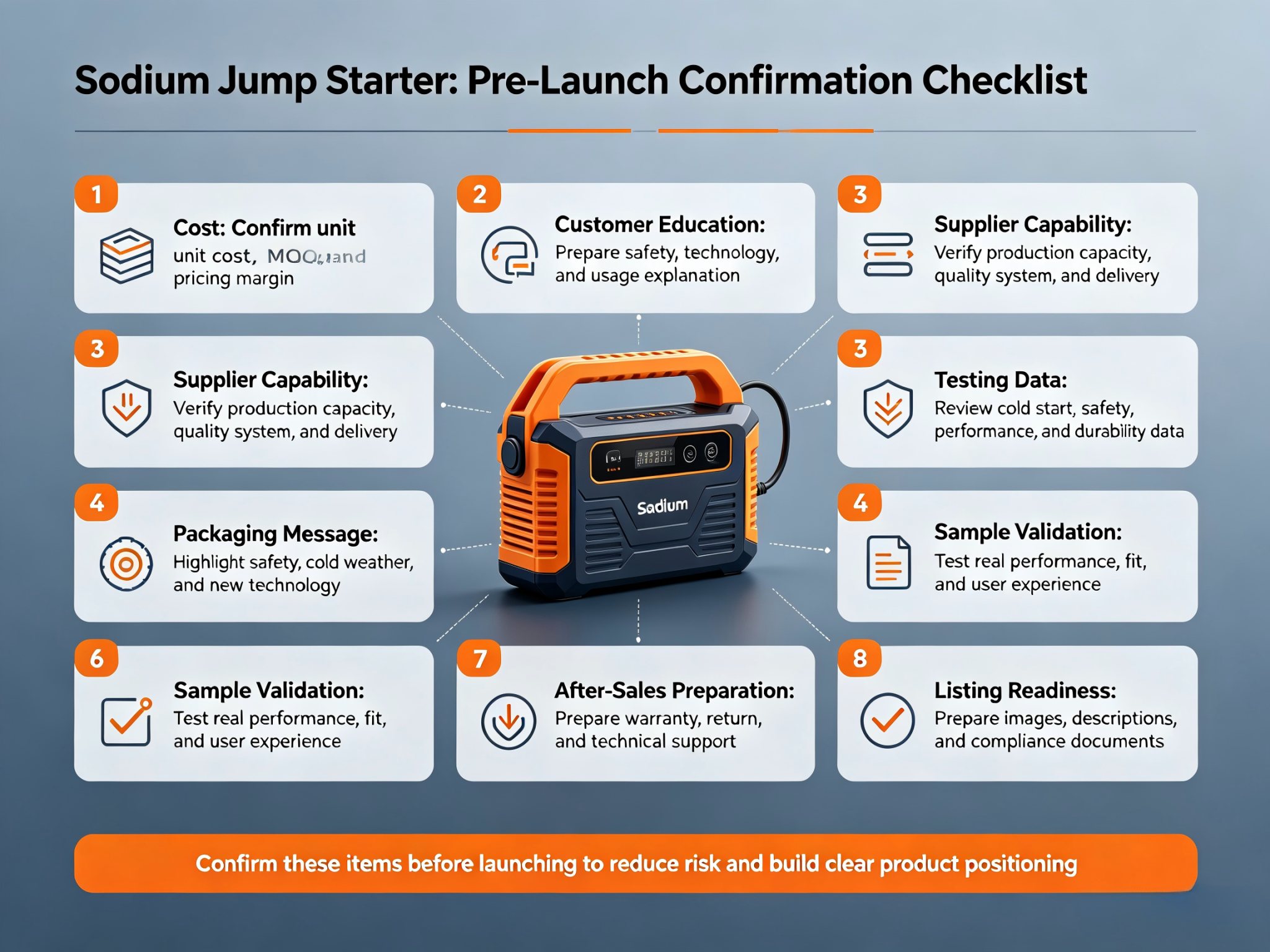
Before switching from lithium to sodium jump starters, sellers should review their current product position and customer expectations.
Important questions include:
- Is the current lithium jump starter line too similar to competitors?
- Does the target market value safety or cold-weather readiness?
- Can sodium technology support a higher price segment?
- Can the supplier provide clear test information?
- Are product images and packaging ready to explain sodium technology?
- Does the product meet the required starting performance?
- Are accessories, clamps, cables, and case design suitable for the channel?
- Can samples be tested before bulk orders?
- Is after-sales support prepared?
- Should sodium products be launched as a new line or added beside lithium models?
For many sellers, the best strategy may not be a full replacement. A mixed product line may work better: lithium models for mainstream price competition and sodium models for differentiated or premium positioning.
Quick Marketplace Evaluation Table
| Factor | Lithium Jump Starter | Sodium Jump Starter | Buyer Meaning |
|---|---|---|---|
| Category Maturity | High | Emerging | Lithium is easier to sell, sodium needs education |
| Competition Level | High | Lower but developing | Sodium may offer differentiation |
| Customer Awareness | Strong | Growing | Listings must explain sodium clearly |
| Safety Messaging | Common but crowded | Stronger differentiation angle | Claims need support |
| Cold-Weather Positioning | Depends on model | Useful positioning opportunity | Good for northern markets |
| Supplier Requirement | Standard supply chain | Stronger technical explanation needed | Supplier capability matters |
Conclusion
Lithium jump starters remain a mature and important marketplace category. They are familiar to customers and supported by established supply chains. However, strong competition can make differentiation difficult.
Sodium jump starters give marketplace sellers a new positioning angle around battery technology, safety communication, cold-weather readiness, and product-line innovation. For B2B buyers, this makes sodium technology worth evaluating, especially when existing lithium products face price competition.
The key is not to switch blindly. Sellers should compare cost, customer education needs, supplier readiness, test information, packaging, and channel fit before adopting sodium jump starters.
YANTU supports sodium jump starter projects for marketplace sellers, automotive retailers, distributors, and OEM customers. If you are evaluating sodium jump starters for your product line, our team can help discuss specifications, packaging, sample testing, and bulk order requirements.